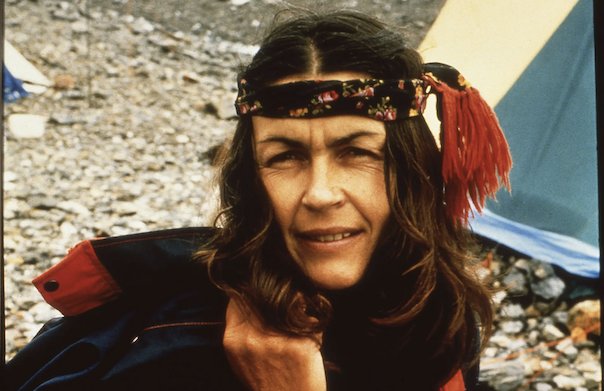
This enticing and intriguing documentary about Polish climber Wanda Rutkiewicz, the first woman in the world – and the first person from Poland – to climb the two highest peaks on Earth, offers tantalising hints of possible intrigue and mystery as it tells the story of a remarkable woman who entered the very masculine world of mountaineering uninvited – and seemingly paid the highest price.
Director Eliza Kubarska introduces herself right at the start of the film when allowed access to a room full of documents from 1992, and finds a battered sheet with information about Wanda, who was born into a Polish family living in Lithuania in 1953. The man who gave Kubarska access to the documents asks about her interest in Wanda, who had gone missing more than 30 years previously, in 1992. Kubarska, a climber herself, replies: “When I heard about her I was interested in her story more and more. Then I realised there are people who believe that she’s still alive.”
The film cuts quickly to archival video footage of Wanda. Her first major expedition was to the Pamir Mountains, which she found unpleasant due to her difficult relationships with the male climbers, and on returning she started to lead her own expeditions, including a number of all-female ones. On October 16, 1978, she became the first Pole, the third woman (after Junko Tabei and Phantog in 1975), and the first European woman to reach the summit of Mount Everest. Married and divorced twice, her husbands couldn’t accept that she wanted to climb mountains, and her desire to be independent.
Intercutting archival footage with new interviews, Kubarska tells the story of Wanda’s climbing life and ambitions. There are loosely drawn theories that she could still be alive, but given that her body has never been found, there is no proof. While climbing Kangchenjunga in 1992, the then 49-year-old Wanda was last seen alive by Mexican climber Carlos Carsolio, whose interview recounts how he found her sheltering at high altitude, but could not convince her to descend.
Dr Tara Nath Adhikari says: “We don’t know is she is alive or she’s dead…according to her expedition record it looks like she loved the mountain very much. She wanted to be part of mountain life.”
Nepal nun Jetsunma Tenzin Palmo adds that “if you were determined to disappear you could, because there are nunneries and monasteries in remote areas of Nepal…authorities might not know you are there,” adding Wanda might have been looking for “inner joy” and wanted a spiritual journey.
Wanda’s manager Marion Feik, talks about the climber’s relationship with German doctor Kurt Lyncekrüger who she had met in Berlin and was keen on marrying. “She was in love with love,” says Feik. But during a climb with Wanda and others, Lyncekrüger slipped and fell to his death. Feik stresses how Wanda’s was deeply disoriented by the tragedy, and the she vowed to do something with her life.
So she started to work on the ‘Caravan to Dreams’ plan to conquer all 14 of the world’s 8,000+ metre peaks. In the end, she climbed eight of them – including Mount Everest and K2, often climbing alone, eschewing oxygen and taking difficult routes.
In the film, Eliza Kubarska sets off to the Himalayas in Wanda’s footsteps. The clue to the search is the subject’s audio-diary found among that pile of archival materials. Wanda disappeared 30 years ago and her body was never found, but reportedly she stayed in a Buddhist monastery.
The film proceeds to explore her life with the help of famous climbers such as Reinhold Messner, Krzysztof Wielicki and Carlos Carsolio, as well as the women closest to her, sister Janina Fies and manager Marion Feik.
It is not known if Rutkiewicz reached the summit of Kangchenjunga on the final fateful climb, but if she did so, she would have been the first woman to reach the top of the world’s three highest mountains. While what happened remains uncertain, what is clear is the importance of her skill and determination in forging her way into the traditionally male world of high-altitude expeditions. The Last Expedition impressively gives her a voice and reinforces her reputation.
Poland-Switzerland-Nepal-India-Italy-Austria, 2024, 80mins
Dir: Eliza Kubarska
Production: Braidmade Films, Tilt Production, TVP, SRF, 3Sat, MX35
Producer: Monika Braid
Cinematography: Piotr Rosołowski, Marcin Sauter, Małgorzata Szyłak
Editor: Bartosz Pietras
Sales: Rise and Shine