“I don’t try to predict where my documentaries will go. Life always teaches me that I don’t know enough. Why don’t we embrace possibilities and surprises?” reflects Netherlands-based Chinese filmmaker Louis HotHotHot whose The Year of the Ghost world-premieres in IDFA Competition.
Produced by prolific Dutch producer Pieter van Huystee, the feature doc comprises an intensely personal exploration of family, grief and filial responsibility in the wake of the passing, in 2022, of the director’s father.
HotHotHot’s debut feature, Four Journeys, opened IDFA in 2021, at a time when the pandemic was still raging. On returning to China, he was forced to undergo 28 days of quarantine. During this period, his father, the family’s “shepherd,” died. Unable to be by his side in his final moments, HotHotHot was also prevented from attending the funeral.
His mother subsequently left Beijing to settle in the village where her husband was buried, devoting herself to caring for his “gentle ghost.” The village is home to widows and children whose loved ones have left for the big cities in search of work, leaving their families behind.
Meanwhile, Louis’s sister works from home as a matchmaker for an online dating platform, helping strangers find love while increasingly feeling abandoned within her own life. At forty, caught “between the promises of modern China and the expectations imposed on unmarried women,” she makes a sudden decision to marry a man she has met online and begin a family of her own.
Her decision leaves Louis facing a difficult dilemma: who will care for their mother? Should he give up the independent life he has built as a successful filmmaker in Europe? Or should he stay in China, embrace his familial obligations and look after his mother? Caught between these competing demands, he describes his predicament as leaving him adrift, like “a wandering sheep.”
“After my father died, I had to face the reality of caring for my mother, and this meant reconnecting with my sister,” HotHotHot tells SEE NL. “We had a complicated relationship, with many years of resentment and misunderstanding between us. At first, I found her anger difficult to understand. But by spending time with her, recording our family history, and exploring the generational trauma of women, I gradually began to see her differently. My feelings towards her slowly shifted from a mixture of love and anger towards love and compassion.”
“I think the camera helped me stay close to a reality that I might otherwise have wanted to avoid,” he adds. “Instead of simply reflecting on our relationship from a distance, I had to be present and experience it as it unfolded.”
As we see, the three main characters all undergo clear and significant personal transformations.
“My mother gradually emerged from the grief that had been eating away at her after losing her partner, and firmly chose to live independently. She began learning digital technologies, asking AI questions, and trying to solve problems on her own. Her strength exceeded my expectations, and perhaps even her own,” the director explains.
“My sister found the partner she deeply loves and gives everything for this love. Her love is so passionate that it is astonishing! She devotes herself entirely to her partner, while also providing shelter for our mother, who has complicated feelings. Although she still carries a lot of resentment towards our family of origin, she is learning to live with it. There is more tolerance in her now.” HotHotHot continues.
“As for me, my transformation has taken place more on an intellectual level. By focusing closely on a few women I know best ,and starting from their personal experiences I gradually came to discover the history and circumstances of Chinese women. I have developed a new sense of respect and tenderness towards my mother, and a greater sense of love and acceptance,” he adds.
Nevertheless, he still feels guilty about being away from home and not contributing fully to his mother’s care. “These feelings of guilt were shaped by the political and cultural environment I grew up in. The culture I grew up in not only taught us to take care of the elderly, but also to be loyal to our family, to follow those in authority, and to suppress our own freedom. These values have become part of my blood. I am afraid these feelings of guilt may never completely leave me, especially whenever I set foot on the land of my hometown.”
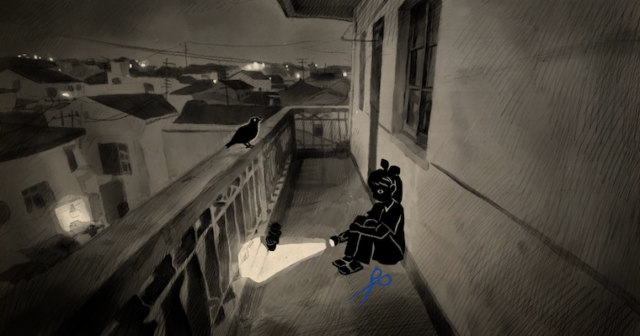
The film uses animation to help illustrate the complex family dynamics that drive the story. “Ghost stories are not just products of our imagination. They can also express a tender wish to soothe our wounds,” expresses HotHotHot. “Animation is one of the best ways to tell ghost stories, allowing me to explore my deepest fears and desires.”
“On the other hand, animation allows me to tell stories about the past that were never documented,” he adds. “Beyond these two functions, animation also enriches the film’s visual language. It creates another way of approaching reality, allowing memories, emotions, and the past to be expressed in ways that live-action footage alone cannot.”
It is obvious that HotHotHot is mining a rich and productive seam in documenting his family’s story, which is why the expansive trilogy format is so appropriate for its telling. “If Four Journeys, my first documentary, looks at the past, and The Year of the Ghost, my second, deals with the present, then the third film will turn towards the future,” the filmmaker confirms. “I want to explore whether we can create a future that does not repeat the mistakes and traumas of the past. Ultimately, it is still about the same question that runs through my work: how do we love?”
A shorter version of this article was first published in SEENL, a collaboration between EYE Filmmuseum and the Netherlands Film Fund.