The mid-term elections? Filmmaker Ava DuVernay is predictably delighted at a question about the savaging Donald Trump’s Republican Party suffered at the polls a few days ago, losing control of both the Senate and House.
“There is a euphoric feeling here in the States. Everywhere I go, people are talking about it. You feel a lightness of being around it,” DuVernay enthuses. She is speaking to Business Doc Europe from San Francisco as she prepares to head to IDFA where her new Netflix-backed documentary 14th will have its Dutch premiere in the festival’s ‘Signed” section. The film explores how the Fourteenth Amendment, which protects birthright citizenship, has been under savage attack by President Trump and his acolytes.
Trump’s electoral losses last week have renewed hope that the US Constitution can now be protected from the President’s assaults.
“But also, history warns us that these feelings of euphoria can quickly dissipate if not followed up by real organisation,” the director warns that the mid-term elections on their own won’t change anything, unless accompanied by “real strategy.”
“That is something that the right in the United States does very well. They are patient and strategic.”
Like her earlier feature 13th (2016), which showed how the amendment that abolished slavery has been compromised, 14th is a talking head film. It boasts dozens of interviews explaining often abstruse points about US history and the legal framework behind the constitution. There is a lot of information to digest but DuVernay serves it up in fiery fashion.
“Every single person is in a different background. That backdrop, and the composition of the frame, is really speaking to who this person is,” she says. The director also talks about using “very simple symbolism that allows people to really understand a very complicated amendment – the hands, the stars…the archival material sitting side by side with the contemporary footage that we pulled from [the internet]. You might be looking at a photo from 1866 and two seconds later you’ll be looking at something from YouTube.”
It helps that all the lawyers and historians are plain spoken. DuVernay asked them to talk to her “as if I know nothing.”
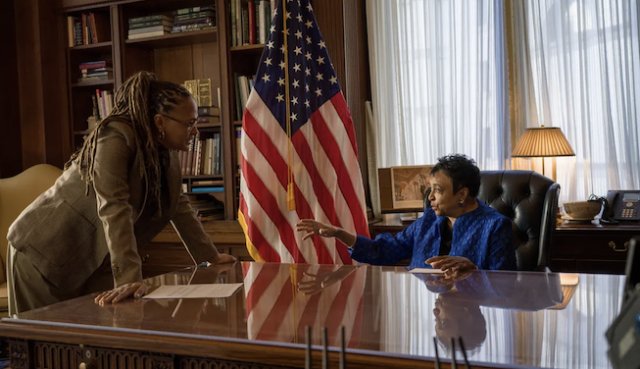
“I am not a constitutional historian. I am just a regular lady from Compton, California, so I would sit down and say ‘explain it to me,’” the director describes her technique for ensuring the experts made their points clearly. She describes her interviewees, who include such figures as Democratic Party activist Alexandria Ocasio-Cortez, and Carla Hayden, former librarian of Congress, as well as an array of historians, as the real stars of the film.
The filmmakers approached hundreds of Republicans, but only the smallest handful were willing to appear on camera to give their point of view. “I was surprised. Someone asked why I was surprised and I said we hear them talking all the time. We did 316 interview requests to every sitting Republican congress person, senator, every Republican governor, and every sitting Republican mayor in a major city…and four said yes!”
DuVernay believes that most of the Republicans only feel comfortable when “they’re preaching to the choir,” talking to those they already know share their beliefs. She emphasises she wasn’t trying to catch them out – these weren’t going to be ‘gotcha” interviews, but simply a chance to go on the record. Most sidestepped the opportunity. “That really says something about the muscularity of their ideas. If you cannot speak your piece in any room, then there is a weakness there that you are acknowledging without even saying it.”
The director gives short shrift to those who’ve criticised her for using AI to animate 19th century archive photographs whose subjects are obviously not around to give consent.
“I would argue that taking photographs of enslaved human beings who were treated as property – they didn’t have much domain over the picture being taken in the first place.”
Her intention, as “a descendant of those people,” is “to give dimension to their lives. No-one gets up and starts to dance or says something they didn’t say. These are photos that have a gentle animation that allows you to feel the dimensionality of people who have been flattened by history.”
DuVernay argues that artists should be able to use new technological tools to “express the story they want to share.” What she is doing isn’t so different from, say, Ken Burns moving the camera over a still image in one of his documentaries.
One point that the film makes is that Confederate iconography remains embedded in US popular culture, for example in TV series like The Dukes of Hazard where the flag is on a car. The US still has thousands of statues of Confederate leaders or streets and bridges bearing their names, and often the racist ideology espoused by these figures is either forgotten or overlooked.
“It’s our swastika,” DuVernay says of Confederate symbols. “In the American South, Black people really know what that means. It really is a silent warning of the hierarchy of this country.”
In the film, contractor Devon Henry is shown pulling down some of the old monuments. He’s the only one ready to take on the job. There are examples of other contractors who’ve received death threats or had their cars blown up for removing Confederate statues.
“That instils fear in everyone. Whether it was their personal beliefs or their fear of retribution, there was this whole swathe of people who did not participate.” During the reign of what she calls “the Trump crime family,” she adds, many citizens have been cowed and are too scared to confront uncomfortable reminders of the country’s disturbing past.
The film will land on Netflix in early December after its theatrical release on November 27th. The director credits the streaming giant with throwing its full weight behind the project.
“So many companies have moved away from saying anything about the current moment because of fear of blowback from the administration. [But] Netflix is really leaning in to amplify my voice as an artist. I’ve done a number of projects there. They are really giving us a push – they are doing a very robust campaign.”
The film has already closed the New York Film Festival and received a gala premiere at the BFI London Film Festival. It will receive free screenings on college campuses and at museums. Netflix is also supporting the impact campaign that is being mounted by Array, the multi-platform arts and social impact collective set up by DuVernay in 2011.
“Documentary is my favourite form because of the depth of research,” says the director (who has also made several award-winning dramas including 2014’s Selma). “And documentary also allows me to steer myself to my favourite part of the filmmaking process which is the edit. Some filmmakers love to shoot, some love to write – and I love to edit!”
14th took two and a half years to make. It was shot in multiple locations with over 50 people participating, but the “bulk” of that time was devoted to cutting the film. During the post-production, there were constant developments in the news cycle which DuVernay was keen to incorporate. “
“At some point, Netflix said lady, are you going to stop?”
The film was only finally locked a fortnight before its New York premiere. “I am proud that we were able to put the pieces together. It was more of an investigation than anything else,” she says of her painstaking efforts to describe the protections that the 14th amendment ought to offer to American democracy and the various ways in which those protections have been eroded. “Docs are thrilling in that way!”
Many of her interviewees speak to the camera from their offices or from historic settings. One, producer and political commentator Van Lathan, is shown sitting none too comfortably on a staircase. Why put him there?
“Since my very first documentary, there has always been someone I really like who sits on the stairs. Also, what Van symbolises in the film is the everyman. He’s not a professor, not a lawyer, not a constitutional lawyer. He is a Black man from the south who often on these panels says ‘I don’t even know why I am here.’ I wanted him to feel very grassroots and connected to somebody who might be watching….and I think it works!”