

Business Doc Europe caught up with Dutch interactive doyenne Corine Meijers of Studio Biarritz during the recent IDFA where she presented two major new works within the DocLab Competitions, and an XR project in IDFA Forum.
Meijers’ IDFA projects were diverse in both style and content. Iris van der Meule’s Lesbian Simulator VR, which played in IDFA DocLab and Immersive Non-Fiction Competitions, is designed, in part, for “lesbians looking for recognition,” but as much “for anyone who would like to get a sense of what their queer family, friends, colleagues and acquaintances experience, both negative and positive,” the logline reads.
“It is a very personal project,” says Meijers of director van der Meule. “It is her story and based on her own experiences.”
The animation for the VR was completed in Canada, courtesy of funding sourced from the Quebec-based government-backed agency SODEC by Canadian partner Jeanne-Marie Poulain of Art & Essai. The partnership illustrates Meijers’ reliance upon co-pro as a key finance mechanism.
“I don’t know how to do it otherwise,” she tells BDE of cross-border collaboration. “It is nice that we have basic funding in the Netherlands for immersive projects. But the kind of projects I make, with the basic funding that there is, it’s quite hard to do it at that level, so I have to reach out.”
Another co-producer on Lesbian Simulator is the Belgian outfit Cassette for timescapes who was also partner on Meijers’ The Imaginary Friend by Steye Hallema. The two companies collaborate on a “structural level,” says Meijers who was, in turn, minority co-pro partner on Cassette for timescapes’ Floating With Spirits by Juanita Onzaga. Studio Biarritz is also minority co-producer on the Belgian outfit’s 275 Million Births and Deaths by Zam Zadeh.
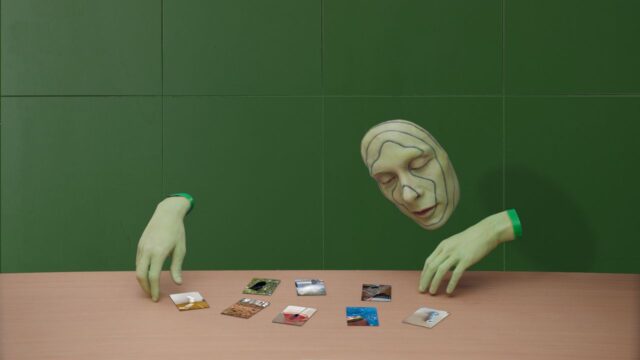
A project that Studio Biarritz made without international collaborators is the installation Deep Soup by Luna Maurer and Roel Wouters, which was selected for IDFA DocLab and Digital Storytelling Competition.
Meijers distils the essence of the installation. “Digital technology is increasingly steering us towards a world of the mind, a frictionless existence that has become detached from our physical experience. With this film, Maurer and Wouters attempt to turn the tide, seeking a way to lead people back from their screens to “a bodily and material experience.”
The directing duo invited people online to contribute their own videos on the themes of matter and movement—breaking, rolling, sinking, floating, falling. All these clips went into the soup, “a green physical intelligence that is trained on the collected images.”
“We then see this non-human intelligence in its weightless world, processing this morass of information. The result is a challenge to view physical reality with fresh eyes,” the synopsis explains. “A celebration of the forces that belong to our material world, which digital AI models and algorithms try to smooth out.”
Meijers adds to BDE: “In the story, Maurer and Wouters are two post-humanists who are developing a physical intelligence model, shaped as a liquid soup – a model that learns from matter, not from data. So the project asks questions about who we are, what is our relationship as humans with technology, with AI specifically, and what makes us humans different and unique.”
The Studio Biarritz boss also pitched the interactive project Amasonic in Amsterdam, described as an XR experience where the user can experience different (non)human perspectives on the Amazon River, gathered by local communities and scientists. The project is a collaboration with scientist Cecilia Maria Oliveira (RIFS) and Marcel van Brakel (Polymorf). While exploring the installation, users compose a sonification, translating their interaction and co-existence with the river, echoing the multitude of life connected to the Amazon River.”
“It’s an urgent project. It’s about climate change. And it’s about our relationship to nature,” underlines Meijers, who hotfooted from Brazil for a timely arrival at IDFA. She is looking for support and funding not only from regular co-pro outlets, but is also targeting scientific and environmental organisations that focus on ecological matters.
“This is about the rights of rivers. The rights of nature. And it’s about ancestral relationships. Spiritual relationships with nature. There’s a lot of research done about this already, and more research that needs to be done, and therefore potential funding,” she tells BDE.
Meijers founded Studio Biarritz in 2019 with a remit to produce dynamic audiovisual, interactive content that could cross borders, both in its production and in its reach to international audiences. Over the past six years, the company has worked with leading creatives whose projects have been selected for the likes of Cannes (Lacuna by Maartje Wegdam & Nienke Huitenga Broeren); Venice (The Imaginary Friend by Steye Hallema and Floating With Spirits by Juanita Onzaga); SXSW (Symbiosis by Marcel van Brakel and Mark Meeuwenoord, Future Botanica by Polymorf, Marcel van Brakel and Hazal Erturkan and Steye Hallema’s The Imaginary Friend), and more besides.
So, what does Meijers put her success down to? “I’m not so scared to take on projects that are a bit different than usual,” she answers, further underlining that at the heart of each successful project is a “great concept.” The ability to be flexible is a core determinant, she adds. “We keep looking at each project, all the time, while we are making it. Does it still make sense? Or do we have to adjust?” she describes her ongoing modus operandi. Each project is “custom-made” according to its specific requirements, she stresses. “But that’s also the fun. You need to be able to embrace that. If you can’t, then interactive production is not for you, I think.”
As importantly, Meijers underlines the necessity for team spirit in embarking upon such projects. “It is really a team effort. We walk together and we work together in exploring the possibilities.”





