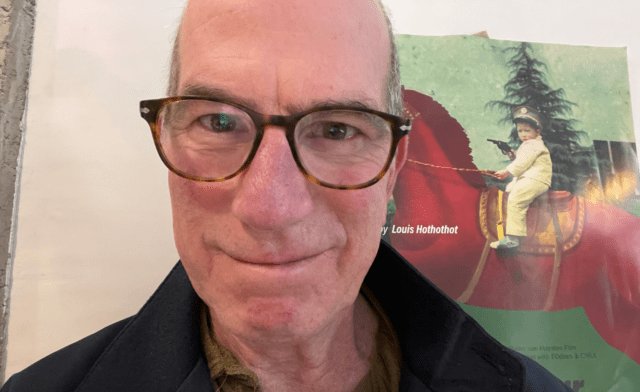
The Dutch documentary doyen is having one of those dream IDFAs. Not only did he produce the opening film Four Journeys, the festival is celebrating the 25th anniversary of one of The Netherlands’ most influential docs, Amsterdam Global Village, one of Van Huystee’s first feature doc productions.
And to cap it all he’s jetting off to NY work on Saturday to cheer on They Call Me Babu (IDFA 2019), which is competing for an Emmy.
What’s more he is 65 this year. Is he showing any sign of slowing down? Not a bit of it, he confirms.
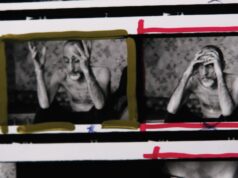
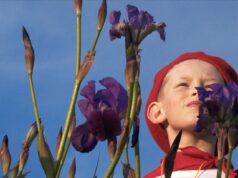
Van Huystee is naturally delighted by the selection of Four Journeys as opening film, a story that he describes as being told “in a very unconventional way.”
“The film says something important about the new [cinematic] language,” he says, citing director Louis Hothothot’s design background and his innovative use of titles, photography and graphics.
The film also chimes musically with the producer’s “credo” of reverse perspective, of not wanting to see documentaries that repeat ad infinitum stuff that he already knows. “We tell what we know. We know the story and then we tell it again,” he bemoans of many filmmakers.
“Reverse perspective is based on learning more about the stories that I know, and the way they are told,” he explains. “So if I make a film on this Chinese story, I make it with a Chinese director and a Chinese cameraman, and I choose a Chinese co-producer, not because of the money, because I hardly get money [from China], but to use their input, to tell a different kind of story than I would tell from the western perspective.”
This is what he achieved on Indo/Dutch Sandra Bereends’ beautiful and highly inventive archive doc They Call Me Babu, which constructs the life of an Indonesian nanny from early 20th Century footage, running through to the 2WW and eventual War of Independence. The film was promoted within the race for Best Doc Oscar in 2021, and now competes for an Emmy, the result of which will be announced this Saturday with a nervous Van Huystee in attendance in New York.
Van Huystee credits the legendary Johan van der Keuken with igniting his enormous fascination for documentary, and let’s face it, there are not many fledgling producers who can claim to kick off their career with such a masterpiece. Because that is what Amsterdam Global Village is, a long, beautiful, all-encompassing, uncompromising love letter/poem/novel of a film, an expression of faith and delight and devotion to a city.
“He [van der Keuken] was an example of pure and free filmmaking,” says Van Huystee of his early mentor. “And after 25 years, the film is still so strong.” The producer remembers with evident delight the funding application that he filled in for the film over a quarter century ago, proclaiming that this was a work for cinema, a work of “that is not fulfilling the small agenda of a broadcaster.”
Since then Van Huystee has, of course, worked with all the top name Dutch directors, from Heddy Honigmann to Renzo Martins to Oeke Hoogendijk to Leonard Retel Helmrich. He is unashamedly hands-on, and is never afraid to voice an opinion. He would much rather hear informal and unguarded criticism of a project (which he believes is more accurate) than receive a tame and measured formal report, and then he’ll look to fix whatever problems need fixing.
“The directors always allow me to come to their editing room. They allow me to be part of creating their scenario,” he underlines. But at the end of the day, “I always say that this is a production by Pieter van Huystee and a film by the author.”
“I feel myself sometimes like a football coach. Every day you are on the field, but the moment they play the game, then you have to leave the field,” he concludes.