Film historian Nikolai Izvolov briefs Business Doc Europe on the rescue and restoration of Russian master Dziga Vertov’s epic The History Of The Civil War which will, during IDFA, be screened for the first time in a cinema to the general public. The momentous event takes place in the Tuschinski on Saturday November 20.
Most western film enthusiasts know Dziga Vertov best for his formally brilliant The Man With The Movie Camera, released in 1929. In fact, the Soviet filmmaker had been making documentaries for many years before that. His first full-length film Anniversary Of The Revolution (1918) was screened at IDFA in 2018 to mark its centenary.
Now, his 1921 epic The History Of The Civil War will also be seen at the festival. This will be the first time it has been screened in a cinema to the general public. (Back in 1921, its audience consisted of a few hundred Bolshevik officials at a Communist congress in Moscow, but it wasn’t shown outside the city and only one print was struck).
The rescue and restoration of the film (sold internationally by the Grinberg Brothers) has been overseen by Russian film historian, Nikolai Izvolov.
When Izolov began work on the project, the footage in it had been scattered to the winds – used in other films and stored in many different archives. By the early 1930s, even Vertov himself was convinced that a complete print of the documentary no longer existed.
“The problem was to collect all these fragments of the film,” Izvolov says of the challenge he faced in piecing Vertov’s work back together again. “The problem was that we didn’t have any precise description of the film – which footage was used in which order.”
The first step, then, was to find a written description which gave a clear idea of the running order. One was eventually discovered in the Vladimir Mayakovsky Department of the Archive for Literary Arts. Using it as a “road map,” Izvolov was able to put the film together.
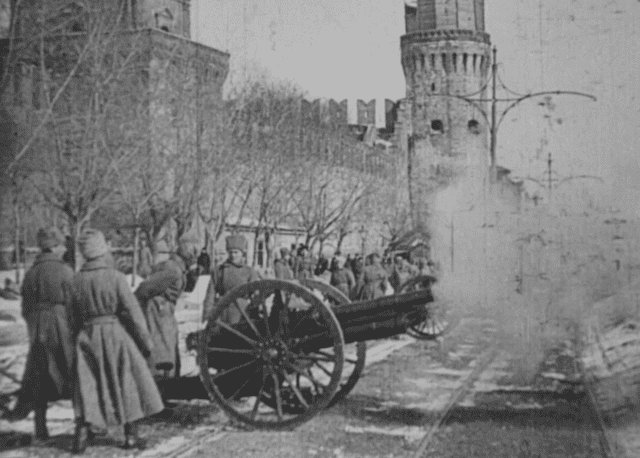
Vertov was shooting on 35mm. He was often perilously close to the action. We see explosions, trials of white Russians, Leon Trotsky rallying the troops, refugees fleeing and mutinies being crushed. On one occasion, Vertov got off a train just moments before it was hit by a furious artillery blast from the white army. (“It was very dangerous and Vertov wrote that he avoided death just narrowly.”)
The Soviet director was refining his technique. “I think the film is very important for the creative evolution of Dziga Vertov. Before the film, he was usually an editor of newsreels,” Izvolov notes of how Vertov learned to direct while also spending time on the front line. This was crucial preparation for him before he embarked on his famous newsreel series Kino-Pravda (1922-1925), his attempt to create a movie equivalent to a newspaper.
Already, in History Of The Civil War, Vertov was looking to experiment, using intertitles in new and inventive ways and even turning to animation in one sequence to show changing positions on a map.
“A lot of people who participated in the Civil War later had…not a good fortune,” Izvolov gives one dark reason why the film wasn’t preserved. This was a bloody period in Russian history. After Stalin came to power, some of the leading figures shown in Vertov’s film were sent to prison or executed. “Some committed suicide, some emigrated,” the film historian cheerfully adds. “Many characters we see in the film were later known as the so-called ‘enemy of the people.’ These people were excluded from the official history.”
Only after Perestroika in the 1990s were the reputations of the victims restored. By then, though, the public had lost interest in the innocence or guilt of alleged traitors from 70 years before.
Trotsky was among those who later came to a bad end, murdered with an axe put through his head in Mexico in 1940. Izvolov says it is no surprise that he features in the documentary. “Trotsky was a person who liked to be shot very much. If he went to the front line, he took a cameraman with him. We have a lot of footage with Trotsky on the screen.”
Trotsky created the Red Army and was commissar for war. Vertov captures him in his pomp. Lenin, by contrast, was camera-shy and isn’t seen at all.
Certain scenes are likely to surprise contemporary audiences. For example, you don’t expect to see camels pulling wagons on the steppes. Izvolov points out, though, that many Kazakhs used them in their everyday lives.
The film historian is continuing to work on further Vertov-related projects. He has rediscovered and is restoring a 1922 film about the Red Army. An added bonus is that includes intertitles designed by Alexander Rodchenko, one of the legends of Russian constructivism.
Intriguingly, the historian is also now turning his attention to the director’s best known movie, The Man With The Movie Camera. This may be Vertov’s crowning achievement, chosen by many critics and filmmakers in their top 10 lists, but the film historian believes they aren’t watching it in the right version.
“All the prints that people saw on DVDs and on television were released from one false copy which was printed in the 1950s. It was printed not from the negative but from the positive…my idea now is to restore the film in its original state: to print it and scan it from the negative, to restore all the original inter titles, to restore all the original animation, to restore it on the real speed and to support it with the original soundtrack which was written by Vertov.”
If Izolov pulls it off, the restoration of The Man With The Movie Camera will be a huge coup. He’ll be making audiences look at one of the masterworks of world cinema in a new light. In the meantime, he’ll be at IDFA to show a film which hasn’t been seen in a hundred years.
History Of The Civil War premieres on 20 November, accompanied by The Anvil Orchestra and followed by a conversation with Nikolai Izvolov.