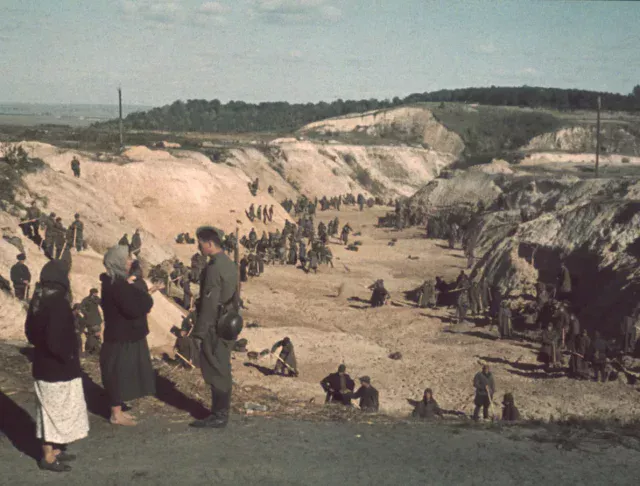
Sergei Loznitsa’s new feature documentary, Babi Yar, Context, is screening in IDFA this week. In the film, Loznitza looks behind one of the most gruesome massacres of the Second World War, when close to 34,000 Jews were shot dead in a ravine in the north-west of Kiev 80 years ago, in late September 1941.
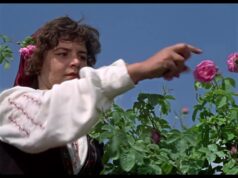
The film is part of a much bigger project, The Babyn Yar Memorial Centre, which is being overseen by the Russian director, Ilya Khrzhanovskiy, who also shot his massive and still ongoing Dau cycle of films and installations in Ukraine. This includes the feature film Dau: Natasha which was a prize winner at the Berlinale last year just before the pandemic began, and a Dau exhibition in Paris. Dau is set in Soviet Russia over many years. Originally conceived as a biopic of the brilliant physicist Lev Landau, over the many years of its gestation, it evolved into a phantasmagoric chronicle of the horrors and humiliations of life under Stalin.
The Memorial Centre is an equally ambitious endeavour, comprising the first modern Holocaust museum in Eastern Europe and a centre for the study of the tragedy in which large-scale scientific and educational activities will be carried out. The centre is due to be completed by 2026. Last month, on the 80th anniversary of the massacre, leading dignitaries and politicians, among them President Volodymyr Zelensky of Ukraine, attended commemorations at the site.
“It was in a way an accident. It was not in my plans. I could never imagine that I would be responsible for building a Holocaust memorial centre,” the director reflects on his involvement in what has turned into a huge project. “In a way, it was logical on two levels. It came from Dau because Dau was a project where I worked with different media and tried to combine film, art, science, performance, philosophy, debate, discussion.”
Board members behind the Babyn Yar centre had asked Khrzhanovskiy for advice about how to make the project “interesting and alive for a future generation.” The filmmaker had a connection with the story. His mother is Jewish and from Ukraine. “She is a Holocaust survivor. She left a couple of days before the Nazis came to Vinnytsia. That is why she survived because no Jews in Vinnytsia survived.”
A couple of months before he embarked on the Babyn Yar project, Khrzhanovskiy secured an Israeli passport. He asked his friends what he could do on behalf of Israeli culture. He had visited the site of the massacre.
“Step by step, I understood that I have to do it because I can combine things nobody else can combine. I can combine respect for the memory of the past, respect for the victims, relatives and survivors. Most important, I can build a bridge between past – where we almost don’t have any witnesses any more – and future generations who don’t have any idea about this,” Khrzhanovskiy explains why he eventually decided to take on the job at the Centre.
What were his feelings the first time he set foot on the sacred ground where the massacre took place? “My first reaction was that the Soviets and Nazis had succeeded to erase the memory. In the place where the shooting, the massacre, actually happened, you have a nice park, people walk with dogs. They recently built residential housing.”
A little further along, the ravine is still visible. Khrzhanovskiy said he could feel “an energy” there. Nearby is the site of a psychiatric hospital (752 psychiatric patients were killed during the massacre).
The director realised one of his main tasks was “de-stigmatisation” of the psychiatric patients. “What is mental health?” he asks, pointing out that the killers were the ones who were supposedly were sane and level-headed.
The international media reacted to Khrzhanovskiy’s involvement in the Babyn Yar project with predictable hysteria, just as had happened with Dau. It was written that he was trying to create some tasteless interactive museum, a “Holocaust Disneyland” as one headline put it.
“It’s because I am doing something nobody did before. There is no benchmark for what I am doing,” Khrzhanovskiy says of the absurdly overblown reaction to his involvement. “I am touching something which is painful in life. I am trying to do something about love and emotions.”
The two words “interactive” and “immersive” especially perturbed critics. Khrzhanovskiy, though, sees his approach as modern and dynamic. “Our life is immersive. And the reality of the new generation is that it’s immersive and interactive – and it doesn’t matter whether we like it or not. I think we should respect life and respect the people who died there. For me, the best monument to the people who died is to create life.”
As they seek to “create connections between past and present,” Khrzhanovskiy and his team have already found out about many of the relatives of those who perished. Among the many initiatives already hatched, they’ve made a “huge sound installation” where, over a period of 24 hours, the names of all the victims who are known are spoken out. Manuel Herz Architects has designed a synagogue to “re-establish a living Jewish presence on the site today.” Artist Marina Abramovic, also involved in Dau, has created a ‘Crystal Wall of Crying,’ a new interactive installation on the site.
Then there is Loznitsa’s documentary which premiered in Cannes, is screening in Amsterdam this week and is nominated for a European Film Award. Loznitsa is also now planning a Baba Yar dramatic film.
Whatever happens now, one prediction can safely be made. The massacre, which was largely wiped from public memory for 80 years, is back in the public consciousness as never before.
“To show light and joy in a spiritual way, you have to show darkness,” Khrzhanovskiy reflects on a project whose real intention he insists is to create “a feeling of love and light.”