

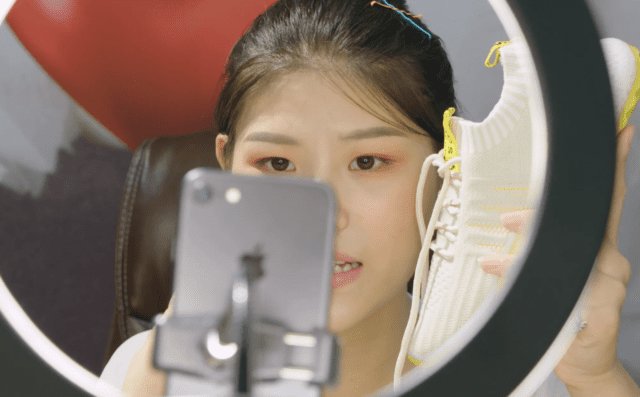
Jessica Kingdon’s feature doc Ascension provides viewers insights into Chinese society from its lowest rungs to its highest. An observational film without voice-over or talking heads, it offers revealing, beautifully framed and often humorous glimpses into the lives of everybody from factory workers to soldiers, from women constructing sex dolls to participants in “dating training” programmes and social influencers. It was shot in over 50 locations.
The MTV-backed film, which premiered at Tribeca, where it won two prizes (Best Documentary and the Albert Maysles Award), is now considered an Oscar front runner. It receives a market screening at IDFA.
“A lot of the process was quite intuitive for me,” the Chinese-American director says of her impressionistic approach. On the one hand, there was a road map. She set out to depict “the ascension of the class levels.” On the other, she was relying on instinct during the editing process as she sculpted together all the various vignettes she had shot.
Initially, Kingdon had planned a series of chapter headings through which to arrange the film. These were the equivalent of “scaffolding.” Once she removed them, the film still kept its shape but she was able to let her ”imagination run wild.”
The movie is about the Chinese dream and so, with typical, playful irony, the director made sure she included images of people sleeping.
Put it to her that some of the scenes of factory workers moving in unison, as if they’re cogs in a huge machine themselves, are reminiscent of moments in Charlie Chaplin’s Modern Times (1936) and Kingdon tells Business Doc Europe that this observation has been made before.
“I hadn’t actually seen Modern Times but I showed my friend’s mom an early cut [of the film] actually and she referenced that film. Then I went and watched it and I could see the resonance between the films.”
Kingdon talks of how her documentary “tumbled into something larger” from what she had originally anticipated. In 2017, she had made a short called Commodity City which took place in the biggest shopping mall in the world, Yiwu International Trade City in China, where you can walk for miles on end without escaping the never-ending rows of stores. She already felt a pull to China because of the film, and also because her mother in Chinese.
The director was intrigued, too, by what she calls “the paradox of progress” in China. This is a nation which has undergone enormous changes in a very short period. Millions have risen out of poverty. The country went from being “the world’s factory” to becoming the largest consumer market in the world. Her film therefore stands as a study of capitalism. It also looks, though, at the costs of that growth, both in the loss of personal freedom and the rise in pollution. Many have been lifted out of poverty but the result is a more divided society, with enormous income inequality and exploitation.
Kingdon set out to study work in all its forms in China. The film includes scenes set inside a factory producing sex dolls. The women employed in the factory show extraordinary craftsmanship in the way they construct the dolls but there’s no hiding the grim nature of the job.
“When I was talking about labour and exploitation, it somehow seemed like the logical conclusion to everything that came before it,” the director says of the sex factory scenes. “It is one of the most paradoxical spaces we see. We see this dark, misogynistic product being made. The way it is being made too has some hazard. The women talk about the toxic powder. You see the plastic resin steam rising into their faces. At the same time, there is enormous camaraderie, intimacy and tenderness between these women making the dolls. I loved observing that – and their sisterhood.”
One of the most striking facets of the film is how Kingdon can move from the general to the particular, from the macro to the micro. She’ll show huge crowd scenes but will then focus in on the faces, hands and expressions of individuals within the crowd. Apart from anything else, this is very clever fly on the wall camerawork.
“Logistically how I was able to do it, part of that is an access question,” the director says of the painstaking way she secured permission to shoot her subjects. This wasn’t considered a politically sensitive film and so there weren’t censorship issues. “We would say we are an independent American documentary crew saying we are making a film about China’s economic rise,” she remembers the pitch they kept repeating. It always seemed to work. They were able to convince their hosts that they weren’t making news reports but would need time and space in which to do their work properly.
The title Ascension comes from a poem written by the director’s great-grandfather, a well-known writer in China. During the shooting of the film, she actually met Chinese relatives she didn’t know she had. She had mentioned to her mother that she was planning to shoot in a certain city in China and her mother replied that her grandfather had been based there.
“I had no idea [about that] because my mum actually was born in Japan, so my producer Kira Simon-Kennedy put me in touch with a local historian who was able to track down living relatives. They came to me because the scholar who found them connected us.”
Kingdon doesn’t speak Mandarin and so struggled to communicate with the long-lost relatives. Nonetheless, it was a moving occasion and she is still in touch with them. She has also discovered that one of their children, also related to her, works at Google in San Francisco. “She came to one of our screenings [in California].”
And, yes, her mother has seen the film and given it her blessing. “Each time, she watches it, she understands a new detail and facet to it. In terms of the family aspect, I think she is really surprised I went and found these relatives.”





