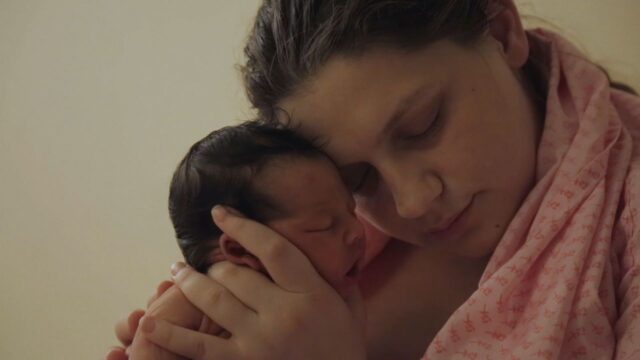
In Camilla Iannetti’s intimate documentary, produced by Zabriskie with Cut& and receiving its international premiere in IDFA Main Competition, we follow Lucy, a music student from Palermo studying in England, who faces the end of her studies because of student debt. She is also preparing for the birth of her baby, Futura…
After her mother Roberta and teenage sister Danny visit for the birth, they all return to Sicily, where Lucy, baby Futura and partner Kitim must adjust to life together in Roberta’s cramped apartment. As Lucy confronts the challenges of family life, financial insecurity, and her artistic aspirations, she wonders if she’s destined to follow her mother’s path.
Iannetti first recorded her subjects in a mid-length doc, before expanding their story with the feature format. “In 2016, I rented a room in this house in Palermo, and I didn’t know [my flatmates] very well. I realised they were interesting subjects already back then, up to the point I suggested to my film school to make my first-year film with them.”
“I began filming The Golden Age five years later, in 2021. In my first film, the protagonists were a family of women living together – a mother, an older daughter about to leave the family home to go study alone, and a younger 9-year-old daughter.”
“Five years later and some time before delivering her first child, the older daughter Lucy and I thought to continue this experience [together], this sort of ‘filmed testimony’ of their everyday life. At first, the project should have covered the first year of [the life of] the baby, and how this transformed their lives.”
However, Iannetti ended up filming for much longer due to “events going beyond everyone’s imagination.”
“So, I decided to spend more time to get a proper ending, able to contextualise the whole experience,” she insists.
The director reveals how editing and filming took place almost simultaneously. “Our editor Valentina Grossi got very passionate about the project and joined it as a co-producer. We began watching our footage almost right away, and we kept working from 2021 in a rather free fashion, sometimes with long breaks between one filming session and another.”
Editing wrapped at the end of 2023, with most of the footage having being shot in 2021 with occasional periods of shooting over the subsequent years.
Asked why she considers it important to tell and share this story today, Iannetti says: “The beginning of this project has much to do with an encounter of kindred spirits…We developed a strong emotional bond, hard to translate into words. Often, while producing the film, I heard [someone] saying: ‘You’re too much in love with your protagonists; what’s your drive? What do you want to talk about?’”
“But for me, it’s been simply a necessity – a personal one, and I wasn’t driven by the idea of exploring a particular theme. I believe that what I found in these people is the beauty and the ability of being themselves, while being in transformation, [going] beyond any labels…”
Moreover, spending so much time with this unconventional family of three allowed Iannetti “to understand through their faces, memories, and everyday life how much they’re loyal to themselves.”
“It’s one thing us human beings tend to forget,” she underscores.
Zooming in on the main challenges encountered along the way, Iannetti admits how working with such a small production “allowed her to be much freer,” but forced her to be flexible and fully committed, given that she shot the whole film by herself. “In other films, I’d have at least worked with a skeleton crew or been accompanied by a sound recordist. So, I had to be very open and flexible with time and ways [of filming] while dealing with the protagonists.”
“Humanly, the hardest thing was to sacrifice – at least in part – some time for myself, but I was motivated enough to do so,” Iannetti adds. “I’ve learnt that the time for telling a story doesn’t always coincide with our ‘everyday’ time. So, the plan I had about filming this and that over a certain time frame required a bit more patience and understanding while dealing with situations unfolding beyond my imagination. And I’ve learnt to accept all of this.”
Lucy, Roberta, and Danny have already watched the film. “They already had the experience of making a film with me, so they knew what to expect. What pushed them to accept and embark on this film is dual: first, they accepted being filmed in the same way a photographer would ask them to pose for a family portrait. They wanted to keep a memory of this time in their life. […] Second, they wanted to get an additional gaze from a person whom they trust and love, someone who doesn’t judge them. And, in the meantime, even that gaze ‘transformed’ with them… [They wanted] to see themselves through my eyes,” Iannetti concludes.