When Danae Elon was a teenager growing up in Jerusalem (where she lived from the age of two to 21), she remembers a strange experience when a Palestinian knocked on the door of her house.
“Those were pretty formative years. I was born in 1970. Those were the years when all that construction was happening [in the city],” says the director, whose new feature Rule Of Stone screens in IDFA’s main competition. She has vivid recollections of how Palestinian labour was brought in from the occupied territories as the city was transformed by Israeli architects. The sound of chiselling was constant. “Later on, chisellers were replaced by machines. Less and less workers were let into West Jerusalem…but during those years of the 80s and into the early 90s, it [the chiselling] was the sound of the city.”
The Palestinian who asked to look around the house had once lived there.
“I grew up in the Jewish-Israeli system of the 80s. The ‘Nakba’ [the violent displacement of Palestinian Arabs] was not something that was ever mentioned. It was never a subject brought up in school or that you could understand what that meant,” comments Elon.
The director’s father, Amos Elon, was an important Israeli author and intellectual. Her family did discuss Palestine, the conflict and the fate of the Arabs. Nonetheless, the “human side was always missing.” It was therefore “tremendously uncomfortable” for her when the stranger turned up at her home and she realised he had lived there too.
“I did not quite know what to do with myself. I felt extremely uneasy at the situation.”
The director tells this story in the film to hint at her own family’s complicity in what happened to the Palestinian people who fled or were chased out of their homes.
“To me, the built environment and the buildings themselves represented something that was very visceral. It was expressing the entire ideology that allowed it,” Elon says of how “Jerusalem Stone” itself played such a crucial part in what she calls the “invisible war of annexation.”
In the film, Elon has another equally disturbing story of how she went to visit an olive tree park that had been built as part of mayor Teddy Kollek’s transformation of the city. In a scene which she says could have come out of “an Albert Camus novel,” she was attacked by a Palestinian man. She was on the ground, fighting for her life. She fought her aggressor off and ran toward the road where she encountered another Palestinian man. He gave her a cigarette, advised her to call the police but then asked her, “when they arrive, you won’t accuse me of what happened?”
Elsewhere in the doc, leading architects discuss the transformation of Jerusalem. One of the most prominent voices is Moshe Safdie, who worked extensively on the restoration of the old city.
“I openly asked him questions and he knew where I was coming from,” Elon observes of someone involved in a project that was effectively taking the city away from its former Palestinian inhabitants. “On the one hand, this is a depiction of an architect at a very specific time. I know why he thought the way he thought…and Moshe knew where I was coming from. He was very generous in allowing me to interview him with some very difficult questions.”
Montreal-based Elon was shooting between 2019 and 2022 – before October 7th last year. Editing took a small eternity. “As we reached our rough cut, which wasn’t working, all of a sudden, this big catastrophe happened.” She talks of the “incredible loneliness” she felt in this period and her sense that she wasn’t accepted by anyone.
“I must say the film didn’t change at all,” the director adds of how she reacted after the massacre and subsequent invasion of Gaza. She describes the documentary as “talking about the formation of colonial strength and colonial powers, and how we gather our strength from facts that we look at as absolute, such as spaces and buildings. In that sense, stones don’t lie.”
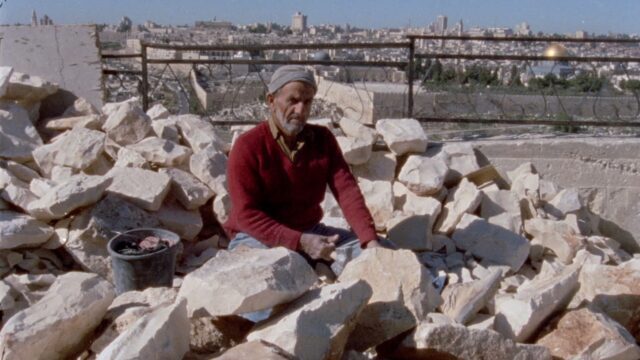
The film has some extraordinary footage of a Palestinian stonemason living in a quarry on the site of his old home. She discovered this man by chance, while location scouting.
“I was looking for homes to document and shoot. All of a sudden, I heard this very loud argument down in the valley that was just echoing…”
Elon went to investigate, met the stonemason, and asked to interview him. “I used him to represent the greater tragedy of the population of Jerusalem. I focused on his story as a metaphor. He was a stonemason. His father was a stonemason. His home was destroyed. It had all the story elements that I needed. And he’s one that just doesn’t abide by the rules and just lives outside of society and the rules that the government forces you to live by…he defied everything!”
The stonemason made it clear that he wasn’t going to move, even if his home has been demolished. “For me, that is the hope of the film…I really needed to end the film with some form of hope. When he stood there and said he was going to restore this [his destroyed home] so his children would have a place to come and see him, I thought that was both an important message and a beautiful way to end the film. You can’t crush him, you can’t crush his spirit!”
Rule of Stone is produced by Elon and her regular collaborator, Paul Cadieux. International distribution is being handled by Quebec outfit, Filmoption.
Elon has already shown the documentary to contacts who don’t share her point of view. Even if they disagree with her interpretation, they accept its narrative. Nonetheless, on the eve of IDFA, she was striking a wary note.
“I still cannot tell you how it is going to be received. I am very preoccupied with being dismissed because I have Israeli nationality and there was a film fund in Israel that supported the film eight years ago…”
Elon pays tribute to IDFA artistic director, Orwa Nyrabia, who selected the documentary for the International Competition. “He’s a real inspiration. He said something amazing to me when I submitted the film. He said ‘I will not turn my back on you. I cannot turn my back on someone like you because I know what you are doing is sincere and you bring an important film to IDFA.’ His encouragement and his standing for these diverse voices and allowing this dialogue to happen is a very courageous place to be…I can only say it’s a miracle the film is being shown in the main competition at IDFA in this climate.”