

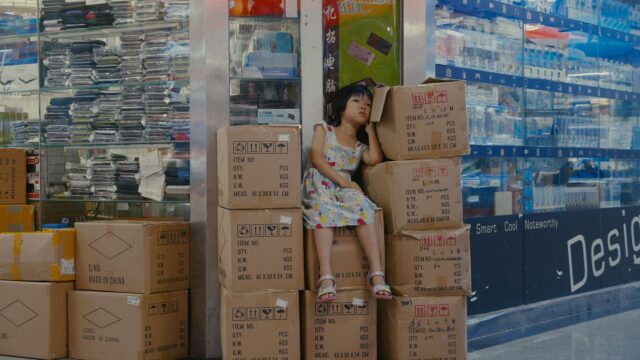
For her debut feature doc Chinese director Qinyuan Lei returned to the city where she grew up initially to shoot a film about industry and the hardware eco-system, until she met two small siblings having the time of their lives being very mischievous. The director explains more to Business Doc Europe.
Young Chinese director Qinyuan Lei (whose debut feature doc The One Who Runs Away Is the Ghost is a world premiere in IDFA’s international competition) was brought up in Shenzhen, a Chinese city which has witnessed extraordinary growth in recent years. The city, where her documentary is set, now has a population of close to 20 million people. When she was a kid, it was far, far smaller.
“I moved to Shenzhen when I was five. My dad was working in a very bad situation in a tech start-up,” the director remembers.
Her family was living in tough conditions. Their home was on a hilltop near her father’s factory. They didn’t have proper electricity. Water was from a well.
In her film, Lei focuses on the day to day experiences of two mischievous and very likeable kids, sisters Haohao and Zhouzhou, as they roam the floors of the electronics market in Huaqiangbei, where their father works. The director herself grew up in similar circumstances.
“That centre is at the very centre of the city. Back then, it was one of the very few places where you could actually go shop – and you could literally shop for anything. It was not just electronics components. There was also the first KFC right next to where we shopped and also my middle school was right next to it.”
Lei used to hang out at Huaqiangbei after school. “Just go buy stuff and have fun,” she recalls how she spent her time there.
The film screening at IDFA is very different from the one the director originally envisaged. The idea early on was to make a documentary about “industry and the hardware eco-system.” On her second trip back to her home city to shoot material, she decided she wanted “to make this into a personal project, something that mimics my own childhood.” She ditched almost all the material she had shot previously. Instead, the film turned into a nostalgic and playful project with the children at its core.
The two sisters had recently arrived in Shenzhen. Their parents have an electronics business on the ninth floor of the shopping centre. Lei had met them during the first trip. “I just found them really nice and cute.” The kids’ parents were “fine” for them to feature in the documentary.
“I don’t think that film, art or anything or what we were talking about mattered to their life at all. They basically don’t care. They have their own life and worries which are the worries of a family which has freshly migrated to a new city,” the director says of the carefree attitude of the parents.
The documentary was made with the full approval of the city district authorities. The kids, for their part, thought it was a big game.
Imagery of the kids is accompanied by a meditative voice-over written by the filmmaker. In this, the filmmaker talks of her longing to leave the city. Ironically, then, she is back in Shenzhen where she is now a professor of art and media technology.
“I guess that wanting to leave is more emotional than factual,” she says of her relationship with her home city.
The living conditions for kids like the ones she shows in the documentary remain restrictive. Nonetheless, looking back on her own childhood, she says she found the city “amazing.”
Lei returned to China having studied at Brandeis University and at Princeton in the US as well as doing a Master course in Cinematic Arts at Art-on-the-run Film School in Berlin.
“When I was 19, all the rich kids went to the UK,” the filmmaker, now 33, remembers. Her family didn’t have the money for that. They were keen anyway for her to stay at home but she wanted to travel and to have, as she puts it, the “opportunity to be confused.”
The filmmaker believes that her academic work and her filmmaking now complement each other.
“There are only certain things you can do with academic work,” the director notes. Research papers and books don’t help you understand the very personal feelings and memories, “the creative itch,” as she puts it, that she is trying to express in her documentary.
The One Who Runs Away Is the Ghost was produced and shot by Julian Moser, the German-based co-head of music video and documentary outfit Moserfilm.
Lei met Moser online through a website that brings filmmakers together. She pitched her project and Moser immediately agreed to go to China with her. “We met in May and then four months later we were in China together,” she says of a collaboration that both aim to continue.





