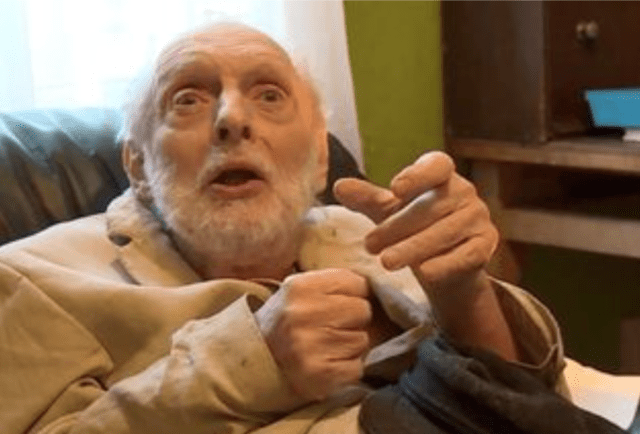
Much Ado About Dying is a documentary with very unlikely origins. The original idea had been to make a movie called ‘Carmageddon’ about traffic congestion and climate change in Delhi. Instead, British documentary maker Simon Chambers left the traffic fumes in India far behind and ended up back in London, looking after his uncle David, whose health was failing.
David was a very flamboyant figure, one part Quentin Crisp from ‘The Naked Civil Servant’ and one part Albert Steptoe, a recalcitrant rag-and-bone British sitcom character. David was also a Shakespeare-loving gay man in his 80s, living on his own in squalid surroundings. A former actor and teacher, he had led a very colourful life but now needed help. Simon became his carer – and ended up making a movie about him.
“He [David] went to Oxford and studied history. Then, he had to do National Service. He didn’t want to. He said he wanted to be a conscientious objector but his father said ‘no, we don’t do that in our family.’ We don’t protest, We go along with things,” Simon Chambers fills in Business Doc Europe on David’s life story.
“He [David] was colourful and charismatic. I have two sisters – we would always end up putting on plays with him for my grandmother. He was also, I remember, completely in his own world and own head. Whenever he came down to Devon where we lived, he would always forget to get off the train at our station and we’d have to go and pick him up in Plymouth.”
David had run the Byre Theatre in St Andrews (Scotland) and worked as an actor in rep. When his family eventually told him to “get a proper job,” David began a teaching career which took him from the revered Dartington School of Art to Goldsmith College in London. He also acted in productions put on by the radical theatre company, Gay Sweatshop.
Now, though, David was an old and frail man. It looked as if he was being financially exploited by one of his carers, a married man called Rodrigo with whom he had fallen madly in love.
Simon had come to London “rather resentfully” to look after David, thinking “it would only be for a month or two.” However, he soon realised he was going to be there for far longer. He had seen what happened to his mother when she looked after his grandparents. “I remember my mum thinking we’ll look after granny for a few months because she has fallen down. We will give her a good end.” Granny, though, ended up living for another 10 years.
David, likewise, was resilient. As he spent more and more time with him, Simon decided to make the doc. This was partly because David was an exhibitionist who tended to be in far better humour when he was allowed to perform. “The only reason I started filming in the first place was because he is an actor. Every time I turned up, he used to be quite grouchy with me. He said why don’t you bring your camera along. I didn’t really want to. I thought: an old man twittering on with his Shakespeare, so boring. But I discovered when I brought the camera along, he was in a much better mood with me because [it was as if] he was on stage.”
On one level, the documentary is about what it means to be a carer. “You’re not clear if you’re doing the right thing a lot of the time. You end up having to play God and make decisions. For example, he [David] said ‘I don’t want to go to a care home.’ I said ‘right, that’s tough, you’re going.’ We bundled him into the back of an ambulance, hijacked him and took him off. Funnily enough, when he got better, he absolutely loved it.”
Much Ado About Dying is produced by David Rane of Soilsiu Films (whose previous credits include Young Plato which premiered at Doc NYC). “Funnily enough, we knew each other in our very early 20s. We were both squatting in a house in the Old Kent Road,” the director recalls his 40-year long connection with Rane.
“I had been working on this film on my own for quite a while, trying to get funding. Nobody was interested in giving any funding because I think nobody was interested in a film about old people,” Simon recalls.
He had also found out that there “was something like 5 million unpaid carers” in the UK, and thought the documentary might appeal to them. He therefore carried on. However, he was close to abandoning the project when Rane agreed to look at it. The producer was immediately enthusiastic.
“I had more or less got to the point when I almost put it in a bottom drawer because I thought nobody is interested. What is the point? He [Rane] gave me the impetus to go on.”
Rane secured a small amount of financing for development from Screen Ireland. “Apart from that, David and I have done it without any funding whatsoever. It is a completely unfunded film. It has been a labour of love for myself and David. He also has got a father who is ill. What we have found out making the film is that almost everybody you talk to, when they watch the film, they go ‘this is exactly the story of my sister who is looking after an aunt’ or ‘a grandparent.’ It seems as though in a funny way we might need a film like this as a cathartic experience for home carers to have!”
Now, the doc is in competition at IDFA (having been rejected by various UK festivals) and is already being talked up as one of the crowd pleasers at this year’s festival. (Simon was also at IDFA with his earlier documentaries, Every Good Marriage Begins With Tears and Cowboys In India).
Uncle David remained “playful” to the end. There is footage of him singing Hot Chocolate’s ‘You Sexy Thing’ not long before he died.
Shakespeare also looms very large in the documentary. King Lear, the ageing monarch who gives away his kingdom and ends up naked in the storm, was the role David most loved but he had never played it. “David was a complete Shakespeare fanatic. He knew huge chunks of the speeches and he would go to all the productions anywhere in England,” Simon says of his Bard-loving uncle. “He really thought Shakespeare had so much to tell us about life…I was aware of the parallels between David’s own life and the story of King Lear.”
Lear went a bit mad. So did David. “It was a happy coincidence that he started to do King Lear speeches…”
The “messy house and anarchy” reminded the director a little of the cult 80s movie Withnail And I. He was also deeply inspired by David’s optimism at the most unlikely moments. “When his house burned down, he says ‘oh my gosh – I am liberated! No more money, no more objects. I am on the way to death now!’”