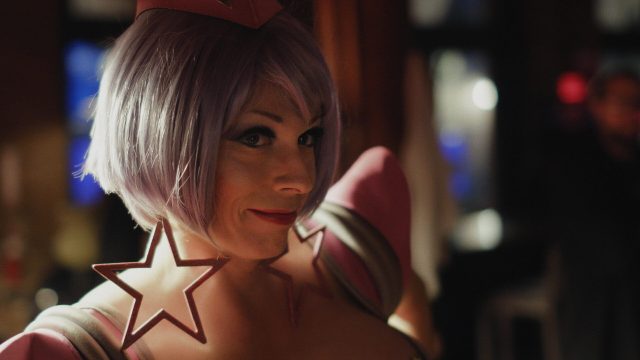
This endearing portrait of multi-faceted trans artist and adult performer Tara Emory impresses with its gentle approach to potentially sensationalist subject matter. It shows Emory as, above all, an interesting individual – who just happens to make some really cool retrofuturistic sci-fi porn.
Tara Emory is a lot of things. She is an artist, cartoonist, hoarder, mechanic, filmmaker, trans woman and much, much more. For most people, however, the fact that she’s an adult performer eclipses all. It’s a job that is so stigmatised that it doesn’t matter what else you’ve accomplished – if you’re a porn star, that’s how society will judge you. Which means many doors will remain closed to you. It means people will probably not think highly of your skills or intelligence. And it means many will look down on you as either a victim or a villain. It’s as if once you’ve done porn, you’ve crossed over to the Dark Side, from which there’s no turning back. You have become the Other.
Canadian director Laurence Turcotte-Fraser, in her feature debut, confronts these preconceptions indirectly and most effectively. She doesn’t argue her points politically, but simply shows Tara Emory’s everyday life. That’s all. Emory is an adult performer, certainly, but for Turcotte-Fraser, she is above all one very interesting and inspiring individual. Not any preconceived Other, but – I’m embarrassed to even have to say this – part of our world. She is “just one of us”, as one man at a car show says, admiring Emory’s self-restored Citroën 2CV and adding, apparently without realising the double entendre, “We know she can get in there and get dirty.”
Apart from generally avoiding the explicit arguments for and against porn, which leavens the documentary substantially, Turcotte-Fraser’s most important decision has been to take her time. She has followed Emory for years. There are no rushed judgements here, no loaded questions, no wild camera work, no shock edits. The documentary approach of her film is traditional, close to cinéma vérité (with a little bit of animation thrown in), but with a calm which is exceptional, especially with such potentially sensationalist subject matter as porn. The music, the editing, the eye for detail: it’s all gentle. This unhurried approach is itself an argument. It tells us to not jump to conclusions, but to also take our time. Let’s sit with Emory. Let’s listen. Let’s have a look. And let’s slowly get sucked in, just as Turcotte-Fraser was.
So, now we get to the porn; thank you for your patience. Because porn is of course a major part of Emory’s life and thankfully Turcotte-Fraser isn’t too prudish – which would have been equally sensationalist (by suggesting it’s too ‘out there’ to be included) and just plain offensive, both to Emory and to any adult audience. For Emory, porn is more than just a job, it’s an artistic calling.
Sure, as a performer she has done traditional shoots, directed by others, without much artistic pretension. But her ownwork is different. She designs and builds elaborate sets, she designs and sews beautiful clothes, she designs and builds fantasy costumes and props and whole spaceships if she has to. She loves Victorian dresses and corsets, fairytale pin-ups, bright colours and bold design. We see her doing photo shoots, by herself, having slowly turned a corner of her barn into a fantasy wonderland with no budget to speak of.
But her magnum opus is the decade-long Up Uranus project, a forthcoming ‘trans sci-fi porn epic’ of which The End of Wonderland shows some fantastical excerpts. Inspired by the science-fiction B-movies of the forties and fifties, but in colour, as Emory also wanted to reference later TV series like Star Trek and Blake’s 7. The sex is fun and self-consciously overacted (Emory still has to laugh when the performers, including herself, talk about “Uranus”), but it’s the sets and costumes that really impress. With next to no budget or crew, Emory has lovingly and meticulously built a sci-fi world which will put a smile on any movie lover’s face. If only for the metal dicks of the magnificent ‘testostrobots’, which contain a hidden mechanism which, when a string is pulled, surreptitiously drops a Mentos into a reservoir of 7Up and presto, ejaculation! Seeing is believing. Although the film is still unfinished, Emory remains unfazed: “This is gonna be a spectacular success or a spectacular failure. Either way, it’s gonna be spectacular.”
The fact that Emory is also a hoarder comes in handy for these scenes, as her yard is filled with old cars and other scrap metal she can use as material. But the hoarding is also a persistent problem, which she inherited from her father, a Volkswagen dealer who could never get rid of car wrecks. When Emory talks to Turcotte-Fraser about these personal troubles, she sounds as if she’s talking to a friend. This is most obvious when she lets herself be filmed, with great vulnerability, before and immediately after an operation in which her receding hairline is partly restored – hereditary baldness being a great fear of Emory. Turcotte-Fraser repays her trust with what can indeed best be called a friendlydocumentary.
If there is one gripe I have, it’s the title. The End of Wonderland sounds too sombre. It refers to the loss of the barn Emory used as a photo and film studio. Which is a setback, certainly, but I do not believe for one moment that it’s really the end of anything. The documentary itself makes clear that obstacles are nothing new for the resilient and resourceful Emory. This multi-talented artist and self-made woman will overcome any and all, on her own terms. Personally, I hope the world premiere of this documentary portrait at IDFA, and its screening one day later at the Montreal International Documentary Festival RIDM, will help Emory gain the recognition and support she needs to finally end Up Uranus.
Canada, 2021, 85 minutes
Director Laurence Turcotte-Fraser
Production Artémis Films
Producer Katerine Lefrançois
Script Laurence Turcotte-Fraser
Cinematography Laurence Turcotte-Fraser, Andréanne Chartrand-Beaudry
Editing Karim Haroun, Milène Ortenberg
Sound design Francis Gauthier
Sound Laurent Bédard
Music Christian Zuliani
Animation Jon Tate
With Tara Emory, Mandy Mitchell, Tiffany Starr