

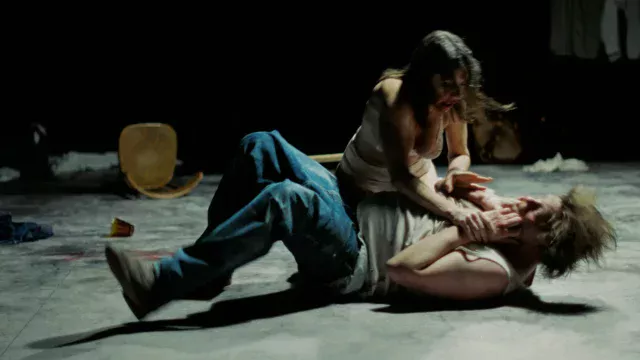
Real life imitates fiction or vice versa in Gianluca Matarrese’s hybrid film The Zola Experience(screening in IDFA’s Luminous section). In the film, a recently divorced theatre director/actress (Anne Barbot) is about to put on a production of L’assommoir by Emile Zola, the great 19th Century French naturalist novelist. She casts her neighbour, who is an actor, in the role of her husband – and they begin a romance for real.
Matarrese and Barbot were students together in the same class at the Jacques Lecoq school of physical theatre in Paris.
“We developed this complicity between the two of us,” Matarrese remembers how he and Barbot quickly became as thick as thieves. After leaving the Lecoq school, Barbot formed her own theatre company. Matarrese joined it for a couple of shows, working as a co-writer and actor and taking care of “all the audiovisuals.” At the same time, he was building his own career as a screenwriter and film director. (His previous features include Il Posto and The Last Chapter.)
“We went on our different roads but at the same time we were always doing the same kind of work, the same kind of research,” Matarrese says of how his career has always run in tandem with that of Barbot.
With The Zola Experience, the duo investigate the desires and real-life backstories of actors. Matarrese acknowledges that the film “comes very close to documentary.”
The storyline draws not just on Zola’s fiction but on Barbot’s life. She chose the novel for adaptation because of the parallels between her own experiences and those of the fictional female character, Gervaise, the washerwoman with the ambition to open her laundry.
Zola wasn’t actually the starting point. Matarrese and Barbot were originally contemplating making a similar work inspired by Dostoevsky’s The Brothers Karamazov but Covid scuppered that idea.
“So she started working on this other project which was Zola. She already created the show and I wanted to make a film about the show. The question was how am I going to film theatre? Is it just going to be an adaptation of what happens on stage? What is it that I am interested in about this story? Then I realised that Anne was the subject I was interested in. It’s actually her.”
Matarrese, Barbot and Benoît Dallongeville (the actor who plays…the actor) set to work recreating the story of how the show had been put together. “They already knew their lines. The text was there. They had already performed the play many, many times.”
The experiment behind the film involved combining elements from the actors’ personal and professional lives. “Then, something magical happened. These two worlds, the world of their lives and the world of the novel, mixed together giving birth to something…in between. We were all lost in this. We didn’t know anymore if we were talking to the character in the novel or if it was Anne in real life.”
“The miracle of documentary, of cinema du reél, is when the things you are fantasising about happen for real,” Matarrese further reflects on how the real characters’ lives and the fictional world they were inhabiting became intertwined. In this case, the actress and the actor who were playing a couple having an affair actually started dating. At first, they hid their relationship.
The film also shows them breaking up. They did this for real too (although they are now back together).
Matarrese may be the director of The Zola Experience but, on another level, Barbot is as much the originator of the project. Heavy demands were being made on her. Matarrese was asking her to “open up” about real events in her private life including her divorce. This made her nervous initially.
The director acknowledges that indie US filmmaker John Cassavetes is one of the inspirations behind his improvisatory, freewheeling approach. He talks of Cassavates films in which the director’s real wife Gena Rowlands would also play a wife on screen. “I remember when he was giving advice to actors in different moments of the shooting so the other actors wouldn’t know what they were doing.”
Was Matarrese surprised to be presented to documentary festival life at IDFA after screening the film in September at Venice?
“Orwa [Nyrabia], the director of IDFA, told me really beautiful things about my first film [The Last Chapter which screened at IDFA 2021] and I really think he supports and appreciates my work,” the director reflects. And, yes, he feels The Zola Experience fits well at IDFA. “I like to question and interrogate this border line between reality and fiction…I almost want to say, maybe it’s a bit strong, that maybe documentary is an illusion, maybe it does not exist. Maybe fiction doesn’t exist also…”
The director feels there is often “more authenticity” in his fiction than in his documentary work. “And sometimes there is more fiction in something that is supposed to be real. I really like film to break the deal that happens between director and public…I want to interrogate this contract between the director and the audience.”
The Zola Experience was made through French production outfit, Bellota Films, founded by Hind Saïh and Dominique Barneaud in 2009 and which works in both docs and fiction. They have collaborated several times with the director in the past upon such projects as Fashion Babylon and the recent short, Pinned Into A Dress, which he co-directed with Guillaume Thomas.
“The good thing I have with this family is that they really trust my ideas,” Mattarese says of the Bellota principals. He also plays tribute to his Italian co-producer, Donatella Palermo of Stemal Entertainment, best known for her work with directors like Gianfranco Rosi and Jonathan Nossiter. Global sales on The Zola Experience are handled by Syndicacdo.





