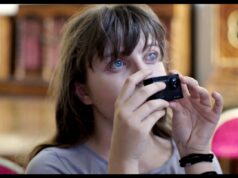
Berlin-based Ukrainian artist and filmmaker Mila Teshaieva gives a vivid and horrific description of what it was like coming to Bucha for the first time after the city was liberated from Russian troops last April.
She had to drive very carefully and slowly, zig-zagging to avoid the corpses. “I felt it was surreal,” she recalls. “I could not imagine that I would see anything like this in my life, that I would be driving on the street and I would need to go to around bodies….you can’t understand at all how it is possible in the 21st Century. Anyone who has seen this will never forget it.”
Teshaieva had come to Bucha to make a film. “I am a not a camera person and I am not a filmmaker but I felt that what is happening, it should be recorded in moving images,” the artist suggests. She is an acclaimed photographer but felt that still images couldn’t convey “all the sounds, the smells of the death.”
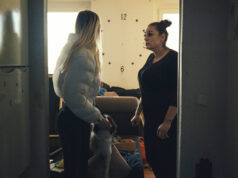
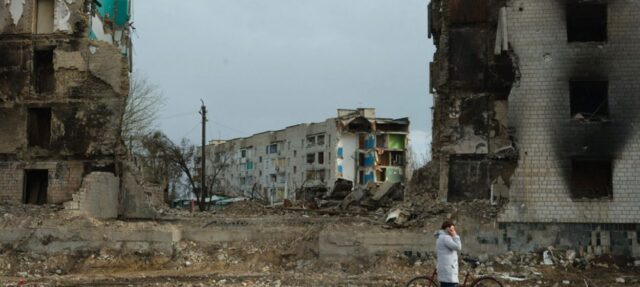
When Spring Came To Bucha (a world premiere in IDFA’s Luminous section), which she co-directed with her partner, German filmmaker, Marcus Lenz, allows viewers to see the devastation that the Russians had left behind them – the burned-out, bombed buildings, roads and the scarred earth. The inhabitants go about their daily lives but you can read the suffering and trauma in their pale, lined faces.
The couple live in Berlin. Days after Russia invaded Ukraine in February, Teshaieva set off by car to return to Kyiv to support her country. She was wearing a bullet proof vest and a helmet, driving with two other women in a battered old car.
”I started to think about a movie at the end of March,” Teshaieva (who has also kept a diary recording her experience in Ukraine) recalls. She was living through a moment of history that she predicts will be discussed and debated for generations to come and she wanted to preserve it.
A month or so after her arrival in Kyiv, Bucha was freed.
There were plenty of international news teams and foreign documentary makers drawn to the town. Teshaieva, though, was an insider – a Ukrainian telling a story about Ukrainians. Lenz was her “helping hand,” an experienced cinematographer and documentary maker who also knew the country well. (His 2020 feature Rival was partly shot in Ukraine).
When Spring Comes… shows how the people of Bucha “try to bring back life [and] to clean the mess left by the Russian army,” Teshaieva says. “It was absolutely a dead land after the liberation.”
This process of moving “from death to life, from winter to spring,” provided the documentary with a natural structure. She was looking for the “flowers on the ruins.”
One of the doc’s final images – used on the IDFA poster – is of a tree blossoming again. The shot has an obvious symbolic power.
“It’s more complicated [than that],” says Lenz. “Obviously, Bucha is not cleaned up. Obviously, there is not a spring right now but what is really impressive to me is the optimism of the Ukrainians. In this moment of deepest disaster, there is hope, there is strength, there is optimism to build up this country again.”
In the documentary, one of the main characters is a yoga teacher for children. “He is nowadays trying to identify deaths, taking mines away from private houses,” Lenz says of the roles that he and many others now play in the reconstruction of their city. The documentary is intended as “a kaleidoscope of disaster” (in Lenz’s words) and as “fragments of life, fragments of trauma and fragments of hope” in the words of his partner Teshaieva.
“It was a very spontaneous idea to go [to Ukraine]. Mila went first. She asked me to come. I hesitated for a long time because I was afraid and then finally I went,” Lenz recalls. “I took my equipment. I bought some sound equipment in addition…we didn’t know this would be a film. We didn’t know what would happen.”
They filmed intensively, working 16 to 17 hour days. With so much to chronicle, they were worried about stopping even for dinner breaks. “It was very, very intense, exhausting work,” the directors agree. “It was our obligation, our duty to fix exactly what was going on.”
The filmmakers started making the documentary without having secured any financing. They thought it was crucial to record events as quickly as possible. “We felt it necessary to inform the world about what is going on.” They rushed to complete a TV version. “But then we felt it’s also material for a feature documentary – and so we continued working.”
At the time, German TV wasn’t allowed to send correspondents to Bucha as it was considered too dangerous. However, en route to Ukraine, Lenz contacted a friend at a German broadcaster. “It was an editor I have known for many years. She said I cannot send you there [officially] but I am interested, I trust you.” WDR eventually came on board. The film is sold in the market by German sales entity New Docs.
There is still unfinished business in Bucha for the directors. They have decided to return to the town to follow their characters in their ongoing struggle to rebuild the city and their lives.
“What was important for me was that this movie breaks clichés about war. People, when they hear Bucha, they expect to see big drama. But what they see [in the documentary] is incredibly strong people, resilient and rebuilding their lives. It’s surprising and it is very touching actually,” says Teshaieva. “What really touched me is that the human spirit is actually much more powerful than any wars or any death.”
Not that the director downplays the pain she both witnessed and suffered.
“Of course today, every single person bears enormous trauma. I bear it, and Marcus as well. It is absolutely overwhelming when bombs are falling on your house and you need to hide, or to move – to take your children and run. You don’t even know if you will be able to take your children out of the war zone…of course, it is very difficult to live with this.”
In spite of the optimism with which the doc ends, Teshaieva. believes the trauma caused by the 35-day Russian occupation of Bucha will endure for generations.