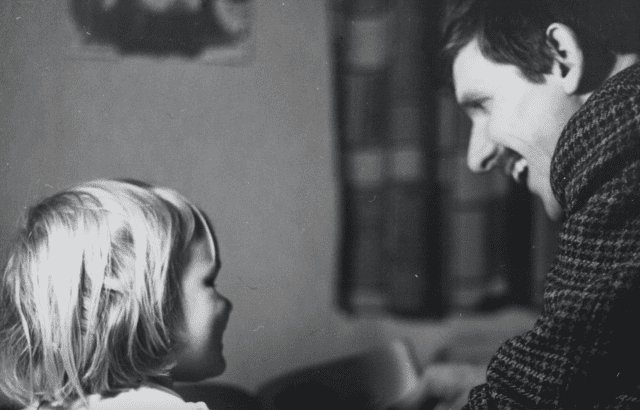
Signe Zeilich-Jensen and her father Leif
In 2020 Netherlands Film Fund’s Swedish-born Signe Zeilich-Jensen received a message telling her that father was the murderer of prime minister Olof Palme in 1986. This led to the documentary she made during lockdown with her husband Niek Koppen, in which she set out not only to investigate what seemed to be an absurd claim, but also, as importantly, to understand her estranged dad, who died in 1992.
Leif Zeilich was nothing if not extraordinary, an ultra right-wing fantasist, a plagiarist, womaniser and self-syled guru/yogi who seemed to cast a spell over his brethren. He was also tied both to a secret religious cult, whose members came from the higher echelons of Swedish society, and the pan-European Stay-behind task force that was prepared to mobilise in the event of a Soviet invasion of Europe. That said, for a while at least, when Signe was small, he seemed to be a reasonable dad, such as when he took the family with him far into the Arctic for 5 months where he studied the Inuits in their natural habitat.
But he also despised the liberal Swedish prime minister Olof Palme with a passion, a politician who, we are told in the film, was on the verge of signing an agreement with the Soviet Union to make Sweden a nuclear-free zone. Leif also had a revolver which matched the weapon used in the assassination, and which he hid in the family loft after the PM’s killing, and which he told his wife must not be found “for 100 years.” What’s more, he lived in the area where Palme was gunned down.
So Zeilich-Jensen and Koppen embark upon an investigation into her father that includes close family (though not, alas, Leif’s second wife Maria who made the original allegations against him on a satellite news channel in Sweden), academics, journalists, former acquaintances of her father and a particular expert named Jonas Nyman, who has devoted his life to unravelling the truth behind the murder. Her odyssey even takes her to Iceland where her father eventually worked in a school and where, at the age of 20, she walked away from him after one row too many, never to see him again alive.
An official investigation into Palme’s death in Summer 2020 concluded that the elusive Skandia Man was the assassin, but there are many experts and conspiracy theorists who dispute this easy and unimaginative conclusion which seemed to present no new evidence, especially among those who have, for many years, tracked the movements of the neo-Nazi cabal who wanted Palme very much dead…
At this point no more exposition and certainly no spoilers, and if you want to know more then request a screener.
But did Zeilich-Jensen herself have any idea that her father was keeping such horrendous company? “I think I kind of forgot. So I put it away for a long, long time. And then when we heard this rumour about my father, I think I had the feeling the only way to really be able to get it out of my head was to really know who he was. It was difficult just to ignore it,” she answers.
What Zielich-Jensen will never forget is the day that Palme was murdered, a tragedy of seismic proportions both at home and abroad. “It was huge, immense,” she agrees. “I think also that part of Sweden died that day, the part that was connected with hope and solidarity and belief in the future. After that, Sweden became quite a different country. Maybe that would have happened anyway, but it kind of disappeared overnight.”
Her husband Niek Koppen, acclaimed director of The Hunt and Gold, adds of the production that “it’s basically a daughter and father story, and a great story.”
“It was made for Dutch television when we could have as easily made it for Swedish television,” he continues. “Actually, I think it’s a Swedish film made in Holland. So we want to deliver the film also in a Swedish version. We have good ratings in Holland and a lot of reactions and I can’t see a reason not to show it across Scandinavia. It’s also a Danish story because he was born in Denmark.”
“And he lived in Iceland, so we go there as well,” adds Zeilich-Jensen. “And my half-sister in the film, she’s from Greenland. So it’s a very Nordic story.”
“My father was just so provocative when he was alive. He still is when he’s dead,” Zeilich-Jensen sums up. “So yeah, it was upsetting. But in a way it’s also a relief to go into things that have maybe never been disturbed, because you want to solve it. But I’m not sure that you ever can. I don’t think that I ever will really understand my father, even though we spent almost a year investigating who he was and what he did. I still don’t really know him.”