Calls for remembrance, to ‘never forget’, are usually made after conflicts have ended and their horrific toll has been established. IDFA’s stylistically daring yet accessible opening film, Olga Chernykh’s debut feature A Picture to Remember instead confronts us with the complexities of recall and the manifold meanings that pictures can onvey while the war in Ukraine is still raging.
Watching the film, my thoughts kept returning to its title, A Picture to Remember. At first, its meaning seemed straightforward enough: Ukrainian director Olga Chernykh recalls her youth in Donetsk, “a city of a million roses and coal” in the now-occupied and inaccessible eastern part of the country, looking at old photographs and home movies to remind herself that yes, she used to live there, and yes, her family had been happy there. It is an approach both touchingly intimate and undeniably political, given the number of people displaced and separated by the Russian invasion that continues to ravage the country.
This last fact, however, points to another meaning. As the war progresses, first since 2014 when Russia occupied Crimea and supported by the Donbas separatists, and then with the large-scale Russian invasion of 24 February 2022, there is a danger that the outside world will slowly stop paying attention. Especially since the escalation of the Israeli-Palestinian conflict. This ‘picture,’ Olga Chernykh’s film is here to remind us. Which makes its selection as IDFA’s opening film all the more poignant.
One thing that the documentary clearly demonstrates is that remembering is not a passive activity. ‘A picture to remember’ does not simply – or only – mean ‘a picture you won’t forget’. It also means ‘a picture to help you remember’, even ‘a picture you must remember’. It is not a tagline, it’s an instruction. An appeal, if you will. Or, more likely, a plea: ‘a picture to please remember’.
This is not to say Chernykh’s film is somehow academic or abstract. On the contrary, its personal approach makes it eminently accessible. It feels like a trip through the filmmaker’s wandering mind, guided by her soft-spoken voice-over. A stream of memories and reflections, aided by the faded photos and films of yesteryear while the inclusion of some Soviet propaganda clips underlines the recurring doubts about the reliability and completeness of these recorded memories.
We are all familiar with the experience of doubting whether we really remember an event directly, or merely how it was recorded. Just as we have handed-down memories of family members we never met and events we did not attend. This sentiment is something that A Picture to Remember echoes stylistically, with its interweaving of memories and registrations and wartime realities.
The effect is that, for all its everyday recognisability, with its home movies and family photographs, much of the film feels slightly detached. Uprooted. As if not only memories but also everyday reality somehow remains just out of reach. Using everything from extreme close-ups and security camera footage to associative match cuts, with a fluid soundtrack of noises, music and ethereal vocals, Chernykh manages to blur the lines between shots and scenes, between then and now, and between registration and stylisation, to create something simultaneously dreamlike and real.
In Kyiv, the ‘now’ of her life, Chernykh observes her parents, especially her mother. But Donetsk has not been fully relegated to the past. Grandma still lives there, survives there among the shelling, and Chernykh and her mother have regular video calls with her. But somehow even these images, these pictures, already feel like memories. Like recordings of what used to be. In fact, each conversation may be their last, given the uncertainty of the future. Each conversation, meanwhile, is also a reminder of a past when they were all together – which they may never be again.
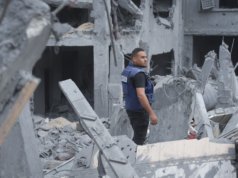
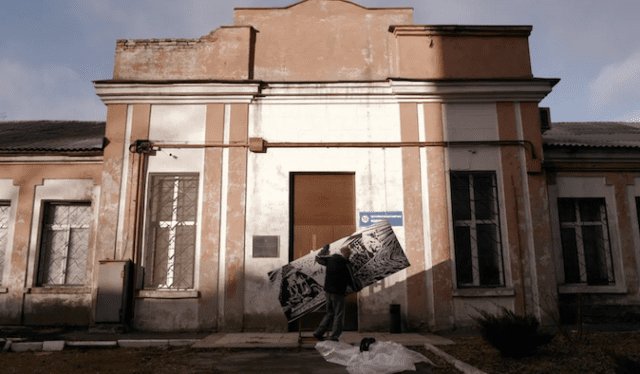
In this way, each picture is both a registering of what is and what isn’t. Each image is also one of loss and a reminder of everything that was not captured, that remained outside of the frame, that ended up in the dark recesses of minds and histories. A sense of loss that is echoed in the similarities between scenes of destruction today and archive footage of the Second World War. Shots of houses ruined; images of lives lost; pictures of times forgotten.
The cumulative effect of this daring approach to mixing the contemporary realities of life during wartime with the elusive attempts to grasp the past and a world seemingly just out of reach is best expressed in Chernykh’s key observation: “My reality became an endless dream with erased borders between memories and real life.” A dreamlike reality which she has captured remarkably well on film – the medium par excellence for blurring the boundaries between actuality and memory. And between life and death.
In Kyiv, Chernykh’s mother works at a morgue. On the night of the Russian invasion, Chernykh decides to stay there. It seems like the safest place to be: who would want to enter a morgue? So there she is, surrounded by body parts in formaldehyde – physical reminders of the once living – with her best chance of staying alive being among the dead.
And then what do you do when a war you were sure would not happen happens and your world as you know it falls apart, when borders are erased and categories get blurred, when real life becomes a nightmare and memories start to feel like dreams? Then, if you’re a filmmaker, you take your camera and you take a picture. To remember, as best you can.
Ukraine, France, Germany, 2023, 82 minutes
Director Olga Chernykh
Production Real Pictures
Producer Regina Maryanovska-Davidzon
International sales Stranger Films Sales
Script Olga Chernykh
Cinematography Yevgenia Bondarenko
Editing Katerzyna Boniecka
Sound design Benedikt Schiefer
Sound Serhii Avdieiev
Music Maryana Klochko
With Olga Chernykh