Mati Diop’s magical and realist documentary about the restitution of colonial treasures, which was awarded the Golden Bear in Berlin, is intellectually challenging from its very first shot.
Dahomey opens with a night-time shot of a Paris sidewalk, with the Seine in the background, where small flashing Eiffel Towers are being sold as cheap souvenirs. At the Berlinale, Diop pointed out that this scene took place on the Quai Branly, near the ethnographic Musée du Quai Branly and close to the famed Tower, a monument created for the Exposition Universelle of 1889, which itself featured a ‘human zoo.’ The same historical period saw the French colonial invasion of the former kingdom of Dahomey, now Benin, in 1892, and the Berlin Conference (1885). But what is most important to Diop is the fact that the clandestine African workers selling these commercialised artworks preferred to stay very much off-camera.
This connection between the looted African objects, which had been displayed in the Musée as treasures and were returning in Dahomey to Benin from colonial exile, and the present-day African sellers of mini-Eiffel Towers for whom it is safer to remain outside of the frame, is already so layered that I could spend an entire article exploring it. There’s also a clear link here to Diop’s earlier fiction feature Atlantique (2019), in which Senegalese women are possessed and empowered by the revenant spirits of their men who drowned at sea while trying to reach Europe.
What Diop is trying to film is invisibility – not being able or allowed to exist in a particular place. One notes how most shots in Dahomey, even wide shots, feel cramped. Sometimes because of see-throughs and obstacles, other times because a building or road is simply cut off earlier than expected. There is a constant suggestion of something deliberately being kept out of sight. Something which exists, but can’t be seen.
Immediately after the little Eiffel Towers, we see security footage of the corridors of the Musée, where numerous colonial artefacts are stored and from where Diop will follow the return of 26 items back to their homeland in Benin.
This usage of security footage cleverly suggests a crime story – which it is, of course. But what Diop would have preferred to show here were the thousands of colonial artefacts remaining behind in the museum. She wasn’t allowed to film those, she says, simply because seeing kilometre after kilometre of underground artefacts in Europe might have fuelled audience clamour fortheir restitution.
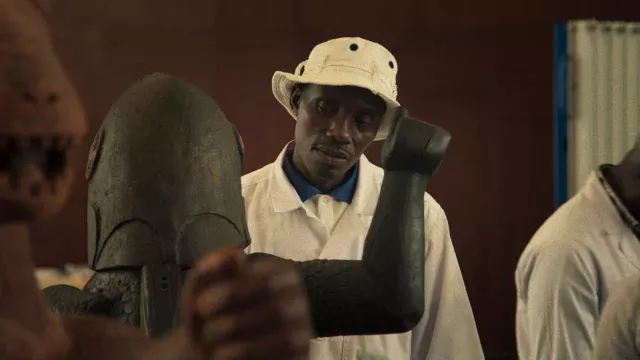
But she was allowed to film how the statue of King Ghezo (1787-1858), fist raised, was being packed with almost ritualistic care for shipment to Benin. The moment the wooden crate is closed, the film suddenly switches to Ghezo’s perspective. But the thing is, the statue was placed face-down in the crate, and we are looking upwards… In other words (and without using any words), this isn’t the perspective of the physical statue, rather its spirit. Its meaning.
Out of this darkness, Ghezo’s voice emerges. It speaks to us in Fon, one of the national languages of Benin, where French is still the official state language. The dreamlike, elegiac voice has been digitally created across different registers, both male and female, and sounds as if it’s coming from another dimension. At the same time, the background noises of the crate being moved ensure that the connection to everyday reality is never severed.
We have now seen a little over 11 minutes of film; such is the complexity and efficiency of Dahomey.
Another striking image is that of a giant female statue looking out over the museum buildings when the artefacts have arrived in Benin. It’s not explained within the film, but this is the recently erected ‘Benin Amazone’, proud representative of Ghezo’s female army, also featured in Cobra Verde (1987) and The Woman King (2022), who once more watches over the former ruler.
Diop avoids mentioning things explicitly. Rather, she turns to allusion in feeding the general sense that there’s more to all this than meets the eye. Take the way Ghezo’s voice sounds surprised when, in Paris, he’s being referred to as ‘number 26’ – “Don’t they know my name?” Together with the white, windowless corridors of the museum depot, which Diop refers to as a “prison,” it suggests a stark contrast between an accountancy-driven West that just wants more of everything (even if it is to be consigned to a basement) and the land of origin, where these statues take on a mythical, living significance.
That said, when we arrive at the museum in the Benin city of Cotonou, Diop subtly inserts a few shots that echo Branly: a security camera, an artefact behind glass, an air purifier and a modernist façade being locked by a guard.
Whether consciously or subconsciously, at this point we have already come to recognise what won’t be said aloud, at least until the second half of the film, which mainly consists of a debate between Beninese students (held in French), that the ‘museum’ is a Western construct and that these statues will regain their full meaning only if they are returned to the spiritual location and context from which they were removed. Which is countered by another student who says this would make them frightening to her and that she prefers to see them as ‘art’ in a museum.
Thus, while it was clear that Ghezo didn’t belong in Paris, his triumphant return to Benin – to jubilant crowds and headlines – also raises the question familiar to every returning migrant: how can I feel at home again in a country of origin which has changed so much during my absence?
There is only one place on earth where a colonial artefact can be located – whether that is Paris or Amsterdam or wherever – but there is also only one place on earth where it can be missing. And that is what Mati Diop, after Atlantique, has shown us again in Dahomey: what it means to be absent somewhere. And what it means to then return.
France/Senegal, 2024, 69 minutes
Director Mati Diop
Production Les Films du Bal
Producers Eve Robin, Judith Lou, Mati Diop
International sales Les Films du Losange
Script Mati Diop
Cinematography Joséphine Drouin Viallard
Editing Gabriel Gonzalez
Sound design Nicolas Becker
Sound Corneille Houssou, Cyril Holtz
Music Wally Badarou, Dean Blunt
With Alain Godonou, Calixte Biahr, Ghezo