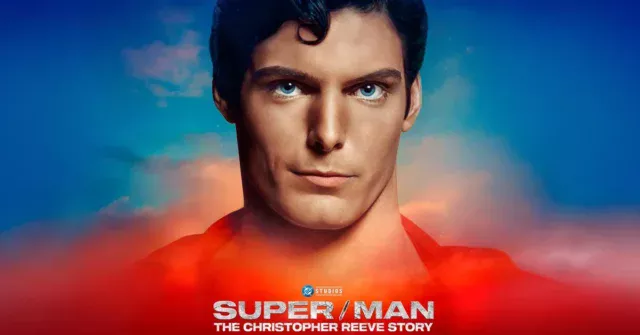
The tear-jerking new feature documentary Super/Man: The Christopher Reeve Story (a market screening in IDFA) tells the story of the brilliant, Juilliard-trained actor, plucked from anonymity to star as the Man of Steel in the Superman movies. After a catastrophic horse-riding accident in 1995 left him paralysed, Reeve became a campaigner for disabled rights.
The film, made through Misfits Entertainment, is the latest collaboration between Ian Bonhôte and Peter Ettedgui, whose previous joint-credits include Rising Phoenix (2020), telling the history of the Paralympic Games, and McQueen (2018), about maverick fashion designer, Alexander McQueen.
Both directors acknowledge they wouldn’t have come to the Reeve project if they hadn’t made Rising Phoenix first.
“Although we had seen some archive of Chris opening the 1996 Atlanta Paralympics, marvelling at that, it wasn’t our idea to start working on this film,” Ettedgui explains. “It was the idea of an archive producer, Daniel Kilroy, who had got in touch with Matthew Reeve [Reeve’s son] through Linked-In and asked if his family had any archive they’d be willing to share for a potential feature film.”
By chance, Kilroy had made contact just as the Reeve children were selling their parents’ old home in Bedford, New York. They’d been clearing the place out. And, yes, there were boxes and boxes of archive material. It was, by then, nearing two decades since Reeve’s death in October 2004. The children felt they had “reached a place in their lives where they felt comfortable for the first time about being approached in this way,” Ettedgui adds.
This was the point that Bonhôte and Ettedgui became involved via Passion Pictures, who had been production partners with Misfits on Rising Phoenix.
“The kids were effectively on board. They just wanted to make sure that whoever was going to do it were the right people,” Ettedgui notes. It helped that the children admired the duo’s previous documentaries.
They eventually met for the first time in New York. “We got on extremely well with them,” Ettedgui says of this first encounter with Reeve’s family. Nonetheless, the filmmakers put certain ground rules in place. Nothing was to be off limits. This wasn’t going to be a celebrity puff piece that would place “Reeve on a pedestal.” It would be respectful but would also delve into the darker parts of its subject’s life.
The children were keen to go ahead on this basis. “Enough time had passed and they were worried that waiting any longer, then young audiences would have completely forgotten [about Reeve]. They wanted to bring his message and what he stood for, and what Dana Reeve [Christopher’s wife] stood for, to an audience, and the way they changed so many elements of the disability conversation and narrative,” Bonhôte says.
Strangely, when the filmmakers began looking for backers for the project, they faced continuous rejection from prominent financiers and potential investors. Although Warner Bros Discovery eventually acquired the rights to the movie in an eye-catching $15mn deal after the Sundance world premiere earlier this year, they weren’t initially involved in the project.
Funding instead came from Connor Schell’s Word + Pictures, an independent studio in New York and a company better known for its sports content than for its work in the feature doc field.
This was a period when theatrical documentaries had been struggling, but Word + Pictures were still ready to go all in. “They came in for the full budget,” Bonhôte remembers. “It was a massive risk.”
The Christopher & Dana Reeve Foundation, the charitable organisation on whose board Reeve’s children serve, wasn’t directly involved in the project.
“Peter and I, toward the end, we felt the film was about love, family and legacy. One legacy is the foundation. It is amazing to know that when people are watching the film, they become aware of the foundation. The foundation has told us that its website has had much more traffic since the film came out,” Bonhôte says.
“[But] it’s important to say that the Foundation had no involvement in the film and neither did the kids particularly,” Ettedgui adds. “They gave us all their archive, they gave us their time for the interviews, and they then didn’t see the film till two or three weeks before we picture locked.”
The two directors were determined to make the film on their own terms, without compromises. They didn’t see it as an issue-based documentary.
“We made a film about an actor who broke his neck nine years before dying, but he spent more than 40 years not in a wheelchair before that,” Bonhôte states.
Nonetheless, Misfits, the London-based company bought by Mediawan earlier this year and which Bonhôte co-runs, takes disability very seriously. “Making Rising Phoenix just opened my mind….we had a majority of people working on the film with disabilities,” Bonhôte says.
Many UK film and TV companies are based in Soho which has “very tricky” architecture. The buildings may have “lovely little back stairs” but often there are no lifts. Several employees at Misfits have cerebral palsy and can be badly affected by noise and disruption in the office. The company, though, makes sure that they provide the best environment in which their staff can work.
“I don’t know if other companies are doing it,” Bonhôte reflects. “We are not judging the others but, yes, we are making our company as accessible as possible. We want as many creative partners and producer partners form the disability community to feel they can come and work at the office, collaborate with us… We are in the business of telling human stories, and human stories means lots of different shapes and forms.”
One reason the Reeve documentary has had such an emotional impact on audiences is that it’s a love story as much as a film about disability or about how its subject became a movie star. Many audiences don’t realise that Reeve’s wife Dana, who features very prominently in the archive material, was herself to die of lung cancer only two years after Reeve.
“Certainly, Ian and I, when we started on this project, we knew Christopher had died but we didn’t really know who Dana was, let alone that she had died. When we read about her death, it was like a hammer blow,” Ettedgui acknowledges. “We wanted the audience to have a similar experience…”
Dana’s death does indeed come as a huge shock. At many screenings this is where audiences are hit the hardest. The filmmakers remember that several execs wanted her death to be cut out of the film so the focus would be more firmly on Reeve. Wisely, they ignored the advice.
Another major presence in the film is Robin Williams, Reeve’s co-student at Juilliard and one of his closest friends. Bonhôte insists that they didn’t feature the actor-comedian so prominently just because he was a huge star in his own right. The comedian and Reeve were as close as brothers. Williams went to extraordinary lengths to support Reeve after his accident.
Ettedgui was 13 when the first Superman movie came out and remembers being blown away by it. “I remember going to see it in the Odeon Leicester Square. It must have been the opening weekend and it was just packed…I had a classic childhood experience of Superman that ultimately fed into me wanting to be a filmmaker.”
Bonhôte is slightly younger but vividly recalls when Superman movies were shown on European TV all the time.
“I won’t lie to you. I love my fashion and a man who wears his pants over his tights is not the greatest look,” he laughs. Reeve, though, was the one actor who could get away with such a look. He watched the films on TV many times. All those years later, both men say it was “an honour” to be able to tell Reeve’s story. “It was a challenge but something no-one would want to pass…”