

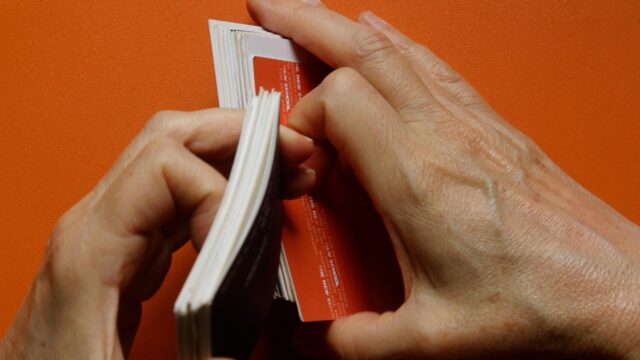
Swapping business cards can offer up many possibilities. It can be transformative, with the giver and recipient becoming friends for life. Or it can be perfunctory, and you end up wondering who the hell that person ever was. And it can be an awful lot in-between.
Lynne Sachs has a collection of 600 such cards. Some of the exchanges she remembers, some she doesn’t. Many of the folk obviously handed over the card with the intention of staying in touch, but life got in the way, and so the card remained the only trace of that initial interaction.
As we see in Every Contact Leaves A Trace, sold by Kino Rebelde, docmakers are a curious breed, and for Sachs the box of cards represented both a mystery and a challenge, and some of those initial exchanges actually spawned relationships with folk that Sachs now wanted to investigate further, and understand with greater clarity.
“These micro situations, I think, become an accumulation of who you are,” she tells BDE. “There’s an expression, you’re sort of judged by the company you keep, but the company you keep may be intentional, or it may be accidental, but it leaves an imprint on who you are, and so that was really interesting to me to go back through my life and to use the cards as a kind of organising structure.” It was therefore the “jumping off point” for her cinematic journey.
The people she profiles are diverse, and tracking them down involved a lot of detective work. We meet German Angela, a festival director in Berlin who Sachs met 30 years ago, and who still wrestles with the very idea of WWII, and how it could ever have been allowed to happen. Angela recalls her mother saying how, one day, the Jewish girls with whom she went to school, simply weren’t there any longer. Sachs, meanwhile had a wonderful time 30 years ago in the city she had been taught to fear by her mother. Sachs saw dissent in Berlin. She saw counter culture.
We also meet a feisty textile artist who refuses to take any direction within the film. “You know, [as documentary makers] we want people to respond to our head-nodding, and then keep doing what we want them to do because we’re imagining how it might end up in the edit,” says Sachs. “And then she just says ‘no way.’ I liked that she is empowered by her own resistance.”
Later Sachs turns to particularly cinematic means in revisiting her subjects. “I can’t forget one woman therapist whose advice once changed my life, so I imagine what it would be like to visit her apartment, create a set and perform with an actor embodying her presence,” she writes in a director statement.
Likewise, a Syrian chef refuses to engage with Sachs’ camera, which “forces me to think about the inherent power imbalance between a director and her subject. To conjure a memory of this woman, I cook one of her tried and true recipes [a maqluba chicken dish] and film my own culinary incompetence in the kitchen.” The pair had no subsequent contact after Sachs filmed a ‘day in the life’ profile of the Syrian woman, many years before. That said, once a year the woman has since sent Lynne a flower emoji.
Sachs’ friend Bradley ups the ante when it comes to the business of identity exchange, transforming artworks into bespoke signifiers of an encounter.
“If you look up ‘business card’ as a term on Wikipedia, it will tell you exactly the size of a conventional business card and that they’re all horizontal,” says Sachs, adding of Bradley, “I really love the idea that truly most people distil themselves within the cards, but then on the other hand, they distil who they want to be and who they are performing as. And he takes that, and kind of discombobulates it, and says, well, you don’t have to even be one person. You can be multiple people depending on where you are.’”
One particularly poignant chapter concerns the artist and filmmaker Lawrence Brose who, in 2014, entered a guilty plea to the charge of possession of child pornography. “I had to look at the obstacle of integrating the story of Brose, who had problems with Homeland Security,” Sachs tells BDE. “I had to reckon with how I wanted to actually share my own fears, my own sense of guilt, for not including him, and my own recognition that we also have many, many people in our lives whom we judge.” Her instinct was “to leave him on the cutting room floor,” she admits in the film.
But on a filmed Zoom call, Brose (who died earlier this year) repeats his assertion that a shared IP network was compromised by a rogue user in the office space where he worked. He compares his subsequent ostracisation within the art world to the fate of Oscar Wilde, about whom Brose made an experimental film in 1997, based on Wilde’s De Profundis letter that he wrote in Reading Gaol.
“I was scared,” admits Sachs to BDE. “I thought this is a film that is both a celebration of meetings, but also an investigation of all the layers of those meanings and meetings. [But] in the end, I was really…happy that Lawrence Brose is in my film.” The artist saw the film before he died and gave it his blessing, Sachs tells BDE.
Throughout Every Contact Leaves A Trace, the director enlists the support of a “Greek chorus” in the form of her teenage niece and nephew, Viva and Felix Torres, who offer both pithy comment and sage advice to their esteemed aunt. “They’re from a generation where I can’t imagine that business cards are even used that much because you can just touch phones and then you swap information, and there you go,” says Sachs.
Would the kids hold onto the cards? “No,” says Felix who imagines their transformation into a papier maché artwork. “Yes,” says Viva, “that’s what basements are for.”
Sachs further describes the generational difference. “I take it [the subject] to a forensics lab, and they [the kids] take it as a fairy-tale. And those are all cultural sources for us to understand more about how we exist in the world,” she says.
Not that she is averse to channelling her inner child when describing the ethos of the doc. For her the process was like the tale of Hansel and Gretel. “You leave the crumbs…and they lead you back somewhere…The whole project was to figure out how we are affected by those intersections of our lives with other people’s.”
“I’m actually doing Q and A’s at five screenings at IDFA, so I’m figuring that by the end of the festival, I’ll understand what I made a bit better,” she adds. “That’s the exciting thing about making a film like this, where you’re not following a singular argument. You’re evolving. The film evolves with the making of it. So I sometimes start a film in the centre, and then have to find the beginning and the end.”
Sachs world-premieres November 17 in IDFA Signed, a section for which two very close friends of hers, Laura Poitras and Jay Rosenblatt, are also selected. Poitras presents Cover-up, co-directed with Mark Obenhaus, while Rosenblatt presents the short film Heartbeat, co-directed with Stephanie Rapp.
“They’re buddies going back more than 30 years. Both of them I met in the mid-eighties. All of us were in San Francisco during the heyday for experimental – particularly experimental documentaries,” Sachs reminisces. “It was an explosive time to be in San Francisco. And I think it left its mark on all of us.” Maybe, even its trace…





