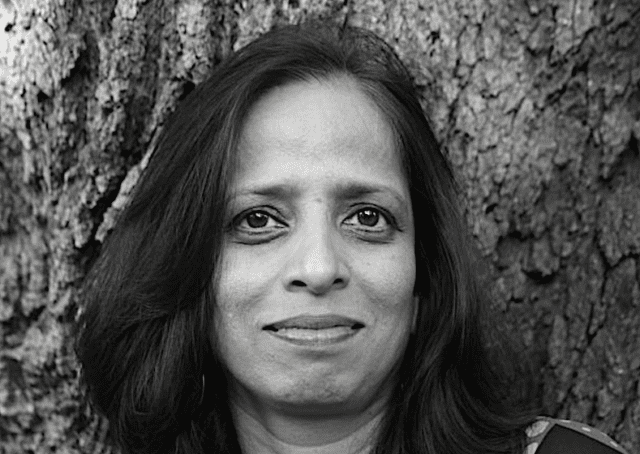
Last week, IDFA hosted a conversation with Indian film director and producer Nishtha Jain, moderated by Pamela Cohn. Jain was also world-premiering her latest doc, The Golden Thread, at IDFA. The picture is set in India and focuses on the mill workers’ fight for a minimum monthly wage (equivalent to 250 USD) and their laborious work, which has hardly changed since the times of the industrial revolution.
After Cohn’s introductory remarks, Jain was asked to retrace the early steps of her career. Over the last decades, Jain has worked in fiction, VR, multimedia production and journalism before embarking on docmaking: “I started off my career as a video editor when there was only one channel in India. There was this thing we called Video Magazine, where we could bring the latest news. […] It was good content, but soon everything ended up looking the same. I handled hundreds of hours of footage.” After one year on the job, stimulated by her frequent visits to cinema, she decided to attend the Film and Television Institute of India to specialise in directing fiction.
Jain was initially inspired by the likes of Chris Marker, Jean-Luc Godard and Jean Rouch. She then spoke of how she approached her first documentary, City of Photos (2004): “I wanted to be independent. Whatever I do, I have to be independent. [At the time] there was no funding for making docs so I took a very hard route. The first film boasts a script entirely based on my research, but dialogues were not written. I could never write them, and I never wanted to do that. So everything is sort of planned, but within the frame I let the people as they are. It’s a different approach to documentary.”
Since then, Jain has experimented and honed her own creative style, firstly by “becoming closer with cinéma-vérité,” and then influenced by her fiction background.
Later on, she realised the importance of tackling themes – for example, caste and gender – without considering them as separate entities. She spoke of looking “at the intersection” and raising awareness of these issues, including that of privilege. She also stressed the importance of the camera, in particular on who is filming and what power they have.
Next, Cohn asked Jain to talk through her work with some of her long-time collaborators, in particular DoP Rakesh Haridas and sound designer Niraj Gera. Jain explained how essential it is for her colleagues to be “her eyes and ears,” and perhaps “even better than hers” as they may notice something or someone that the lens manages to discover. “The film comes alive while capturing those moments. It can’t be handled by someone entirely new.”
Speaking about the making of The Golden Thread, Jain pointed out the necessity of telling a story that doesn’t focus only on the socio-economic hardship experienced by the workers, but also their complexities as human beings: “My stories are complex, they’re not black and white. They lie in the grey. [The story] is about jute. It’s about this factory. It’s about the ecosystem. It’s about factories being made obsolete. It’s about how these factories work and the people [involved].” She also explained how she aimed to pick “certain characters to tell a universal story,” and how she ended up assembling what she defined as an “ensemble cast” made of “full-fledged individuals.”
Towards the end of the panel, Cohn invited Jain to elaborate more on her casting choices, and asked whether these are based on some kind of research. “It’s about my relationship with them, it’s an instinct,” she replied, adding how, when she sees a face, she can usually tell whether that person is able to play themselves in front of the camera.
Finally, she touched upon her upcoming doc Farming the Revolution, which follows the massive year-long protests against the Indian government’s unjust ‘anti-farm’ legislation: “I thought, how am I going to tell the story of this farmer protest over a year with hundreds of thousands of workers? No one farmer would be enough to tell the story of that collective. So, it has to be a symphony of characters. The film has to be like an orchestra. Someone is the violin, someone the viola, and someone else the flute…”