Director Joke Olthaar and DoP Andre Schreuders talk about their precipitous alpine documentary Berg, shot at 2500 metres in Slovenia’s Triglav Natural Park, and selected for the 50th International Film Fest Rotterdam.
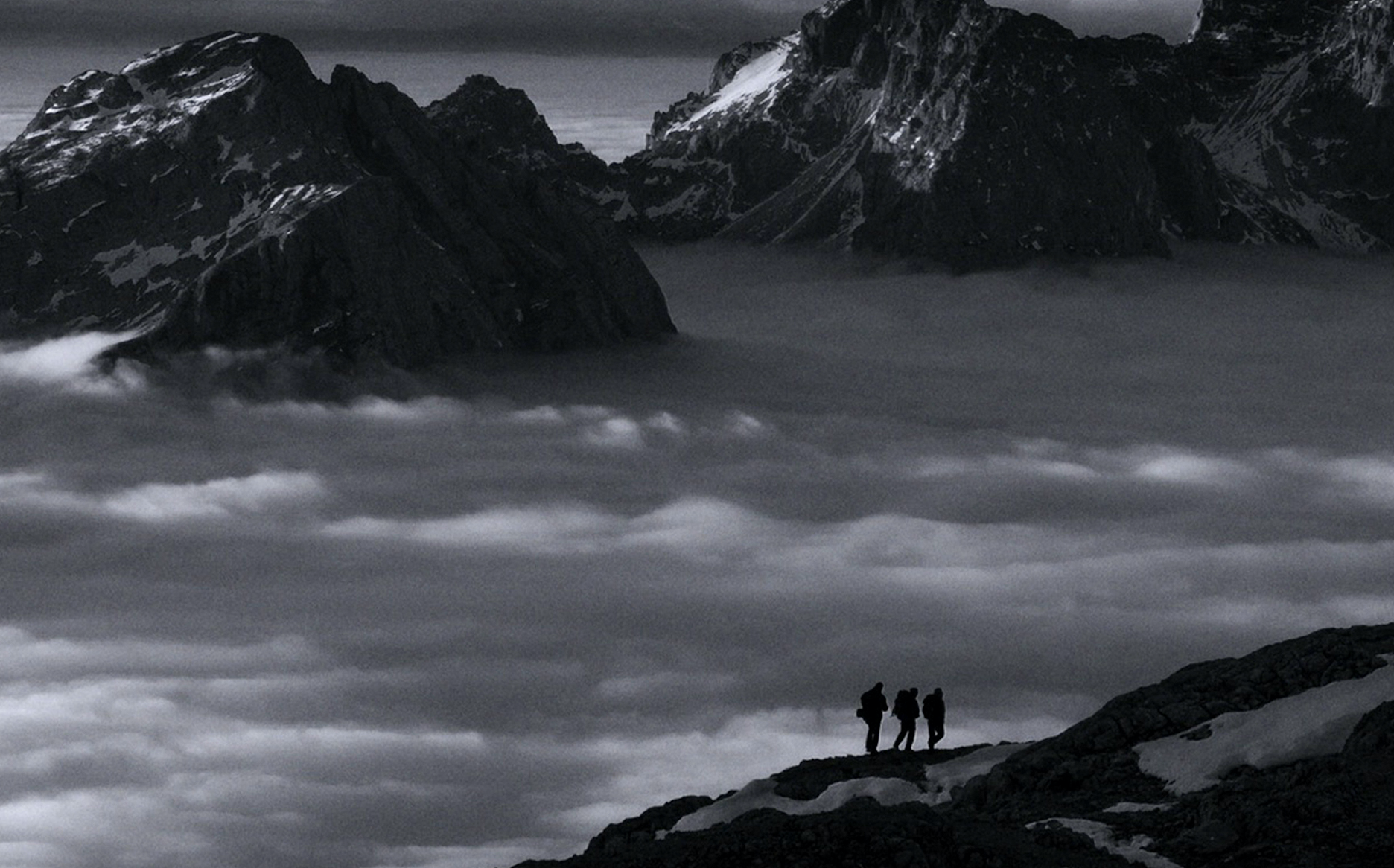
Joke Olthaar’s debut feature, set within the mountains of Slovenia is about as cinematic as it gets, a film made on the grandest of scales, more or less devoid of narration but immersed nevertheless within a deliciously mesmeric soundscape.
Given how much of what we see is so physically imposing, such as enormous slabs of mountain or vast clouds spilling over ridges, the film is almost devoid of people too, until you look very closely and see tiny moving specks, most of the time in clusters of three, traversing the frame.
It is a work of reflection both on beauty and on death, which is, says director Olthaar, always a “mis-step” away. “You see how everything around you is amazing, and it overwhelms you in your feelings, but you always feel the pain, you always feel that death is near you at your back.”
Yet even within this paradox there is beauty, points out the film’s DoP Andre Schreuders. “It’s heavy, but it’s also very beautiful that you have to be with your step [to be so careful] all the time. It keeps you very much in the here and now. It’s impossible not to be in the here and now.”
Olthaar is a keen mountaineer for whom, together with her sisters, such adventures have become a “tradition.” Schreuders, on the other hand, is more of a hiker, not quite so adventurous as his director, he admits.
The pair had to carry their equipment themselves, including the camera and lenses and they slept in bivouacs, which Olthaar described as “totally primitive,” albeit functional and sufficient.
This didn’t mean however that Schreuders wasn’t called upon to shoot some vertiginous material. “Very often the camera is on a tripod, but we did have discussions at some points. As I was filming I was looking down the lens. Because it was a wide lens, it [the drop] seemed very deep. So I felt really shaky on my feet. And then Joke would say ‘you must go a little bit more to the edge…”
The soundscape, sometimes produced electronically, at other times derived from nature, imposes itself wonderfully both on the film’s visuals and the consciousness of the viewer. The effect can be at times blissful (such as bird song), or at other times ominous (cracking ice), or even jarring, such as the deafening sound of a clearwater stream as the film cuts away from alpine contemplation.
But all the time as we watch we are reminded of our mortality, in the shroud-like clouds or the crows that congregate along the ascent. At one point we see a memorial plaque to the fallen climbers.
The constant nearness of death is further underlined by archive used within the film and offered to Olthaar by one of the mountain people she met when conducting research. The 8mm footage shows the loving retrieval and careful transportation of bodies from the mountain, sometimes down sheer cliffs on the back of a rescuer.
“Even there, there is a lot of beauty because of the care they take with these dead bodies, it is so loving to watch,” says Schreuders, before reminding Olthaar of how she first described the scene to him. “There is an expression that you and also others have used, that you are so near to God on the mountain. And in a way, these bodies are also very near to God. It’s more than a simple metaphor.”
This article was originally written for See NL, published by Eye International and the Netherlands Film Fund