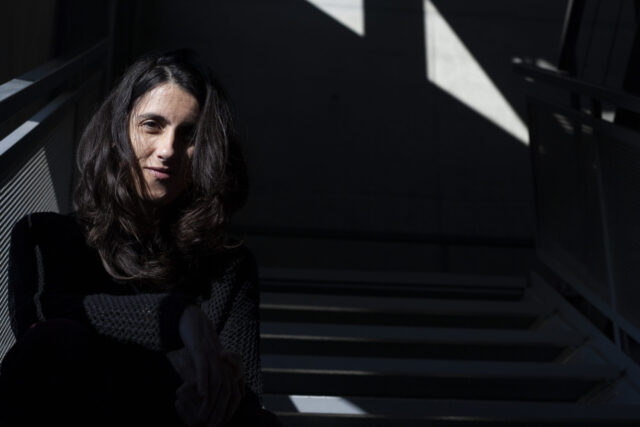
What is the point of documentary? What is the point of doc festivals? And given the plethora of rescheduled events competing for both industry and public attention, what is the point of Sheffield? To answer these questions Doc Fest director Cíntia Gil goes back to first principles with Business Doc Europe.
With 78 features and 88 shorts in its film programme, 55 of which are world premieres, Sheffield Doc Fest seems to be in the rudest of health (which, for those not familiar with the phrase, is a good thing). What’s more, 35 artists and creative collectives are represented in the festival’s eclectic Arts Programme.
On the professional side, 55 projects from 31 countries are selected for Meetmarket, all of which will be pitched to, and mulled over by, top execs from many of the world’s leading broadcasters, festivals, funders, distributors, agents and production houses. Running in parallel, the Arts Talent Market will offer up 22 non-fiction projects from over 20 different production/co-production countries for consideration by the likes of the Tate, MoMA, ARTE, HTC Vive, SXSW, IFFR, MUTEK, and Venice Film Festival.
It comes as no surprise therefore that Doc Fest director Cíntia Gil is proud of her 2021 programme, and very much looking forward to welcoming the great British public back to her hybrid Sheffield doc extravaganza.
Nevertheless the festival comes after, maybe even during, a long period of reflection, in which Covid has forced us all to assess and re-assess everything that has impacted our personal and professional lives. In the case of Doc Fest, a national documentary event that seeks to inform, entertain and inspire in equal measure, this type of existential reframing (or reaffirmation) seems, at least from Gil’s perspective, equally appropriate, going back to basics in order to define its purpose, its offer, its very raison d’etre.
In the same spirit, Gil underlines the singular importance of documentary itself. “This is a time when everything has had to be remeasured and re-considered,” she tells BDE of a form she describes as “half-personal, half-collective and political,” one that maintains “a critical relationship with reality.”
But documentary, like its fictional cousin, is “a collective art, not just in its making, but also in its experience…a desire for a collective experience and collective reflection,” she adds.
“You learn, you experience, you empathise with something that is sometimes quite far away from you [in terms of subject], and sometimes it’s so close to you that you don’t even notice. But this capacity to make you think and empathize and transmit experience is amazing. I think this is [most prominent] at times when we are dealing with fake news and with post-truth. I think the question of experience comes before truth. That’s the principle of documentary, it’s really about transmitting experience.”
Gil refers to the sense of “beautiful reflection” that has pervaded documentary and docmakers over the past 15 or so months. “I’ve seen so many filmmakers telling me, ‘I had this project for a long time and finally I had the time to finish it because I had the time to think about it.’ It was a kind of a weird limbo period where we had to deal with ghosts from the past and fears from the future, which kind of allowed a lot of filmmakers to dig into projects and to [discover] a thread of intimacy. The relationship between the intimate and the political in documentary is something very important in the history of documentary.”
As importantly (or as “fundamentally,” as she puts it) Gil assesses the doc festival sector to see to what extent it can evolve in line with societal change, or even serve as a barometer of that change. “We need to ask about scale, about what is [the value of] a slot in a film festival, what is the visibility that is necessary for a film and how best we defend the film? I think this [the pandemic] gave a little bit of distance on what we were doing, and we have an opportunity to actually reflect on it.”
“We in the rich Western countries are finally opening our eyes and ears, very slowly,” Gil further explains of the emergence into the mainstream of “new voices from new places,” not young first-timers, rather experienced purveyors of the doc arts whose work has hitherto been overlooked.
She points to the Brazilian doc Nũhũ Yãg Mũ Yõg Hãm: This Land Is Our Land! in Sheffield’s International Competition. “You have a collective film produced within an indigenous community, an incredible film and deeply political, that responds to the traditions of documentary in a really interesting way. And it’s fascinating because these people have been doing films for decades already, but no one ever talked about them.”
Likewise, she highlights two films from the indigenous Australian Karrabing Film Collective, Windjarrameru, The Stealing C*nt$ and Wutharr, Saltwater Dreams. “They have been reclaiming their rights to tell their own stories and talking about colonization and racial injustice and oppression. And they have been doing work for a long while. We just haven’t seen them. We need to open our eyes and look beyond what we see, what we are used to seeing.”
Closer to home, Gil is both amazed and dismayed that Black British docmakers have been generally overlooked within domestic festival programmes and across distribution outlets. “I mean, I’m not British…but from a foreign perspective, it’s insane, the amount of richness and variety of this film culture, this Black film culture in the UK is so huge.”
“I think the problem is not that these voices are singing a different song,” she adds. “But I think the problem is that we were just not listening before to that song. So I think it’s a super exciting moment because finally, organizations are needing to look at themselves in the mirror and ask what have they been doing as gatekeepers.”
So what’s it about Sheffield then? I ask Cíntia. What makes the whole Sheffield experience so enticing, so worthwhile?
“I’m very basic, Nick. I like basic questions and I like basic answers,” she responds. “I think the only goal that we may have in life as human beings is to be better and do better. Better as citizens, as colleagues, as family members, as lovers, whatever it is that we want to be. Be better and do better, do better our own things and contribute better to the life and the world we live in.”
“We [at the festival] have the opportunity to make what is very distant, make it very close,” she continues. “Sheffield is a complex community. I mean, we are going through discussions about the union [the United Kingdom]. We don’t even know if the UK will continue to be what it is in the future. Yes, Doc Fest is an international festival that shows films from so many countries, but at the same time it is a festival that addresses and that cares for the filmmakers from the country [UK], and looks at its history.”
“It’s a place where you can put things in proportion. You know you can look at at the world. You can have a map or a diagram where the UK is no longer at the centre, but it’s still your affectionate place. It’s still the place where you have your heart and your feet and your roots, but it’s also a place to depart for something else, which is to look at the whole world and find some sort of dialogue in which everyone can participate. From a public perspective, the festival is a real exercise of citizenship, in the old sense of the word,” she ends.