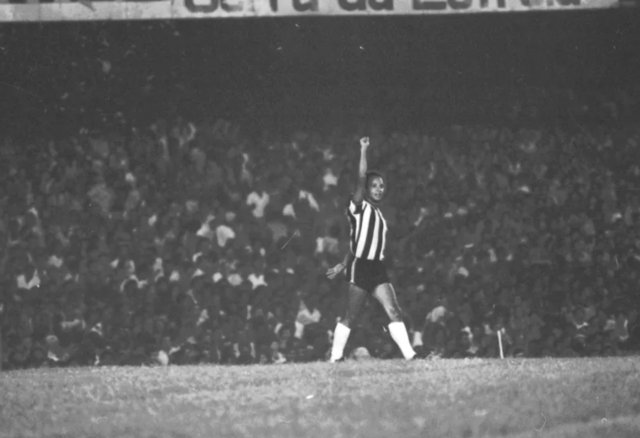
Foto: Reprodução
Sérgio Borges and Helvécio Marins Jr. aren’t just respected filmmakers whose work has been shown widely on the international festival circuit. They are also passionate fans of Clube Atlético Mineiro, the Brazilian football team nicknamed Galo. Now, they’ve made a film about their beloved club, Lutar, Lutar, Lutar (which has been screening this week in the Harbour section of International Film festival Rotterdam).
The two directors had originally been planning a documentary about the experiences of teenage football players who come from all over Brazil to Belo Horizonte (where Galo are based) with the dream of making it as professional footballers.
“That was really hard to finance. Then [in 2013] the team won the Libertadores [the Latin American equivalent of the UEFA Champions League],” Marins Jr. remembers. The club’s President called them and asked if they would make a film about the history of Atlético Mineiro, from when it was founded in 1908 right up until the present day, instead. As supporters of the team, they could hardly turn the commission down.
“It’s a very popular team. It’s a team that unites poor people, black people, white people, rich people,” Marins Jr. explains the appeal of the club he adores. He grew up close to the team’s home ground which, incidentally, is where Brazil’s national team suffered one of the most shameful defeats, losing 7-1 against Germany in the 2014 World Cup.
Borges and Marins Jr. met long ago when they started to study cinema. They quickly discovered their shared love of the football club. Directing the documentary proved remarkably straightforward. They generally did everything together, starting production not long after the 2013 Copa Libertadores triumph.
In 2014, the team also won the Copa do Brasil. It was such a seismic event for Marins that, at least briefly, he lost his professional composure. “I couldn’t hold a camera. I was too nervous.” On this occasion, Borges, better at keeping his emotions under wraps, did most of the legwork.
Under the funding arrangements, the two directors are obliged to premiere the documentary in cinemas. The Covid pandemic has stopped that happening for now. “This film makes more sense doing a big party with the team,” says Marins Jr.
The team is expected to move into a new stadium at the end of next year. One idea being kicked around is for the film to be tied in with the construction or opening of this stadium. In the meantime Lutar, Lutar, Lutar is being shown in the festival circuit.
Ask Marins Jr about the famous match in which Galo won the Copa Libertadores and he describes it as if he still can’t quite believe it happened. The team had to rely on their goalkeeper Victor saving a penalty in added time to get to the final and on further heroics from the man between the posts to secure the trophy.
“We were many times the best team, but we never win,” he says of the countless occasions in which injuries, bad luck or bad refereeing would scupper the team’s dreams of glory. It was as if they were under a curse. However, in 2013, in the quarter finals, the team’s fortunes finally turned, largely thanks to goalie Victor’s “miracle.” They had played badly but, for once, it hadn’t mattered.
May 3rd is still celebrated and called, only partly tongue in cheek, “St Victor’s Day.”
For some reason, the club’s greatest players aren’t always given the credit they deserve. Prime among them is Reinaldo, a brilliant and prolific striker whose career would surely have matched that of Pele had it not been for his constant knee injuries. His contemporaries, from Ronaldo to Zico, also agreed he was the best played they had ever come up against.
The filmmakers never expected their documentary to be selected for festivals. It was made as a labour of love. Nonetheless, when they started showing it to friends, even some who weren’t much interested in football, the response was always very enthusiastic. One former festival director told them that she didn’t like the game at all but that she had fallen in love with the film anyway. “It’s more than football. It’s life,” she concluded. Berlinale director Carl Chatrian was equally enthusiastic, as was the football-loving Brazilian Oscar nominated auteur, Walter Salles.
Marins Jr is currently based in Portugal. That’s largely because he wanted to get out of Brazil while President Bolsonaro was in power. For now, at least, he is having to follow Galo from a distance and will be watching their next matches in this year’s Copa Libertadores on Portugal’s Channel 11.
“I decided to come and stay here at least until the situation in Brazil gets better,” he says of his temporary exile. “He (Bolsonaro) is against all kind of culture…He knows all the artists are against him and so he takes them as enemies. It is the mentality of a child.”