When she was around 18-years-old, Canadian filmmaker Melanie Shatzky befriended a group of street kids and used to invite them to her parents’ house when the parents were out of town so they could have showers and she could feed them.
“Since then, I have always had a tremendous soft spot for people living on the streets,” she says. Now, she and her filmmaking partner Brian M. Cassidy have directed a new movie, A Man Imagined, about a 67-year-old homeless man with schizophrenia.
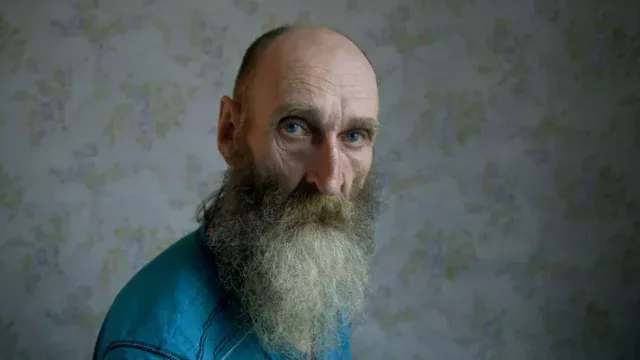
Audiences are likely to be surprised by the film (which has been screening this week at IFFR, with a final screening on February 2). Lloyd, its subject, is a sympathetic and compelling figure with a rugged, very photogenic face.
Shatzky and Cassidy planned to have several protagonists. They spent around a year volunteering at a homeless shelter, getting to know the residents. The project was originally intended as “a panoramic view of people living on the streets.”
“At about the year mark, we met Lloyd and said, ‘oh no, this is the subject of our film.’ We need to make a film about him! He stood out as different to the rest. He had a certain aura,” Shatzky says.
Lloyd approached the two filmmakers. He was intrigued by their camera and keen to participate. They were struck in particular by his “timeless” quality, his “beautiful penetrating blue eyes” as Cassidy puts it, and his “biblical” beard. They felt he could have “walked out of an old daguerreotype or a Russian novel.”
Shatzky and Cassidy were inspired and fascinated by the man. He was a damaged soul who had suffered heavy trauma in his youth but he also gentle and reflective.
“When you spend a lot of time in these shelters, there is a lot of drug addiction and people tell a lot of tall tales. [But] Lloyd was a straight shooter. He wasn’t trying to press us at any turn. He was just was who he was – and we found that just very captivating,” Shatzky says.
“In spite of his very chaotic lifestyle, weaving in and out of traffic, sleeping rough on the streets, he has a certain paradoxical precision about him. He is a very controlled person with his own body and with his own immediate circumstances,” Cassidy adds.
A Man Imagined offers an honest chronicle of Lloyd’s life but it isn’t straight documentary.
“This is really central to our practice,” Cassidy says. “Our documentaries are never journalistic. They are always more impressionistic. They borrow a lot from the language of fiction.”
The film was made as a collaboration between the directors and their subject. Certain scenes were “constructed” but they were always rooted in Lloyd’s experiences. He shared details about his childhood with the directors: how he had grown up in the countryside and his love of nature.
Lloyd has been living in a rooming house for a year and a half and can’t always remember his roommate’s name. However, when he looks back in time, everything falls into place.
“His mind is very much still in the countryside. He recalls that period of his life very vividly. He remembers all the names, all the details. If you ask him to repeat all the stories, they are identical and there are no gaps.”
The film includes sequences of Lloyd on the streets, trying to sell bric-a-brac he has found in skips to passing motorists. “At one point, there was a police officer he interacted with. I thought, ‘oh no, the police officer is going to give us a hard time’ but actually the police officer was delighted. He was thanking us for what we were doing,” Shatzky recalls.
The film was backed by the National Film Board of Canada (who are also handling sales). The filmmakers remember how, when the NFB agreed to come on board, they suddenly faced an unexpected hitch. Lloyd had gone off grid and it took them “an entire month” to track him down again.
“We approached them with the project. The way it works is that they do things in stages. First you have to make a demo,” Shatzky remembers. “We had to spend a good time trying to find him. He has no cell phone. He is not trackable.”
“He is a lone wolf. It is no small task trying to find him in the city,” Cassidy adds.
It turned out he was in the area of Montreal where US filmmaker Ari Aster was shooting his new feature, Beau Is Afraid. Once they managed to locate him, they made sure to keep him close.
“We filmed with him throughout the pandemic. It took just over two and a half years. It was a relationship that we got into with this man. He was proud of his contribution [to the film]. It gave him a sense of worth. He is so used to people ignoring him or crossing the street on seeing him. The fact that we were leaning in and getting to know him really resonated with him,” Shatzky says.
The filmmakers would pick up Lloyd from the rooming house and he would say to the staff there, “Goodbye. I am going to work.”
They still see him regularly and take him out to lunch. They’ve showed him the film on their iPhones. “He loved it. In particular, he loved the close-ups of his eyes,” Cassidy says.
Shatzky’s sister had died in February 2020, just as they were beginning to work on the project. Her grief gave the film an extra resonance. “Lloyd was the last person we saw before my sister died…and the first person I saw after my sister’s death. Lloyd became a sort of guide for us during a very uncertain and traumatic time. We were dealing with the grief of losing my sister unexpectedly plus the pandemic. It was so interesting with Lloyd, not that he was a shoulder to cry on or anything like that. But the pandemic meant nothing to him…he was [already] so used to navigating circumstances. Just following him and his lead was so inspiring for us.”
Lloyd was the only person the filmmakers saw regularly during the pandemic. He wasn’t vaccinated but they felt completely comfortable in his presence.
Alongside the footage of Lloyd during his wanderings, there are some interview sequences. This is unusual in the directors’ work but they intuitively felt it would help the film to have conversations with him on camera. “We didn’t have prepared questions beforehand,” Cassidy days of these moments. “We just rolled for a few hours and had long chats.”
Lloyd never uses the term “homeless.” He prefers rot describe himself as “living on the streets.” He is active, resourceful and refuses to cast himself as a victim.
“He is a very poetic person, an artist at heart, the way he is always collecting things and trying to beautify himself,” Shatzky observes. The filmmakers deliberately show him n beautiful countryside to counter the usual clichéd representations of the urban homeless.
Once the film has completed its international festival run and theatrical release, it will be available on the NFB’s streaming platform.