Thomas Imbach’s IDFA competition selection Nemesis is a follow up of sorts to his Day Is Done, which premiered at 2011 Berlinale (and which was filmed over a period of 15 years from his Zurich studio). Nemesis was shot from the same apartment window. He opens up to Business Doc Europe.
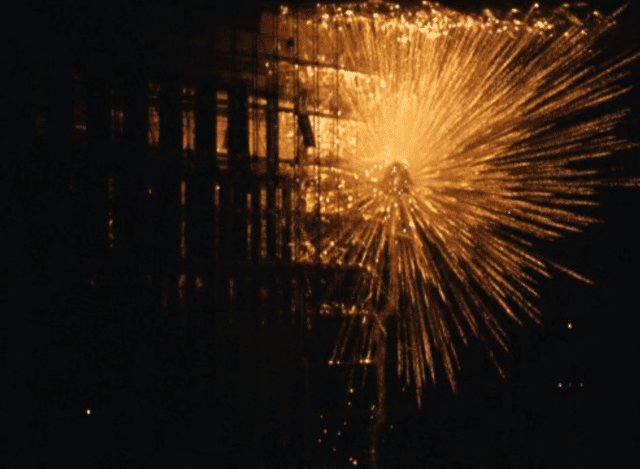
Exquisitely filmed on 35mm, Nemesis chronicles what is happening outside on the streets below his studio apartment. This time, the primary focus is the train station opposite which is in the process of being demolished to make way for a new prison and police centre.
“I was very familiar with what was happening in front of my window. I had a special kind of relationship with this monument,” the director says of the film, which screened at Visions du Réel 2020.
Planning on the new prison/police centre started way back in 2000 and is not expected to be completed fully for another two or more years. Initially, there was considerable opposition to the building plans. “I could not tell that in detail because it was too complicated and not of interest to people outside Zurich.”
The moment the builders started to demolish the station, Imbach began to film. “It was then that I felt obliged to install my camera and to witness the destruction process.”
Making the documentary was a painstaking process. Imbach didn’t just shoot indiscriminately. He talks of the “sixth sense” he had developed when shooting Day Is Done for knowing when it was worthwhile to film. His approach wasn’t journalistic.
“For me, it is like painting,” Imbach says of how he composed his images. “I am only interested in what looks strong for me.” The director paid as much attention to the sound design as he did to the visuals. “That (the sound) makes the images flourish even more. You see them better. When we are looking a film, sound is very much guiding us.”
There was no pre-set shooting programme. “I could not plan it. Whenever I started to wait for something, it did not happen. It always happens when you’re not waiting for it – and then you have to be really quick,” he says of the rush to capture the key moments unfolding from his window.
The director had a special interest in shooting how the industrial 19th Century station rooves collapsed. “They looked like waves in the sea in front of my window, they were like the architectural DNA of this building.”
Occasionally, Imbach would try to follow individual workers but this was a struggle given the huge amount of activity on the site. However, there are a few main characters that audiences will recognise, among them the foreman on the site.
“I’d process my rushes every three or four months. Filming on 35mm helped me to be selective…I filmed a lot, but on 35mm, you can’t just film like with your video camera.”
It was way back in November 1989, on the day the Berlin Wall fell, that Imbach first moved into the flat. He stayed, he says, “mainly because of the view. I fell in love with the view. It gave me a not very Swiss-like panorama. It is a very different view of Zurich from the postcards.”
Imbach’s approach may be observational but the film has an obvious political sub-text. “I think it has become a very political film although I did not plan to make a political statement,” the director reflects. He didn’t go into detail about the horse trading between local government officials and politicians going on behind the scenes. “But the fact I realised while the old station was being torn down that there would be a prison and police centre and my new neighbours will be prisoners and people waiting for their deportation…Their testimonies opened up a whole new world to me and it became a film with an even more political scale.”
Nemesis premiered at the online version of Visions Du Reel. While he fully supported the idea of showing the film online, he doesn’t feel as if he has had a proper audience premiere, something which IDFA will address during its international premiere on November 22.
“I did Nemesis as a painter and I want to see it on the screen. I am kind of old-fashioned in this,” Imbach continues. “Although it is not a film for the masses, it is still a film for the big screen.”
This article was previously published in Business Doc Europe during online Cannes 2020. It is updated for IDFA 2020.