

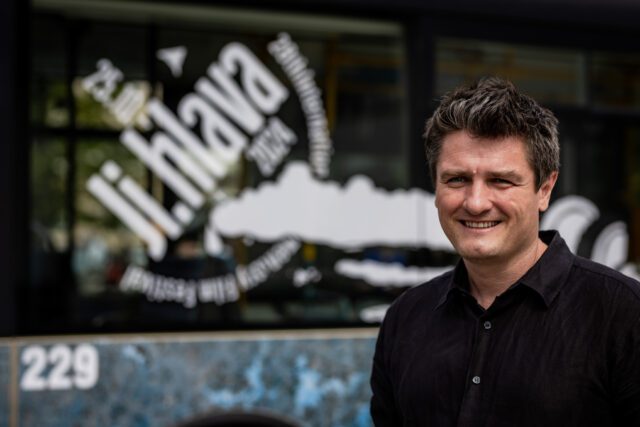
Marek Hovorka has no qualms about his festival, arguably the most important doc event in the CEE, situated nearly two hours drive from the Czech capital of Prague. “People are meeting in Jihlava because it’s not the capital. It’s like a documentary Woodstock for them. They really are focused on films and talks and meetings inspired by cinema – and by the festival itself,” he tells Business Doc Europe on the eve of Ji.hlava 2024.
“Something special happens because when you are there,” Hovorka adds of the experience. “You are in a different mode. You lose your daily routines.”
The 28th Ji.hlava IDFF, extended to 10 days in 2024, kicks off October 25 with the world premiere of Ms. President by Slovak director Marek Šulík, which chronicles Zuzana Čaputová’s five years as the Slovak Head of State.
“At a time when a woman may become the next US president, the film takes on yet another dimension, showing that Slovak society is perhaps even more divided than the American one,” said Hovorka when the film was announced as festival opener. “Ms. President is a universal testimony to the contemporary world. And it shows us up close what women face when they are in key positions in a system still dominated primarily by men. But despite everything, the film is above all an encouragement, namely to our own integrity and belief in values.”
This year the Czech docfest will screen 340 films across Competition and non-competition sections, of which 129 are world premieres, 23 are international premiere and 11 are European premieres.
Ji.hlava IDFF plays out again during the insanely busy Autumn festival season, running simultaneously with DOK Leipzig and Doclisboa and a number of smaller doc-related fests.
What differentiates this festival from other events, Hovorka observes, is that it represents the “marginalised” CEE region, at least when assessed in doc terms. Every year the festival publishes the East West Index that indicates the long-term underrepresentation of Eastern European films at Western European documentary fests.
“For me, film is a part of art, and art is a tool to understand our society, our lives, our time. And if we somehow erase half of Europe and their reflections on our contemporary times, that means that we are losing something,” he stresses. “And that’s important. We don’t want to erase anybody. We want to connect different perspectives and approaches and the way we think and reflect on artistic language, visual language, cinematic styles and generations.”
“For us it’s important to think about Europe in east, west, north and south perspectives and also connect European cinema to filmmakers from other parts of the world because, in the end, it’s one world and one language,” Hovorka adds.
So, yes, there is a redressing of the balance within the Ji.hlava programme that has strong representation from CEE, but there are still global voices to be heard. Of the 13 films in Opus Bonum International Competition, for example, eight are from non-CEE countries as far afield as Argentina, France, UK, Spain/Mexico and Canada.
Hovorka also places strong emphasis on what he calls the “competition for new voices in cinema,” the First Lights section, re-introduced in 2024. Highlights include Czech Marie Dvořáková’s highly anticipated World Between Us, about renowned fashion photographer Marie Tomanová who travelled from Mikulov to the USA as an au pair, and today shoots campaigns for fashion brands such as Nike, Instagram, or fashion magazines such as Vogue. Also, in the First Lights section is Slovak Daniela Meressa Rusnoková’s Grey Zone, about the 24th week of pregnancy when the foetus is still not perceived to be a full human being, but during which some babies can be born pre-term.
Other festival sections include the Czech Joy celebration of the best local docs, as well as Testimonies which is ”dedicated to powerful documentary films which deal with important social, economic, environmental, and political phenomena.” Both are Competition sections, as are the experimental Fascinations and VR programmes.
Special guests this year include director Tsai Ming-liang, who will be granted a special tribute; director Kirsten Johnson, who will give a key note and is author of this year’s Ji.hlava festival trailer; and the powerhouse trio of directors Roberto Minervini, Albert Serra and Andrei Ujică. The festival will also present a retrospective of the work of Czech docmakers Vít Klusák and Filip Remunda. The latter presents his new doc All is Happiness in Opus Bonus Competition.
“For us it’s important to connect established filmmakers, thinkers of today who are really pushing forward how cinema and documentary film will look like in the future, and those who are newcomers, those who are making their first films, and create a vibrant dialogue, because this is what the art space should be like,” says Hovorka of his special guests. “It’s really a place where we should not have limits and special zones, but a good vibe of dedication. When I’m meeting these [special guests], I see that what’s most inspiring is their dedication to film and they really are so much dedicated and thinking about reality through films, through images on a daily basis. I think this is something that is so inspiring for all the visitors attending the festival, not only filmmakers.”
Hovorka reserves special mention for Swiss filmmaker Anne-Marie Miéville whose work will be featured in a Ji.hlava retrospective. Miéville was a close collaborator of the late Jean-Luc Godard.
“Fortunately, we now live in an age that restores equality to women artists in the reflection on their work, and replaces ‘inspiration by the masters’ with ‘artistic dialogue between equal partners,’” he says. “Běla Kolářová is no longer ‘just the wife’ of Jiří Kolář and Lee Krasner is more than just the life partner of Jackson Pollock. In this context, we have chosen to focus on the film work of Miéville, whose retrospective is a revelatory one and presented for the first time in a wider international context.”
Ji.hlava IDFF will present a packed Industry programme in 2024, overseen by section head Jarmila Outratová. Core to proceedings is the New Visions Forum for 15 new European doc and experimental projects, eight from the US and seven from East and South East Asia .
The Emerging Producers Programme for promotional and educational training will again present 18 talented European documentary film producers. The programme will conclude at Berlinale 2025.
Ji.hlava Academy is an educational, networking and creative platform open to emerging filmmakers, film students and aspiring film professionals in non-fiction contemporary cinema, while Festival Identity is Ji.hlava’s platform for representatives of film festivals that aims at strengthening collaboration among film festivals, encouraging know-how exchange, and building the film festivals’ community. Meanwhile the Visegrad Accelerator looks to secure stronger professional ties between docmakers from the Czech Republic, Slovakia, Hungary and Poland.
Hovorka stresses the quality of Ji.hlava’s Industry offer, even as other important professional events are happening simultaneously elsewhere. “The DOK Leipzig market is a great place for finding German-speaking co-production partners, TVs and other professionals from Germany, Austria or Switzerland. And if you want to keep track on new faces, new voices and new approaches, then New Visions Forum is the spot where professionals should be – and I am happy that it’s manageable to attend both.”
“Last year we could see that the professionals who attended Ji.hlava’s pitches and Market, they were the new blood of the film industry,” Hovorka adds. “They were maybe not CEOs, but they will be speaking in the future from these main positions. Their perspectives and their reflections were inspiring and supportive for the filmmakers and for us.”
The Ji.hlava director muses to BDE on the current situation of the doc sector and how his festival intends to reflect the need for film and documentary to remain a dominant voice across audiovisual culture.
“Maybe you heard Harmony Korine say in Venice that film is not the dominant art form anymore. I think this is a good provocation and is something that came to my mind several times in past years,” Hovorka says. “I think that we are going through a redefinition of what documentary film will look like because there’s the new impact of streamer production and the social networks, which are completely changing the way how people think about documentary films, documentary series, documentary content in general.”
“I think this is something THAT will also be part of Kirsten Johnson’s masterclass because she’s really thinking how cinema has changed from celluloid beginnings to this digital overwhelming, this digital storm we are going through. But thanks to this new digital layer we are becoming authors or co-creators, not just a passive audience as it used to be in the celluloid past.”
“Definitely there is something which is happening now, and we need to be proactive in formulating the future of documentary cinema. One of the effects of the pandemic, along with the further development of AI, is the digitisation of everything – from social networks to the distribution of films and many, many other things. And this has a huge impact on documentary. I believe it is our responsibility to lead in discussions as to how documentary films, art films, and independent films in general should look in the future, what their position will be, and how to remain a strong voice within art and for society.”





