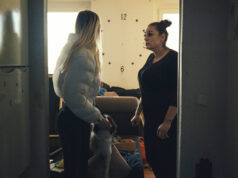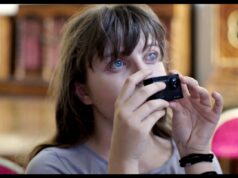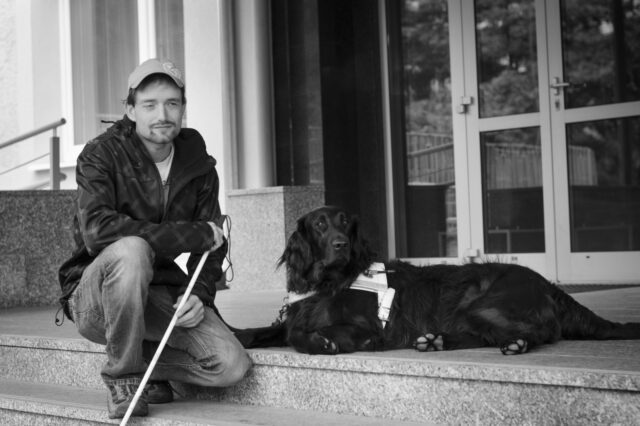
In her new film Those Who Dance In The Dark which screened in Ji.hlava’s Czech Joy Competition (as well as winning the Best Documentary Feature at the Warsaw Festival), Czech filmmaker Jana Ševčíková looks at the lives of young blind people. As the director acknowledges to BDE, however, her first idea was to make the film about their guide dogs.
“When I was walking down the street and met a person with a white cane in the crosswalk, there were many times when I didn’t know how to approach him or her, spontaneously wanting to help and actually feeling a little ashamed that I didn’t know how to do it,” the director remembers. “I was intrigued by the guide dogs, who moved as if they were part of the person. Quiet buddies who know what to do – and do it. Originally, I thought guide dogs would be the main theme of this film.”
Ševčíková searched out an expert, Lenka Pláteníková, who provides services to the visually impaired with guide dogs. The director started to talk to Pláteníková about guide dogs, but during the conversation realised it would actually make far more sense to concentrate on the blind people rather than their canine companions.
“And so we moved on to the topic of blind youth. I asked if she knew any interesting characters. Without hesitation, she said Ondra Zmeškal.”
Ševčíková discovered that Ondra lost his eyesight at the age of twenty. “I already knew he was my first character in the movie.” He revealed his plans to compete in the Great Wall of China Marathon the very next month. There wasn’t funding for the entire crew to follow him but cameraman Jaromir Kačer headed out to China to shoot the event.
Another of the doc’s main protagonists is intrepid world traveller, Zuzana. Ševčíková was keen to accompany her on one of her trips. She thought the young blind woman might go to somewhere nearby like Slovakia. Instead, Zuzana headed off to the Middle East – and the filmmakers followed.
Pavel was an experienced sheep farmer and “motorcycle nut” who also sewed saddles for horses. “We had a hard time believing he could only see five percent,” the director says of Pavel.
Another of the subjects, Pavla, hasn’t seen since birth. She had had a tough childhood being sent from one boarding school to another. However, as soon as Ševčíkova heard her play the piano, she was determined to include her in the documentary.
Lukáš and Cilka were a couple who also featured – but they separated. “People break up, whether they’re blind or not,” the director notes.
Ševčíková spent many hours with all of her subjects before shooting began – and the documentary took five years to complete. “The essence of all the films I’ve made is a relationship based on friendship,” she says. “They become part of my being and I try to offer a piece of myself. But I could never fully understand the different shades of blindness. It’s incommunicable. One of the characters in the film asks a similar question. “Tell me, what is it like to see?””
Those Who Dance In The Dark was shot in black and white. The director wanted “to show blindness with an image that allows you to delve into the inner world of these six characters. The black and white camera is focused on light and shadow, composition and dynamic movement with orientation in space.”
She was determined to make a film “without a hint of pity or sentimentality.” And she refused to take any shortcuts. It’s all about perception. For me, documentary filmmaking is a matter of authenticity; you film what is real, real people who will or won’t let you in, and from that you create intimate moments. It takes time and it’s tedious…”
It helped, though, that she so admired her subjects. “I found their energy and spontaneity captivating. Their sarcasm disarmed me,” Ševčíková reflects on how invigorating it was to spend time with young blind protagonists.
The documentary will be released in the Czech Republic by the Aerofilms distribution group on November 24. Its director, meanwhile, is casting around for a new subject. “Finding a meaningful theme for a film is a matter of time and patience. I’ve never made a subject that didn’t touch me body and soul. For now, I’m searching…”