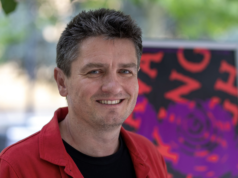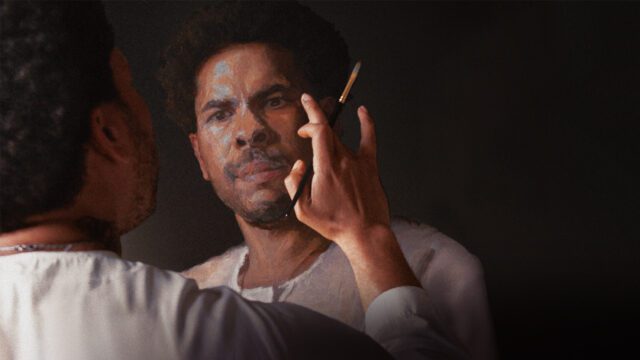
Submitted for consideration in the Academy Awards Feature Doc category, Master of Light tells the incredible and vital story of George Anthony Morton who, having spent eleven years in federal prison for dealing drugs, now paints like a latter-day Rembrandt after honing his artistic skills while incarcerated. Director Rosa Ruth Boesten and producers Ilja Roomans and Anousha Nzume discuss their feature doc.
Early on in Rosa Ruth Boesten’s Master of Light, George Anthony Morton tells how his first memory as a small kid was catching his mother smoking dope. George grew up in Kansas City, the first-born son of a woman who was then a mere 15 years old, within an environment that seemed hopeless from the start. If he dealt drugs, that was because everybodywas dealing drugs. It was normal. And the police had no authority in telling him to do otherwise, he thought, until he was banged up for what seemed a relatively minor (and non-violent) offence for all of ten years. Like a third of the male Black population of the US, he was now doing time in a state penitentiary.
But George had a skill like few others. He was a mesmerizingly talented painter who could, more so than just about anybody else on the planet, capture the emotional and psychological essence of a subject in paint, charcoals or pencil, all the time manipulating light to create depth and subtlety, and reach a level of divine artistry.
After he came out of jail in 2013, in his thirties, he knew that his talent was unmatched, and was confident that all he needed was a wall to place one of his paintings on, and that something great could happen. And so it happened that after he got a job in a gym in Atlanta, he painted the owner and hung the work on the wall. The painting was spotted by a board member of New York’s Florence Academy and within six months, George was studying within the walls of the esteemed institution.
But years later, as George assesses the light that rests on his face in self-portrait, what he sees is a spirit of redemption, and of course he feels a sense of survivor’s guilt. So he returns to Kansas City to come to terms with the life he had led before prison, to meet again his mother and to find healing in the company of a psychoanalyst. But most importantly to determine that his daughter Nuri and nephew Treshon are elevated out of the hideous cycle of despair and criminality, at whose root is systemic and institutionalized racism.
Director Rosa Ruth Boesten met George in 2017 after she read a story about him in the New York Times. “When I met him he would teach me a lot about the criminal justice system and how slavery turned into segregation, then into mass incarceration. He knew exactly what the cycle of his family’s trauma was about,” she comments. “But to actually go on this healing journey and to allow us to film it, was challenging because it was the first time that he was going back to his hometown to engage and interact with his family members and to really look at his trauma.”
Boesten points out that she filmed his first nervous steps into therapy. “It was the beginning of that deeply personal healing process. You have to remember that he was in prison for 10 years and didn’t have any experience in social settings and interacting with his family as a grown man. It was humbling that we could film parts of that process.”
From a technical perspective, how did the debutant filmmaker design a film that has the subjects of art and creativity at its core. George is, after all, a man who both understands and experiences the importance of framing and the potential for nuance across the colour palette. As, of course, did Rembrandt whose ghost looms large within the film.
“It was a challenge. And at the same time, within both our artistic processes, we would inspire each other,” Boesten answers, pointing out how advice would be given and sought between the pair (and Dutch cinematographer Jurgen Lisse) on light and composition, whether as used in the film or on the canvass, with both referring to ancient Egyptian art or the old Dutch masters for further inspiration. “It was like we were both discovering how to be the best artist that we could be.”
Dutch producer Ilja Roomans got involved after being approached by US Academy Award winner Roger Ross Williams who was pitched the story by Boesten. Roomans and Williams had previously worked together on American Jail (2018), produced by Submarine in Amsterdam. Roomans had also produced Oeke Hoogendijk’s My Rembrandt (2019) and was therefore in-part familiar with the subject, but she had to move fast as funding was proving difficult out of The Netherlands.
“So we decided to invest in tickets and Rosa and I flew to New York, and we also got George to come to New York. We all met in Roger’s office where George gave the assurance that this film was really going to be made. He allowed us to exclusively film his story,” Roomans tells of her relief.
To Roomans and Boesten’s further delight, they met Dutch writer and activist Anousha Nzume in the office, who had been working with Williams on a previous project. Nzume was immediately assigned as producer on Master of Light. “Anousha was sent to us from heaven,” Roomans enthuses.
Nzume explains the huge importance of the film to her. “I think it’s very important that we change the narrative when we speak about systemic racism, that everybody is very aware that it’s a social and economic structure that’s part of Western society. And what I love about this film is that there’s the possibility to talk about it in a beautiful, subtle, artistic way,” she stresses.
“And also that Rosa did it as a white filmmaker in a very respectful way by always championing, wherever she could, Black talent. We would have dinner in Black-owned restaurants. If we were buying presents for somebody we would always champion and use Black-owned businesses, and financially [we worked so] that we could, in a fair way, make an impact. That was, for me, very important in this film and it’s something I’ll always be happy to talk about.”
“This is such a personal story of George and his family, but at the same time one in three black males in the States have been to jail,” Boesten warns. “There are so many people with talent, whether it’s in art or in any other field. But there is no real chance for re-integration, or for breaking those intergenerational cycles. There is so much talent that is just discarded by society. I hope that’s something that people will be reminded of in watching this film.”
This article originally appeared in SEE NL, a collaboration between Eye Film Museum and the Netherlands Film Fund. Master of Light shows on HBO from November 16.