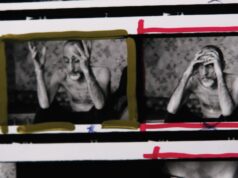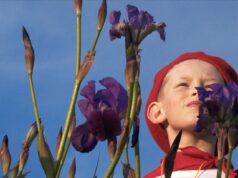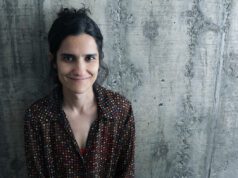
Anna Kurkurina, the protagonist and heroine of the Krakow FF Audience Award-winning Everything Needs to Live sums up her country at war. “Kids are dying. Mothers are dying. Animals are dying.”
Anna is many things, a world champion powerlifter, a social media influencer, an out and proud gay woman. She is also an activist with a heart of gold who has dedicated much of her life to looking after animals and to folk with disabilities.
At the beginning of Tetiana Dorodnitsyna and Andrii Lytvynenko’s film, also selected for Docudays National Competition and handled by KFF Sales & Promotion, we see Anna leading a weights class in a Ukrainian gym back in 2019. By the end of the film she is wading through flood waters in a village in order to save the cats and dogs rendered both homeless and ownerless. The flood waters are the result of Russian artillery having destroyed the nearby dam.
For Anna it isn’t just animals. She also sets her sights on those folk less well equipped to deal with life in general, not to mention during wartime, such as the 42 elderly who we hear are stranded in the basement of their apartment block, or Dima, who has cystic fibrosis, whom Kurkurina has trained into a prize-winning weightlifter.
“This film is about what makes us human, about being human, about the complicated nature of human beings, society and their connection with nature.” Dorodnitsyna and Lytvynenko say in their notes for the film. “We believe that the experience of war reveals the true human qualities and strips bare the human soul. The litmus test of humanity is our attitude towards the weakest: those who cannot take care of themselves or those whose well-being is of ‘no interest’ to the society. Therefore, people’s attitude towards non-human beings such as animals and towards persons with disabilities is in essence the test of humanity and tolerance.”
Everything Needs to Live started off as a pro-animal rights film back in 2019 when the issue seemed to divide the city of Mykolaiv in the south of Ukraine, where Dorodnitsyna is from. At a demonstration, the filmmakers first encountered Anna, who has a masculine bearing, and who talked about her passion for animal activism via the delivery of support and aid.
“It was wow, such an interesting woman,” says Dorodnitsyna of their first encounter. “I wanted to hear and know more about Anna. Her words came deeply to my soul because she also told about children with cerebral palsy. She is a rehabilitator and she takes care about these children also… They can’t integrate because we don’t [offer] opportunities for them in the cities and [on] transport. Also [she said] that society is not ready to communicate with those people because they [are forced to] hide like animals in cages at home.”
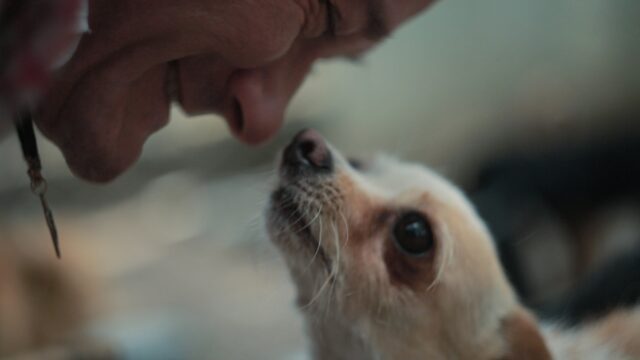
The filmmakers duly visited Anna in her home where they encountered a menagerie of stray animals that were saved by her. She would also receive strays found by local kids who would come knocking at her door.
But then came the full-scale Russian invasion in February 2022, at which point Anna’s work took on monumental proportions as she began to co-ordinate support and supplies across her region. In one scene she defines happiness as the unloading of 18.5 tons of humanitarian and animal aid cargo in two hours, having mobilized people in the region. Weight and its importance is very much a motif within the film.
Anna Kurkurina was forty when she turned to powerlifting. Before that she was a teacher of biology whose calling was in part determined by her childhood shock of seeing animals used as target practice by wielders of pistol crossbows. The experience gave her the stress-related skin disease vitiligo.
Later she became a zoo keeper whose relationship with the enormous lioness Elsa is as extraordinary as it is touching. In archive we see them wrestling and playing together. But Elsa is stronger, so Anna was determined to develop super human strength as well. (She is currently a multi-world record holder.)
Working with Anna was a pleasure, the filmmakers say. “Every time we came to ‘Mama’s home’ she would feed us, she would take care of us,” Dorodnitsyna remembers. “From those four years grows up a friendship.”
But Anna was also a frequent blogger and therefore had a totally different relationship with the camera.
“So we had to tell Anna, you’re not blogging, we’re making a documentary movie,” says Dorodnitsyna. “At first she didn’t understand why we are making some scenes with her in her bedroom or in the shower. So yes, it was a little bit difficult that she would understand why we are making the film. But at the premiere in Krakow she was so touched, she cried and after she made a speech and said [to us], ‘now I understand why you worked all those four years to make this big work.’”
Anna is well-known in the south of Ukraine (Lytvynenko, refers to her “Marvel” and “superstar-blogger” status) but not so much across the country. That seems set to change however after this film. Dorodnitsyna explains how a friend of hers who was ambivalent about LGBTQ issues experienced a change of heart and mentality after watching the film, impressed by Anna’s larger than life persona and heroic actions in providing aid.
How important are such Ukrainian personalities as Anna Kurkurina, or the better known Vitali Klitschko and Oleksandr Usyk (both heavyweight boxing champions), as symbols of resistance to the Russian invasion?
“They have a huge power,” says Dorodnitsyna. “It’s very important what they do because in the darkness of the war there is much stress and pain, and when people lose their beliefs, yes, it’s a big support from them. All the world, I think, sees the unity in the conflict that will help us to survive in this conflict.”
“I think they are making a very important role, because in the beginning they help people to not go to the darkness, and second they motivate people to do something good.”
In the case of Anna, this has been to help inspire folk to look after the non-human victims of war. The inspiration felt by filmmakers Dorodnitsyna and Lytvynenko is no less significant.
“For us personally, making this film is a particularly painful experience, since both of us are from Mykolaiv and Kherson,” they write of the cities under constant bombardment. “It is a very difficult process to see and document the destruction of our cities, the experience, which many people in Ukraine share with us and our protagonist. In a way, Anna is probably our mirror. Through her words and attitude, we can voice our ideas about war and peace in our land.”