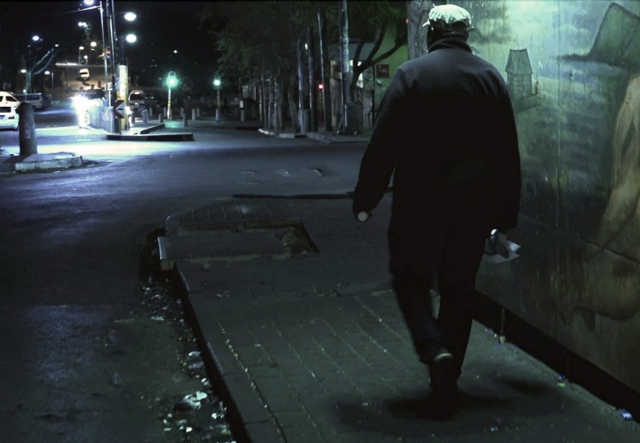
To call Walk With Angels a tough documentary to make is something of an understatement. During shooting, Polish director Tomasz Wysokiński remembers having a shotgun pointed in his face and seeing someone murdered in front of him. Wysokiński was shooting in the townships surrounding Johannesburg in South Africa.
He had originally gone there to make a film about an emergency room in a huge hospital in Soweto. He had never been in South Africa before and was keen to learn more about the country. Renowned Polish photographer Tomasz Tomaszewski provided the phone number for Jerry, who was to become his main protagonist.
“I said, man, show me your life, show me your world,” Wysokiński remembers what he said to Jerry when they first met. The director quickly discovered that Jerry was spending his time looking for stolen kids who had been kidnapped from their families.
“When I understood that he was looking for stolen babies, stolen kids, you know it was like a sign,” Wysokiński clicks his fingers. “I decided to go follow him. I said, man, I would you like to be your shadow.” At this point, the director quietly shelved his plans for the film about the hospital.
The director is a well-travelled figure who has spent time everywhere from the favelas of Brazil to the most remote parts of Asia. Nonetheless, the black townships of South Africa were something new for him. “South Africa? What can I say. It is the most dangerous place in the world for me now.”
As a father of two children, Wysokiński, worried about his own safety, was uncertain whether he wanted to continue with the project.
“To tell you the truth, it was very difficult. I don’t know how it was possible but I was working with a very small pocket camera with a small mic on the top of this camera.” His equipment was so unobtrusive that passers-by didn’t realise he was a professional filmmaker.
Walk With Angels is intended to work on three different levels. It is partly about the “reality of life” for the most disadvantaged South Africans. It is an investigation into an ongoing crime – Jerry is trying to find a girl kidnapped years before but who had a very distinctive birthmark. The film is also about Jerry himself. He’s a former ANC fighter who, as he reveals in his voice over, has witnessed much violence and lived through extreme trauma.
Walk With Angels was made through Mañana, the Polish distribution, production and marketing company originally founded by Piotr Kobus in 2001.
“I am a film lover. I used to go to all the festivals. Many years ago, Piotr organised Latin American festivals with great movies from Argentina, Brazil, Mexico and these kinds of places,” the director remembers how he first encountered his producer. “He [Kobus] didn’t know me but I knew him because he used to introduce the films before screenings and he used to say in a very beautiful way information about the movies.”
Kobus discovered the project when Wysokiński presented it as a project in Krakow – and the director was delighted to work with him.
The first screenings of Walk With Angels have already been provoking very emotional reactions from audiences. One filmmaker who saw the documentary sent his apologies for not staying behind for the discussion afterwards. He said he had gone to the church to pray. Jerry himself, the subject of the film, saw it for the first time a few days ago. He said it was “amazing” but was also confused by it. “I didn’t know even that this movie was about me,” he told Wysokiński.
After all they’ve experienced together, the director and his subject are now very closely bonded. Wysokiński says they are like blood brothers.
Having finally finished Walk With Angels, Wysokiński has other ideas for films. One that has been mentioned is a feature adapted from a short story by Jose Luis Borges. But first he needs a decent rest, the director insists. “I am tired. I feel destroyed inside, [like] the man who drank napalm. I am not ready to start these next topics. I need time…”