

Silent Flood, which has just won the Silver Horn for High Artistic Value at Krakow FF, and is sold by Filmotor, isn’t a film in a hurry. Ukrainian director Dmytro Sukholytkyy-Sobchuk is telling the story of a closed religious community based in rural west Ukraine. Life is quiet and peaceful – or at least would be if it weren’t for the constant floods and wars that bedevil the area, and which still leave their traces.
Forests are full of discarded cartridges. There have been times when the river has broken its banks, for example the ‘High Water’ of 1941. Then came the full-scale Russian invasion.
Sukholytkyy-Sobchuk embarked on the documentary having made the fictional film Pamfir (2022), which premiered in Quinzaine (Cannes) and was acquired by Netflix. He had actually been working actively on the project since 2020, and was contemplating a possible film even before then.
“I was thinking about this community a long time ago. My first meeting with [them] was when I was studying with the philosophy faculty,” he remembers of his time at Chernivtsi National University.
While travelling down the river by raft with his friends, he saw the village. “It looked to me like something out of a picture by Hieronymus Bosch,” the director describes his first encounter.
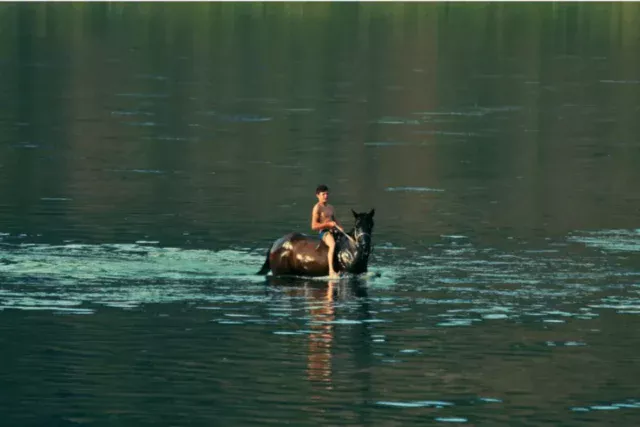
Silent Flood has taken almost five years to complete – four years of shooting and well over a year of post-production. Don’t come to it expecting reportage, or journalistic insights into the state of Ukraine since February 2022. “For me, to be a filmmaker, it’s like to be a painter who has the ability to move images,” the director says. Every shot in the documentary is lovingly framed, whether a boy riding on horseback in the river, or characters standing by the banks in the mist, skies, mountains and forests at dawn or dusk, farmers tending fields or men building walls.
Sukholytkyy-Sobchuk studied philosophy and architecture before turning to filmmaking. He believes this unusual background has helped him in his directing. The architecture forced him to think deeply about space and thereby to “feel and combine shots,” while the philosophy was useful for “developing thoughts.”
He adds that he is also very influenced by his studying of painting, “learning about perspective, composition and many other things.”
“By the time I went to film school, I was already developed in a visual way. It has helped me explain what I want from directors of photography or production designers.”
Sound is as important as image in Silent Flood. Counterpointing the images in the film are the murmured stories heard on the soundtrack. In the first part, we hear elderly villagers reminisce about the past and reflect on their lives. This is a deeply religious community that abides by New Testament values. There is no drinking or smoking. As one community member tells us, “if others thought like us, there’d be no war. There would be no fighting, only peace. No one would trespass on others’ land. We have our field. We don’t fight over borders, none of that.”
This peaceful, bucolic life is continually interrupted by natural disaster – the floods – and by the recurrence of war.
In the latter part of the film we hear kids from today also try to make sense of what is going on around them.
“The first voices are of the very old people who met with the war when they were children. The last voices are of children who are now meeting with war,” Sukholytkyy-Sobchuk explains. “What I truly believe, and what we fight for, is for this place to be the same paradise that we see in [older] chapters.”
One of the biggest challenges was finding soldiers who would agree to be in the film. “Even if they agree, we’re supposed to find them on this evening, at this location…[but] they’d be busy or on another mission. You didn’t know if you would find them – and if you did find them, you didn’t know if they would want to talk.”
The soldiers are startled by the simple way the community lives. “They don’t use electricity or any modern convenience…they don’t have TVs, no electricity, no phones. That’s nuts,” soldiers are heard murmuring in amused bafflement on the soundtrack.
Silent Flood was made through leading Ukrainian production collective, Tabor. What the director liked about the company is that it’s run by filmmakers who share creative passion. But ask him how easy it is to make a contemplative, artistic film like Silent Flood in the middle of the current war and he replies: “It’s hard to explain. Every month, there are challenges…I can’t give an answer to such a question in a couple of sentences. I can’t describe it.”
Sukholytkyy-Sobchuk did some of the camera work himself, although the main cinematographer, who shot around 60% of the material, was Ivan Morarash. “The shooting style came from the concept – and the concept is the passing of time, how that’s almost invisible – but that what happens through floods and war is visible.” He also talks of trying to capture “the inner change” as war intrudes in the community’s existence.
This is a film without juddering, hand held camerawork or sudden jump cuts. “For me, it was very important to stay stable,” the director states. Whether showing bucolic country scenes or moments when war intrudes on the community’s life, the style remains the same.
Certain panoramic shots in the documentary last for several minutes at a time. The director talks of wanting his film to be a memorial of what the community has endured.
Silent Flood was produced by Karina Kostyna and Eugene Rachkovsky for Tabor in Ukraine, with co-production by Tanja Georgieva-Waldhauer for Germany’s Elemag Pictures. Small screen outlets MDR and ARTE also joined.





