

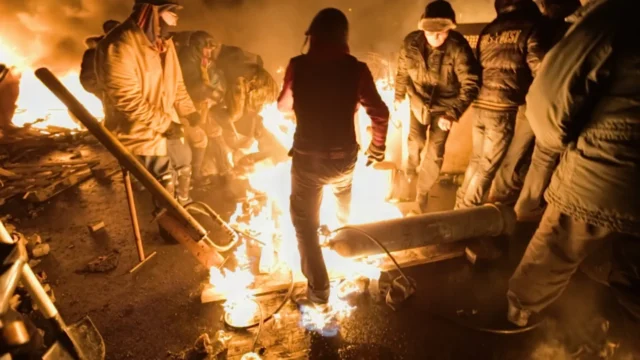
Time Machine Maidan (a world premiere in International Competition in Sheffield Doc Fest) has been described by its co-director Roman Liubyi as “an upside-down mockumentary.” The film (also directed by Volodymyr Tykhyy) is structured like a time travel fantasy, but deals in forensic detail with some seismic moments in recent Ukrainian history.
A young soldier in the Ukrainian army falls into an ambush. “And I died…but not completely,” we hear him say in his dreamy, poetic voice-over. Somehow, he ends up in a crowd of young people in Kyiv. He has travelled more than 10 years back in time to 2013 and finds himself in the middle of the Maidan uprising. He is searching for his friend Maksym who died in 2024 but was a Maidan activist. He wants to warn Maksym about what lies ahead…
Liubyi is almost certainly the only director with a film in Sheffield this year who is currently serving on the front line of a military conflict. He is part of a unit fighting in the north of Ukraine.
The director was in London 2022 when the Russian full-scale invasion began. He returned to Ukraine and completed his documentary Iron Butterflies, about the shooting down of Malaysia Airlines Flight 17 in 2014 by Russian supported forces. The film screened in Sundance and he spent several months travelling with it on the festival circuit. Afterwards he worked for the army behind the lines in a workshop repairing drones, while also continuing his filmmaking projects (including Holy Power, a long-gestating animated project based on Ukrainian folklore). Then, around four months ago, he joined a combat unit.
When it came to Time Machine Maidan, Liubyi and Tykhyy had realised that there wasn’t yet a proper film about the Maidan revolution – one that Liubyi could show his daughter. They also knew that the Babylon 13 film collective (which Tykhyy co-created and heads) had an extraordinary archive of footage shot in the square.
Early on in the gestation of the project, Liubyi had edited some of this Maidan footage to the accompaniment of a “crazy, interesting song” that had been recorded at the time by a sound editor, Andrii Rohachov. “It was more like a music video but it was a first step…”
Gradually, the filmmakers conceived the idea of creating the character of the soldier who goes back in time, and of using fictional elements to bring the archival documentary footage to life.
The director pays tribute to actor Kyrylo Nikolaev, who does the voice-over. He made his own small but subtle changes to the narration as it was written, thereby making the character seem yet more real.
The documentary opens in stylised fashion with images of very young soldiers, all of them real-life members of the Ukrainian armed forces, looking at the camera. We don’t hear any of them speak. Liubyi suggests that their faces give the audience “a hint” of what the main character might look like. “He could be one of them.”
At the time of the Maidan protests, Liubyi, who was then in his early 20s, had been working primarily as an editor. He has strong memories of the period. Some of the footage that was shot was published at the time on the Babylon 13 YouTube channel.
“We were making subtitles in English and Italian and sometimes German and French, to spread the word about what Maidan was,” he remembers. This footage offered a very different perspective to that given in the mainstream media. This was an insider’s view of how Ukrainians stood up to dictatorship.
On one level, the experience of the revolution was exhilarating for its young participants. There was a huge camaraderie between them. Liubyi likens the atmosphere to a nightclub: “the coolest people were there, the people you love, the people you trust, the people you want to hang out with.” The filmmakers didn’t feel they were just bystanders, covering events as part of the media – they were participants too. “But compared the guys who were literally fighting, your work is pretty safe,” Liubyi clarifies.
The protests had started because the then-president Yanukovych was looking to turn his back on Europe and forge yet closer ties with Putin’s Russia. A huge camp was set up by the protesters in Independent Square in Kyiv. They stood up against the ‘Berkut,’ as the riot police were called. Violence was inevitable. “Unfortunately, revolution is impossible without it. You cannot avoid it.”
The film includes some footage filmed by one protester, who went under the nickname ‘Mustang,’ of snipers shooting at the crowds. He gave the footage to Babylon 13 as he wasn’t sure what to do with it otherwise.
Time Machine Maidan also has an undertow of romanticism. There are references to love affairs. We catch glimpses of the mysterious Sonia and see a Canadian journalist to whom the narrator takes a shine (she is a real-life character, although she is not referred to by her actual name).
“All the people I know had some romantic stories on the background of Maidan,” the director recalls one side of the protests that outsiders don’t always appreciate. He himself met his future wife during Maidan.
This was a turning point in Ukrainian history. What happened then, the ‘Revolution of Dignity,’ would eventually lead to Russia reacting by annexing the Crimea and then, in 2022, to the full-scale invasion itself.
“It’s a very hard fight but we have hope,” Liubyi draws a stark contrast between the situation for Ukrainians and that facing Belarus, a country completely under the Russian yoke. “It’s a moment when our people choose a particular branch of history…the whole world is affected by Maidan basically. We can all complain about our life, our situation but who knows? Probably it is the best option. Unfortunately, Belarus is an example of where we would have been if we had not fought back against the Russian influence. Now we have hope and many people interested in Ukraine.”
Co-director Tykhyy has talked of the film as revisiting Maidan “not as a frozen page in a history textbook, but as a living and emotional foundation of contemporary Ukrainian identity.” He also says that it is aimed primarily at young Ukrainians, to give then access to “an authentic history” of events that continue to shape their lives.
The documentary was produced by Andrii Kotliar and executive produced by Bohdanna Semen. It is a Babylon 13 production made in collaboration with Suspilne Ukraine and with TRIMAFILM as German co-producer. After the world premiere in Sheffield, the film will be seen by Ukrainian audiences at the Odesa International Film Festival later in the year. There is also expected to be an installation in the Square itself which feature sights and sounds from the Maidan period. “It will feel like time travel itself,” Liubyi suggests.





