

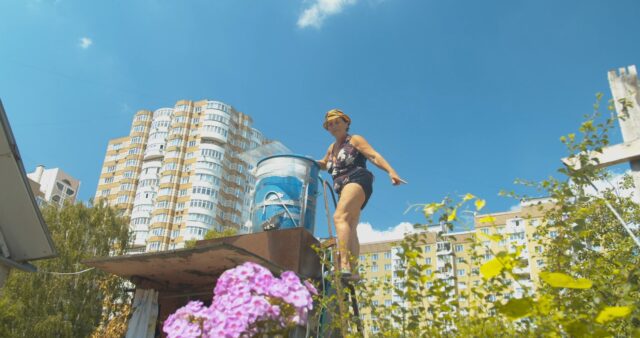
Debutant director Adelina Borets describes her feature doc Flowers of Ukraine, which world premieres May 30, in somewhat surprising manner, given the tragic undertow of most films from the country since Russia’s full-scale invasion. “In the documentary industry in Ukraine, every of us, also me, we are looking for our own unique way to present the situation. I would say my film is a war comedy,” she says.
At least for the first 25 minutes of the film, world-premiering at Krakow FF, that indeed seems to be the case as we follow the ebullient Natalia (68) and her two former husbands as they resist developers who want to take over their idyllic smallholding among the tower blocks of Kyiv. There, goats and chickens run wild and the seasons are experienced in their full glory. Rain water is collected in a butt, jars are stored in an underground bunker, and a spirit of joy pervades.
Husband number one Grandy is quiet and is “good with his hands,” we are told, while Russian-speaking Kitty, who has a penchant for cowboy hats and dancing, was ever so good in bed. Natalia teases both continually, laughing all the time.
In 2021, the war is elsewhere in the country but Natalia still invokes a nationalist spirit when talking about her opposition to the developers. When she stands before the bulldozers she is fierce and fearless. “We resisted just as Ukraine resists now,” she says. Later the developers make her an increased offer for her land (“a million dollars!” she claims) in order to build a private kindergarten. She refuses and is unable to contain her mirth when calling her daughter with the news.
But 25 minutes into the film there seems little reason to smile. When the bombs come after the full invasion of February 2022, Natalia is shaken and retreats to her underground food store reciting an Our Father, as if either could offer protection. Very soon the surrounding tower blocks are in ruins, and Kitty leaves for Warsaw.
Natalia has considerable pluck however. She signs up for civil defence. She is not yet 70, she explains to the recruiting office, and is “a pretty young grandma.” She signs up to make dumplings and weave netting, and works out the correct ratio of two parts gasoline to one part oil in order to deliver Molotov cocktails to the military.
And so her new existence continues in the face of Russia’s murderous intent, but she remains indomitable, even when having to bear the passing of a dear loved one. She teaches her grand-daughter how to bake pashkas, tends to her farm and chooses dancing and laughter over despair.
“I could say that [Natalia] really represents the emotions of my country,” says director Borets, acknowledging that not everybody can express their emotions quite as freely as her heroine. “She is an example for everyone…every time resilience, every time be strong, even [after] the death of her husband and even when the war breaks out, because everyone has the same fear inside. But not everyone has these strong beliefs in our ourselves and in our country and in the power of our earth.”
Not that Borets’ first meeting with Natalia seemed in any way auspicious. When the director heard about her future subject she followed the goats to her plot of land, only to discover one on top her car denting the roof with its hooves.
“I was furious. I just took this goat. I came to Natalia… and I started arguing with her and she just told me, not even sorry, but if you want, you can take this goat because I don’t have the money to pay for your car. And I was like, oh my God, the way she speaks with me!” But Borets was impressed. Originally, she had planned on three subjects for her documentary, but after the invasion, one of the others joined the military while the third left Ukraine. “So [Natalia] became the star of my film and also I could say of my life at the same time.”
“I’m reflecting on my hero in the way of my life goal,” says Borets, who lost her home in the Ukrainian city of Mariupol. “Because I also have a dream to come back to my land, to my house.”
The director says how her “skin becomes freezing” as she recalls filming Natalia during the first Russian strikes on Kyiv in February 2022. “I’m from Mariupol, so I remember the first time, but I was younger and I think my memory tried to erase this feeling, this fear. But this time I decided to stay with my character, not to be back home, not back to my family who actually live near Natalia in the next [neighbour]hood.
“But Natalia was really calm before the shelling. And she really tried to keep my possibility to continue shooting. ‘Adelina, please continue. You really should do what you do because it’s your choice, because you decided to do that before the full-scale invasion started.’ So she really also helped me a lot in mentality.
“But when the shelling was started, oh my god, it was awful. Every of us was in such kind of shock.”
Recently in conversation with Business Doc Europe, Ukrainian filmmaker Alisa Kovalenko (We Will Not Fade Away, 2023) told how the reason she attends film festivals is less about promoting her film or project and more to generate support for Ukraine in its war against Russia.
“I feel the same way. I’m so proud of our documentary sector right now, the documentary industry in Ukraine, every of us,” says Borets. “Every one of us is trying to look for our own way for telling our story of Ukrainian rebuilding. So of course my main dream is to tell how many great people we are but how much our independence costs, and I really want to continue telling our stories. And I am really begging to keep supporting us. So that’s why I also make a comedy for telling how, yes, it’s hard times for us, but also we are resilient and we can be funny because of our situation from inside, and because it’s our type of humour. That’s why we become even stronger. So yeah, the main core is to tell about the different [aspects] of us, and asking for your continuing support.”





