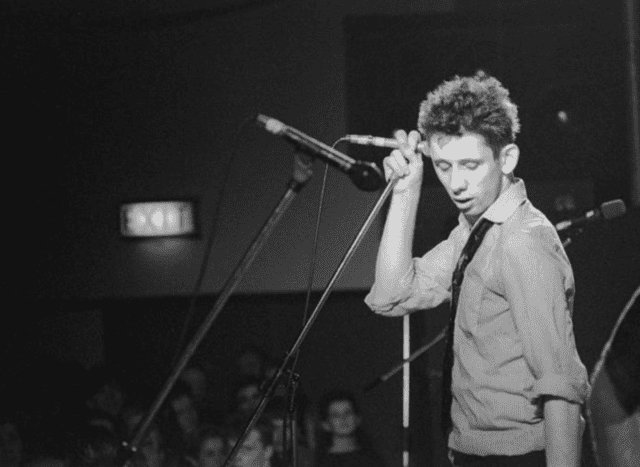
(Photo: Andrew Catlin)
The Irish Irish may have come to love Shane MacGowan and claim him as one of their own, but the London Irish were his first parishioners, the sons and daughters of the great diaspora of the 1950 and 60s. They were first to know – and the first to love – The Pogues’ front man.
First of all I must admit to a mammoth prejudice.
The two greatest gigs of all time, without question, were The Pogues at The Mean Fiddler (April 1985, Harlesden, north-west London) and The Jam at the Music Machine (December 1980, before it became the Camden Palace and the birth-place of New Romanticism).
Back in 1980, when Prince Charles had yet to pop the question to Lady Di and Margaret Thatcher was eyeing up the necessity for social strife and mass unemployment, the support act at the Music Machine was the punk outfit The Nipple Erectors (aka The Nips), headed up by Shane MacGowan, and playing their last ever gig.
When MacGowan came on to sing an encore with Paul Weller and Bruce Foxton (singer and bassist of The Jam respectively, the song being ‘Heatwave’ from the ‘Setting Sons’ album), never in the history of live music was one punk lead man covered in so much saliva from a discerning mosh pit. Such was live music then, and such was the esteem in which MacGowan was held by London’s youth.
“He didn’t flinch, I’m sure,” agrees director Julien Temple whose Crock of Gold: A Few Rounds With Shane MacGowan goes into cinemas December 3 ahead of its DVD and digital release December 7 through Altitude Film Entertainment.
The film proceeds to tell the life story of the punk laureate, musician and staunch Irish republican who co-wrote what many believe to be the greatest of all Christmas songs (A Fairytale of New York) as well as helping to define the cultural identity of the Irish demographic in the UK.
In the documentary, MacGowan was a child who fell in love with Ireland almost from birth, although he was born in Kent (England). He was taught by his Aunt Nora (when still a toddler and in the most demonstrable of terms) about alcohol, smoking and gambling, and about the Gospels. He was also taught by his Tipperary clan of relatives to be pro-IRA (later in the film MacGowan admits that he was ashamed never to have joined the organisation).
His parents settled in London, deciding to live in the Barbican among other places, where the boy suffered acute depression, missing his beloved Ireland. He attended a very posh private school (Westmister) where he survived by dealing in narcotics. After a later period of high-octane drug us MacGowan found punk, which was the saving of him, his sister Siobhan tells in the film.
Director Julien Temple has known MacGowan for a long time, although he concedes they were never close friends. Back in the 1970s he shot much of the footage at the Sex Pistols and Clash gigs where the last man standing on the dance floor was inevitably the future Pogues lead man, especially after Sid Vicious “left the crowd to join the Pistols,” as Temple puts it.
“He was just so caught up in the energy coming off the stage from those bands, that my camera would drift and lock onto him,” Temple continues. “I also did the first ever interview with him, with the peroxide blond punk hair (in the film). So I go way back with him.”
MacGowan is interviewed in Crock of Gold by an unlikely crew of friends and admirers that include Primal Scream front man Bobby Gillespie, wife Vicky Mary Clarke and actor Johnny Depp, a long-term friend and “drinking buddy”. And former Sinn Féin president Gerry Adams, in whose presence MacGowan is uncharacteristically deferential.
“He seems to look up to Gerry. I have never seen Shane behave like that to anyone actually,” says Temple. “Normally he is going for the jugular…but with Gerry there is almost a reverence there, it is quite funny.”
MacGowan is in a wheelchair and drinks white wine throughout his interviews, at times slurring but in the main comprehensible (despite rumours that the film will be subtitled for general release). He tells of the rise and fall of The Pogues, about writing the great songs (many on the ‘Rum, Sodomy and the Lash’ album) and those which reeked of compromise as The Pogues turned into “a rockband” and therefore everything he despised, no longer an adherent to “my own ethnic.”
Yes, he wheezes a lot, and every laugh sounds like a death rattle, but the front man’s inherent lyricism and word-craft is continually in evidence throughout the interviews. He describes how “songs are floating around in the air, that’s why tunes are called airs.” And if he doesn’t grab them, then someone like Paul Simon will grab them instead, he says. He also comments wryly to Gerry Adams of their shared Irishness: “We’re literary people, but we’re illiterate.”
MacGowan is none too complimentary about, and takes distant pot shots at, fellow cultural icons Bob Geldof and Elvis Costello (himself a child of the diaspora), as well as Ireland’s national poet WB Yeats.
But in the presence of Ireland’s music royalty (Bono and Sinead O’Connor, as well as Nick Cave and the Irish president Michael Higgins) at a concert in Dublin to celebrate his 60th birthday he is far from bilious. On the contrary, he is respectful and, to an extent, happy to join in from his wheelchair.
“You can see all the emotions playing on his face – he has a very expressive face. There is a sense of him being kind of overwhelmed by it, almost amazed that he is still alive to see it, but also slightly wary of it,” says Temple. “I don’t think it would be Shane MacGowan if he thought adulation is all you need. I think he is after a lot more than just being popular…He has never been a straightforward rock star.”
“He is so riddled with contradictions which make him run: public schoolboy, punk, street rocker, London boy, Irish figurehead. It’s the contradictions that make him fascinating and really made his songs unique.”
The director himself resists the opportunity to muck in onscreen as an interlocutor (“I’m not Nick Broomfield. If the film is about someone else, why should I be in it?”) at the same time conceding that a doc about, and starring, MacGowan was never going to be plain sailing.
“He does what it says on the tin. He’s not the easiest man in the universe to capture on film, or even have a conversation with at times. So yeah, it was very difficult at times. I was lucky to have Johnny Depp (producer) involved who could steady the film when it looked like it was going to sink. But, you know, if it wasn’t difficult it wouldn’t be Shane MacGowan, and he’s definitely worth it.”
“You’d walk through a shitstorm and back to get a few bon mots from Shane,” Temple ends.