Last week Alina Gorlova’s This Rain Will Never Stop won the IDFA First Appearance award, as well as the main prize at Festival Dei Popoli. The winning filmmaker talks aliens, life cycles and the power of film to unite, to Business Doc Europe.
In This Rain Will Never Stop, the disparate members of the Suleyman clan gather not in a physical space, rather in “another reality,” that of film, as we follow son Andriy on an odyssey from the Ukraine towards his former homeland of Syria.
The pledge to unite the family in film was one that filmmaker Alina Gorlova made on the death of father Lazgin, whose desire it was to be buried in Syria. For many reasons, son Andriy (a Red Cross military worker whom we follow through the film) could not return to the country. There was the strong possibility that he may be immediately conscripted into the Syrian army, Gorlova notes, but aside from that, the swollen Tigris had blocked the roads and therefore denied him access. So the director remained with Andriy, negotiated with family elder Mezgin to allow a local Syrian crew to shoot the funeral and thereby completed her promised to complete the story, the cycle, of his family.
As Gorlova simultaneously filmed lone son Andri as he contemplated the flooded banks of the Tigris, she knew her film was nearing completion.
Prior to these moving scenes that we see towards the film’s end, Gorlova presents a complex study on family dynamics, migration and the cyclical nature of things.
In her opening sequence, she imagines the arrival of an alien onto a planet Earth that resembles the surface of the moon (it is in fact Ukrainian wasteland beside a factory belching smoke and fire into the sky from its chimneys). Observations first take in a lonely old vagrant whose only companion is a cat, before we move to an unspecified Ukrainian border checkpoint (one assumes it is the border with Russia) where we encounter crowds of people having their papers checked and stamped before continuing on a journey.
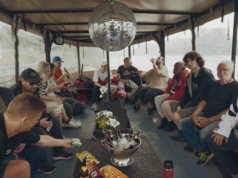
Then we meet Andriy, gentle and shy, whom we follow for the rest of the film. He works for the Red Cross and has immediate family in the Ukraine. His father Lazgin has three brothers, living in Germany, Turkey and another back in Syria, all of whom Andriy decides to visit by road. His odyssey takes in a joyous wedding in Germany and he visits Kurdish Iraq where he has a tearful reunion in a Syrian camp with his uncle (Mezgin). Then we receive news of his father’s death back in Ukraine, at which point we move towards the film’s denouement.
But intercut with Andriy’s story are scenes of mass joy and unity, as expressed during highly co-ordinated and precise military parades, national celebrations replete with Cossack sabre dancing and indigenous costumes, and extravagant and noisy gay pride rallies.
In the black and white film shot in extreme wide angle by Vyacheslav Tsvetkov, who also lensed Iryna Tsilyk’s Sundance winner The Earth is Blue as an Orange, director Gorlova also seeks to employ metaphor and symbols to tell her story.
“I like to work with the viewer’s subconscious, and that’s why I was trying to create several symbols like a bridge, like water, fire, also I was working with black and white, which means opposite sides, like war and peace, life and death,” she says.
“It is about the cycle of war and peace, the endless migration of humanity, about death which will be always with us, but about the joy that will be every time with us. And water means a lot, the flow of the people,” she continues. “We see in our film these flows of people in the military parades, and also we see the same flows during parades in praise of love.”
War, however, is a root component of the film and Gorlova paraphrases Heraclitus’ assertion that war is both king and father of everything, which creates a dialectic which leads to growth and creation. “He means that contrast and opposite sides actually create our universe, t
hat these opposite sides, these black and white things, create our world.”
The film is divided into eleven chapters. This allowed her to compartmentalise the story into its geographic components, but as importantly the chapters are numbered from zero to zero with numbers 1-9 in between, which underlines the sense of cycle, of birth, rebirth and continuity.
Gorlova goes on to describe her conversation with family elder Mezgin for the need to shoot the very intimates scenes at the funeral towards the end of the film.
“I said to him that in this film your family could meet, because nobody knows when you will see each other in real life, because it is a long way to each other,” she stresses. “And I think that he was understanding this, so they decided to let me film this episode, just to have this possibility to show it to the other relatives in Germany and Ukraine and so on. In one film. In another reality. Not in one country, but in one film.”