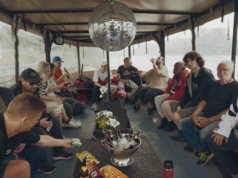
During the pandemic, director Kamila Serwicka returned to her family home in a small village in Poland to tell the story of her mother, Agnieszka, who had endured years of domestic abuse. What emerges is an intensely personal debut documentary that reaches beyond her mother’s story to reveal a devastating pattern of violence across generations of women in Serwicka’s family.
Her grandmother, Danuta, had also suffered and survived years of abuse. So had Serwicka’s sisters, Natalia and Kinga. And, ultimately, so had Serwicka herself. Blossoming, which world-premieres August 9 in Locarno Critics Week, comprises a complex multi-generational portrait of the five women, who find strength and eventual happiness in the bond that they are determined to maintain, even after mother Agnieszka goes to The Netherlands to seek work.
The women are, throughout, the key drivers of the film. The girls and their mother all bear a striking resemblance and sense of duty to look after each other. Grandmother Danuta, meanwhile, a staunch Catholic who watches mass on TV and insists on grace being said before meals, has no such faith in the opposite sex. For her, all men are useless, she says, adding with a huge dose of irony that perhaps her ideal prince is yet to be born.
The girls’ father Wojciech is a shadowy figure, a drunk (we hear), needy, work-shy, complaining and pathetic, and quick to take offence at his family’s increasingly frequent decisions to sideline, avoid or ignore him.
Late in the documentary, there is a blacked-out dialogue between the director and Wojciech which was recorded three years after he left the family home. Even as he attempts to apologise to her for years of deplorable behaviour, his confused state of mind is such to assume that his eldest daughter is still 20 years old. He has to be reminded that she has actually aged a further eight years.
In her film notes, Kamila stresses how, “growing up, I witnessed my mother’s fear and suffering as my father humiliated her, draining her will to live. My two younger sisters and I were insulted, beaten, and thrown out of the house – punished for opposing him. Anger became my strength.”
“It helped me escape that home. For years, I gathered the strength to finally face the past and tell our story. This film is my companion through our transformation. I want to show the power that rises when women unite, to give hope and courage to those who are still silenced,” she adds.
The director further tells BDE how there was another father figure in her life when she was a child growing up, an art teacher who was both kind and receptive, and very encouraging as she took her first steps towards filmmaking. Marcin Bondarowicz has gone on to be one of Poland’s most celebrated artists and illustrators, and has created the poster artwork for the film.
“He was my teacher when I was a kid. He felt that something is not right, but he never, you know, asked too much about it,” Kamila remembers. “Looking back, I see a kid who had that person that stopped and asked, ‘ok, what do you need? What do you want to say? I want to show you how to express it, how to show it through the paintings.’ And that’s why I think it’s really important to share, to stop in life and to focus more on people around, because maybe there is someone that needs help…Sometimes you don’t know that you can be the most important person for a kid when you stop and listen to what he or she wants to say.”
The sense of collegiality among the film’s subjects was such that that camera would be frequently shared. “When they took the camera, my sisters and even my grandma, it was like I have that kind of feeling that we are all equal, that not only me decides what kind of situation I can show. They had this really open space to take the camera, or even to decide, ok, today I don’t want to shoot.” For Serwicka, the camera represented “humility.” “They really understood what kind of needs I had and how important it is for me, but we tried to make a comfortable situation for each other, for me and for them,” she stresses.
The film’s credits further emphasise the collegial sense of sisterhood in evidence. Even though father Wojcech plays a significant role he is given a lesser billing in the final credit roll. “There was a lot of talk about it, and we decided to make women the most important on this film, to give them the special space. For me, this story is not about an alcoholic father, it’s more about women’s strength when they stand together.”
Post-Locarno the director is determined to show her debut feature as widely as possible across Poland and beyond, given the toxicity of its subject. “I have a mission to reach even the smallest villages. We need to focus on theatres for sure, but at the same time, we are thinking about television to reach many people, to show them this story. From the beginning, I really want to give people hope that you can change your life if you start to talk about your feelings, talk about your heart topics.”
As for reactions within the family, Serwicka underlines how her mother was very moved when she saw the film, “but at the same time, she said to me that, yeah, it is what it is. All of us knows what happened, how the story is.”
As for her father, he is concerned that he may be judged harshly after the screening, Serwicka says. “I’m a bit worried too. But I did everything to not judge him, to make the film from the bottom of my heart to express my emotion, not to judge anyone. So, yeah, it’s really hard for me.”
“Maybe it’s really hard what I’m saying right now. But it was really a weird feeling that I felt that my father died in my heart, in my mind. Only after this, I feel that I can talk with him once again. And I can look at him like at a human. Not my father, but as a human who doesn’t have enough strength to fight for himself.”