After getting to know members of the world-renowned Guinean circus group Amoukanama, Flemish director Marjolijn Prins followed her instinct to see where and how it all began back in the West African republic.
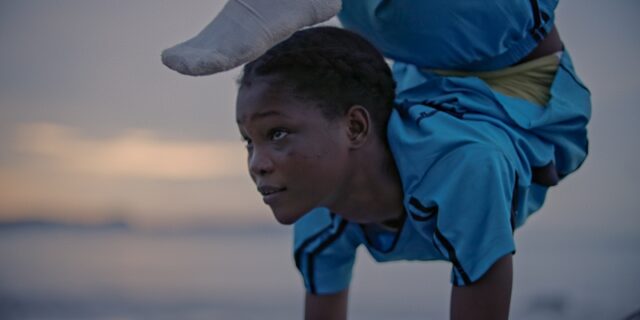
At first, Prins had intended to chronicle the life of the youngest boy in a local troupe of aspiring acrobats, but when she was on the beach where they practised her eye was drawn to a tiny, beautiful and very flexible little girl. This was nine-year-old Fanta, who resembled a magical sprite, and who could contort herself into impossible shapes, twisting herself a full 180 degrees, so while her torso faced north, her toes were pointed south.
But Fanta wanted more than the approval of her friends and family. We observe her over the following six years as she develops towards young adulthood, all the time clever, studious and attentive to her increasingly sick mother. But she also possesses a driving ambition to join the circus, even if she is, at times, assailed by self-doubt.
The opportunity to do so is offered by the heroic return from Canada of Balla Moussa Bangoura, one of the Amoukanama founders, who determines to hold auditions for a circus tour of Guinea, with the realistic prospect of an international tour thereafter. His arrival at the airport is a riot of joy, colour and muscular tumbling to impress the master showman.
“When I found out that Balla was going to Guinea to train the troupe there and create a show and tour I knew we had to make sure we would be there to film, as the impact on Fanta and the group would be big,” says Prins.
Balla is a true professional, a calm but tough disciplinarian who demands total dedication from the performers. They are required to build their strength and perfect their natural skills, all the time striving for faultless precision and accuracy. Can the youngster Fanta, whose domestic role has expanded greatly since her mother’s illness, overcome her myriad obstacles to eventually join the troupe?
Director Prins describes the first time she met Fanta. “She suddenly appeared on the sidelines of where they were training on the beach, and it was just like a magical moment – this very tiny girl starting to do all these flexible tricks and the boys being like, ‘oh cool, this is Fanta, she’s part of our gang.’ They were taking care of her like she was their younger sister. So my of course my attention shifted straight away to her.”
“I think from a very young age she’s never been shy in front of the cameras, natural and confident,” Prins adds of Fanta’s suitability as a film subject. “Yes, she was very open so we hung out a lot, spending time getting to know her, getting to know her family and to know all the other acrobats as well and the dynamics between them. So that was our starting point.”
Fanta also had a seriousness and sense of purpose that impressed Prins. “I have difficulties with using the word ‘dream’ as it has a very childish and naïve connotation. I think you really make everything beautiful, but when you get older you really have to fight for it, and that’s I think what we found with Fanta.”
“My work often explores youth perspectives, gender, and social inequality in playful yet thoughtful ways.” Prins adds in her notes. “I believe young people, with their curiosity and imagination, can offer fresh ways of seeing the world – especially in times of division and prejudice. Creativity and connection are powerful tools for change.”
Fantastique is a hybrid work, imbued with values both verité and magical realist. Water is present throughout the film, and all the time the essence of the African goddess Mami Wata is evoked, whether in the golden flowing streams or in the phosphorescence through which Fanta wades and swims.
“The supernatural is always present in stories and myths,” says Prins, who decided not to physically portray the goddess, rather to have her present as a vital force. “There were already so many strong women in my film; Fanta, Fanta’s mother, her best friend Makhissa, I thought that it was not needed to present Mami Wata as an extra character, but that it was more important to have this magical feeling of nature.”
Balla is an inspirational character in the film. He showed a keen interest in the documentary process but never neglected his core duty to gather and prepare the troupe ahead of the tour. Furthermore, he bore an acute sense of responsibility in enabling a new generation of Guineans to follow in his illustrious footsteps.
“A lot of the acrobats who leave for Europe or America, or for Canada in Balla’s case, whenever they get the chance to come back they really see it as their duty to train the youngsters, to give them the same perspective and to really teach them about what is important, especially techniques, because they don’t have any kind of circus school,” says Prins. “And so he [Balla] takes it very seriously, and he wants everybody else to take it super seriously as well. For the boys, as well as for Fanta and Marissa, he was tough on them, really strict.”
There were hurdles to overcome during the production, such as 3-day power cuts and torrential rains and the resulting geographical inaccessibility. Nevertheless, Prins maintains that shooting periods were as close to seamless as they could be. What’s more, situations that may have been irksome for some directors – such as the rescheduling of scenes due to shifts in the circus agenda – ultimately proved more of a boon than a bane. “What I love most, I think, is improvisation,” says Prins. “You thought you were going to shoot a scene with is not there, so you make Plan B, and then from that Plan B the whole day develops differently. and you end up with great scenes that you never imagined in your original script.”
“Immersing yourself in the moment and the world of the characters often yields more surprising and moving scenes than a pre-written script. And it ensures your film stays close to the characters. I loved it.”
The film has been screened for its protagonists, who were thrilled with the results. After the Locarno world premiere (and before what will undoubtedly be a successful festival roll-out) Prins will be arranging screenings for the wider Guinea community. “In their shows, the Amoukanama circus always tells the story about how it is for everybody from Guinea to travel, and the obstacles they meet whilst crossing borders,” says the director. “It’s very difficult to travel (even with a Guinean passport) but everybody still longs to travel. So this is a very important part in their society. Especially in the circuses, they feel like their success is only reached when they are working abroad.”
Prins sees a distinct parallel between the worlds of documentary and the circus. “I think the great thing sometimes about the circus is, like documentary, you don’t really need so many words to tell the story. It can reach a wide and diverse audience, using humour and playing with imagination. You just feel it. You’re opening up and you become part of this vibe and rhythm,” she signs off.