Swiss filmmaker Antshi von Moos has always been a keen gardener, not just in terms of cultivating vegetables and flowers, but also in observing the rhythmic interactions between plants, insects and soil. Her interest in the subject went stratospheric, however, after she became familiar with the writings of biologist and author Florianne Koechlin. Koechlin explained with precision and clarity the complexities of the mycorrhizal network beneath the forest soil, one vast process of “murmuring and whispering” that is unintelligible to humans but which comprises a wealth of subterranean communication between fungi, roots, plants and microbes.
Near the beginning of von Moos’ Flying Scents – Of Plants and People, world-premiering in Locarno Critics Week, Koechlin further explains the response mechanism of a tomato plant when attacked by caterpillars.
“It starts to defend itself by producing warning substances,” she says. “By doing so, it warns its own leaves and the neighbouring plants: ‘watch out, danger is approaching!’ Then it emits a scent to attract beneficial insects. The fascinating thing is that the plant can not only identify that there is danger, but who is causing the threat. It knows from the saliva. When the caterpillar chews a hole, saliva drips into the leaf. The plant can interpret the saliva and it then produces a mix of scents to attract the beneficial insects.”
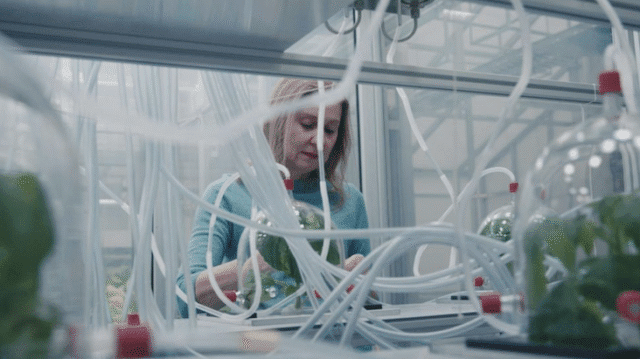
Director von Moos then goes on to explore the work of Professor Doctor Consuelo De Moraes – Head of Biocommunication Group, ETH Zurich – and her colleague Doctor Emanuel Devers, both of whom are seeking the ‘Holy Grail’ of biological research, namely to isolate the ‘florigen’ compound that can trigger early flowering in plants, which could have countless applications within the fields of agriculture and food production and medicine.
Devers demonstrates how bumblebees damage leaves to induce early blooms, and is now trying to determine how to synthesize the chemicals involved. In a fascinating sequence he tells how the pathways used to transport sugars to the flower of a plant are the same pathways that are stimulated by insects into transporting warning messages to neighbouring foliage.
Communication within the microbial space is mind-boggling, von Moos agrees, and works on a human level as well as in plants. “It’s totally subconscious how we perceive these volatiles, but we still react on them,” she refers to the vast amount of information that is imparted even during a simple human hug.
Back in the science lab, we hear how two isolated microbes within a petri dish can communicate (or signal) via volatile organic compounds (volatiles) and even induce death within the other without actual contact being made.
Are there ethical questions to be answered as Prof De Moraes’ endeavours to synthesize the naturally-formed chemicals that produce premature flowering of plants – especially given the potential interest within the farming and food production sector for whom profit is a key motivator?
“Yeah, I think it’s a crucial question,” von Moos responds, acknowledging that scientific research in the field is essential, even if “sometimes in the beginning you don’t know where you end up.”
“The film doesn’t take a didactic stance,” she continues, “but opens up a space for these questions of how we use this knowledge and who benefits from it.”
“What I wanted to do is to bring different perspectives together and I wanted to have this multi-perspective narrative,” she adds. “And during the process, I realised that I’m really interested in the complexity of the world because I don’t have a simple answer, and I really want to encourage a discussion of…the complexity of what a plant is and what it could mean for us as a society.”
Meanwhile, artists Gerda Steiner and Jörg Lenzlinger seek to fuse human and biological sensibilities with surreal art installations that intertwine organic roots with wires and man-made plastic flowers. “Their work forms a poetic counterpoint to science as it reveals intuitive connections and reimagines natural cycles,” says von Moos.
Steiner and Lenzlinger’s work greatly informed the director as she sought to infuse the film with a dynamic, cinematic aesthetic.
“I wanted to make the plants perceptible as living beings,” von Moos underlines. “And I wanted to find ways not to just talk about the plants, but also to make their hidden worlds tangible both visually and acoustically.”
“My aim was to shift perspective, also in the images themselves. So I wanted to meet the plants at a certain kind of eye level. Plants don’t have eyes, but I wanted to evoke empathy with plants without anthropomorphising them. And for that, the collaboration with DoP Pascal Kohler, was really essential. We did a lot of tests, and we found our language together.”
“With this approach, we went to Gerda and Jörg,” von Moos adds. “And because their installations are like visual ecosystems, playful, poetic and connected to plants and life, I asked if I could film in their garden. Because it was a shared experience with Gerda and Jörg, the connection in the film works on an emotional level.”
The sense of magic within the world of volatiles and microbes is further enhanced by an immersive and dramatic soundscape, designed with Pablo Jókay, whom von Moos met at Zurich University of the Arts. “We met in a seminar where we used highly sensitive microphones to record the liquid flow in plants, and also to make the microbes in the soil audible…These sounds became the inspiration and also the starting point of our collaboration.”
“I tried to reflect on this unseen world of the plants, and the inspiration was the vibration, the signals, the tensions and the flow within the plants, but also on the surroundings,” the director adds. “We worked with field recordings and we then added them to a programme to oscillate between organic and synthetic sounds.” She describes the process as an “acoustic extension of what the film is trying to tell.”
The film has obvious educational and Impact potential. “I want to spark the dialogue between farmers, students and researchers, also artists, maybe politicians. Also even with gardeners or plant communities, because sometimes, even for them it’s new that plants communicate in this really specific way.”
“I believe that the discussion needs to go on afterwards, because the topic is bigger than the film,” she adds, especially in a world where pesticides, insecticides and adherence to monoculture determine that plants are restricted in forming mycorrhizal networks. “You take away a huge potential they actually have. Life is made difficult for them.”
As biologist Florianne Koechlin observes: “One thing is clear: continuing as before is not an option. Despite significant scientific advances and many practical improvements, this has been more or less a lost decade. Biodiversity is collapsing, fertile soil is eroding everywhere, and we’re facing a serious food crisis.”
Flying Scents – Of Plants and People is produced by Mira Film in co-production with ZHdK, Zurich University of the Arts and SRF Swiss Radio and Television SRG SSR.