In her debut feature doc, shot over six years and produced by Claire Babany of French Dryades Films, Eléonore Boissinot chronicles the lives of two Muslim sisters in Ahmedabad, a city within the Hindu-majority Indian state of Gujarat. What seems at first a domestic story of teenage frustration evolves into a political rites of passage as the girls come to understand their tragic past and how it was shaped, in 2002, by a sectarian massacre that claimed 69 lives, among them ten members of their own family.
The girls now live in Juhapura, an outlying part of the city, together with their father. When we first meet them they are bored and fed up, sick of the restraints that are placed upon them by what seems an oppressive patriarch. They must communicate with friends and boyfriends via a hidden phone, and when they dance with female friends the same age, the father gets angry as he doesn’t consider these friends to be respectable. They are a ‘bad influence.’
But the father carries a heavy burden, that of the memory of the massacre by a Hindu mob of his family, including his own father, and a memory of the wife who subsequently left him, and melancholy is etched heavily on his features. His is a past that is so traumatic that it can barely be mentioned, therefore he has remained silent. But it is psychologically present in the terrifying nightmares that Suzain suffers, in which she is beaten by a witch, even though she was a tiny child back in 2002. The fear her dreams engenders is so all-consuming that she can no longer attend school.
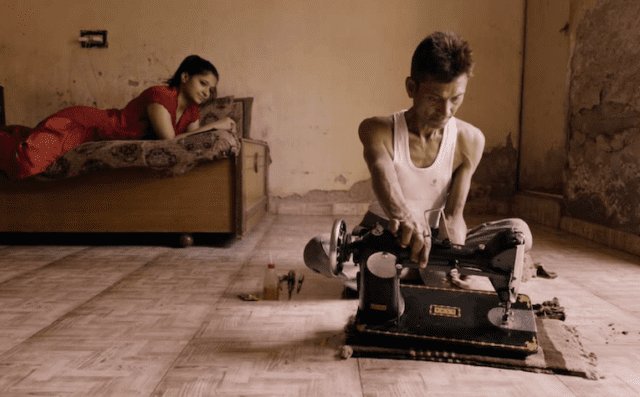
One day her father brings home an object that has a vital connection to his family’s past – the sewing machine previously owned by his own father, a tailor. This proves to be the catalyst both for discussion about the massacre, and for a thawing of his relationship with his daughters. “I was there to capture it, and that really [stimulated] their curiosity for their own family history,” says Boissinot of the family’s reaction to the object.
“I think he is the hero of my film somehow,” the director adds of the girls’ father. He initially seemed a “very mysterious character” but nevertheless one who didn’t object to her chronicling his life and those of his daughters. “I went to other families. Some were more religious and some were not comfortable with the camera, but in his case, he really felt, ‘no, I want to tell my story’…because I think he really wants this story to be known outside India.”
Boissinot’s documentary project derived from of a Master’s thesis that she wrote in 2012, as a geographer at Paris Nanterre University. While working at the Centre de Sciences Humaines (CSH) of New Delhi, she studied how Hindu-Muslim communal violence in the city of Ahmedabad led to the progressive segregation of the Muslim minority within the city. Juhapura, where the film is shot, was a mixed neighborhood in the 70s. Today it is the largest Muslim ghetto of the Indian subcontinent, populated by half a million people. “This area is a ghetto in a sociological sense – it is a place where Muslims are pushed by violence and residential segregation, but it is also a place they move to because they feel safer within their own community,” Boissinot writes in her notes.
The director discovered the girls in a local school within the area, and such was her faith in them she dedicated the next six years to the business of following and recording their lives, learning Hindi in the process, her camera all the time eliciting the most natural and authentic responses from the girls.
“I think it is the bond that we created together that really produced that effect, and the time spent with them, and the fact that I was also working without a translator. It really allowed me to be very intimate. You know, I also grew up with them, because when I started I was 28. Now I’m 35. They were 15. Now they’re 22. The eldest sister [Suzain] is now married. Over the years, that bond really got more and more important and strong. That’s why they are so natural with me and with the camera.”
In one mesmerising scene the girls chat on their balcony at night as a vast wedding, replete with noise and music and millions of brilliant lights, continues below. In another funny scene, an older Suzain shrewdly organises the working day of her future husband, a rickshaw driver, best to help maximise his profits. She loves him, she says, but “be smart for a change, and take my advice,” she signs off.
In 2020, India was shaken by the largest demonstrations since its independence, due to the adoption by parliament of controversial citizenship laws, targeted at Muslims. On television and in person the sisters begin to observe the emblematic Shaheen Bagh sit-ins led by Muslim women in defence of the country’s constitution. These are scenes which play in delicate counterpoint to the horrific testimonies of the massacre of two decades before.
Little by little, the girls’ past is one that can be acknowledged and spoken of, and they even feel able to return to the husk of their abandoned house from over 20 years ago to light incense in the former rooms of their mother and grandmother.
“The urban landscape of Juhapura, made of endless wastelands and residential towers, appears to set new frontiers, both geographically and symbolically,” Boissinot concludes in her film notes. “These are spaces of segregation, where Muslim families were forcefully pushed, but they are also bare lands waiting to be shaped. They reflect the teenage girls’ state of mind [but also] their uncertain future.”
The Pathan Sisters (Les Soeurs Pathan) world-premieres August 10 at 11am in Locarno’s La Sala.