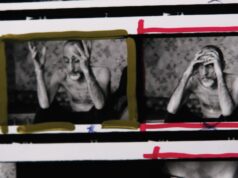
Iranian Nasreen wants to sing. Her husband Mohammad wants to work, most nights until long after his kids’ bedtime. Nasreen would love to sing for him, but he doesn’t want to hear. His response is to belittle her efforts in front of their son Hamid. Nasreen cannot remember a romantic moment shared with Mohammad and even undergoes post-natal corrective surgery, which he doesn’t seem to notice. At his son’s birthday party Mohammad implores Nasreen to “cut the cake and let’s get this over with.” Life is miserable. Eventually enough is enough, and they divorce.
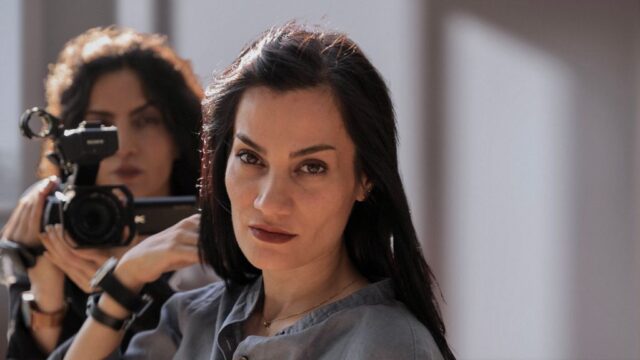
But Nasreen still wants to sing. The dilemma she faces however is that women in Iran have been banned from singing publicly since 2016. So it must be a clandestine practice. “The potential consequences for Nasreen are serious,” underlines director Leila Amini to BDE. “Iranian law and cultural norms are strict when it comes to women’s participation in public life, especially in the realm of music and entertainment.”
Nasreen is nothing if not determined. What’s more she is good, and eventually her beautiful voice reaches the ears of influential composers and lyricists in Iran who want to write for her. “When I sing I smile,” she says, even though any future performances seem destined to be for an equally clandestine audience.
“As a filmmaker, I care deeply for my sister and her experiences. It was a privilege to be able to capture her story in such an intimate and personal way,” Amini says of her film that world-premieres at the Swiss festival. “I wanted to create a safe and supportive environment for her to share her story. I believe that our close relationship was crucial in helping her to feel comfortable and confident on camera. Despite the challenges she faced as a woman and singer in Iran, she never lost sight of her passion and her commitment to her dream, which was truly inspiring to witness.”
The story was not without resonance for the director, over and above the sibling component. “As a woman, I had fought to find my identity and personal independence as a female filmmaker in a patriarchal environment full of prohibitions and limitations,” she says.
Nevertheless, Amini was conflicted as she observed and chronicled her resolute sister. She was fully aware of the hardships Nasreen was likely face on her chosen path, and how much she was likely to suffer. “I would have preferred her to forget her passion and focus on her family life,” she writes in her film notes. “But as a woman, I gave her the right to have a dream and to fight for its realization, discover her identity away from the identity of the wife and mother she was. And as a filmmaker, I picked up my camera and started recording her life with many questions as a woman myself.”
“When I first began filming, I had a general idea of the story I wanted to tell, but as the project progressed, the scope and depth of the story changed significantly,” Amini adds to BDE of her seven-year endeavour. “My initial vision was more of a personal portrait of my sister and her journey, but as I spent more time with her and her family, I realised that there were many other layers and complexities to explore. The finished film is much more layered and nuanced than my original idea, and it delves deeper into themes of gender, family, and societal pressures in Iran.”
As ever in films that detail parental discord within the family home, kids are the collateral damage. This is no different in A Sisters’ Tale, where son Hamid is rendered shy, nervous and often in tears, while daughter Hana is forced to blocks her ears during arguments.
“The issue of children being affected by an unhappy marriage was very poignant for me, and I took a sensitive and empathetic approach when filming this part of the story,” says Amini. “I wanted to capture the emotional truth of the situation and the impact it had on the children, while also being mindful of the privacy and well-being of the family. I tried to be as understanding and respectful as possible, recognizing the difficulty of the situation and the potential long-term effects on [them].”
The sisters in the film (there is a third, and equally feisty, sibling named Saleh) are tough, and deeply miss their late father who seems to have been a rock in their lives, and who contrasts greatly with Nasreen’s fickle husband. The resulting doc attests to their collective vigour within a political and social structure designed to restrict their advancement or achievement.
“The female dynamic within the film is a powerful and important aspect, as it highlights the strength and resilience of women in the face of societal pressures and constraints,” agrees Amini. “My sister and the other women in the film are all strong and determined individuals who support each other and stand up for their own beliefs. This dynamic helped to shape the narrative and message of the film, as it emphasizes the importance of female solidarity and the power of women’s voices.”
The director is delighted that the film will gain an international platform with its Locarno selection and probable roll-out across other major doc fests. This will enable her to generate “meaningful conversations” about gender equality, artistic freedom, and human rights in Iran and beyond. Amini is also looking to mount a high-profile Impact campaign around the film, to help draw attention to the issues it explores. She is also determined to work with grassroots organizations in Iran to enable audiences to see the film without the risk of detection by authorities.
“When I decided to make a film about my sister’s journey to achieve her dream, she was alone. I chose to accompany her, and through this journey, ‘she’ became ‘we,’” Amini reflects on her and Nasreen’s personal growth over the past seven years. “Together we found greater strength, our motivations strengthened, and our path [became] smoother. Neither of us could have endured and continued without the other. We also discovered deeper meanings of being human and being a woman.”
“We became mirrors for each other, and by seeing each other’s weaknesses, shortcomings, and vulnerabilities, we gained a better understanding of ourselves,” Amini ends.
A Sisters’ Tale, produced by Mira Film and Docmaniacs, world premieres August 9 in Locarno.