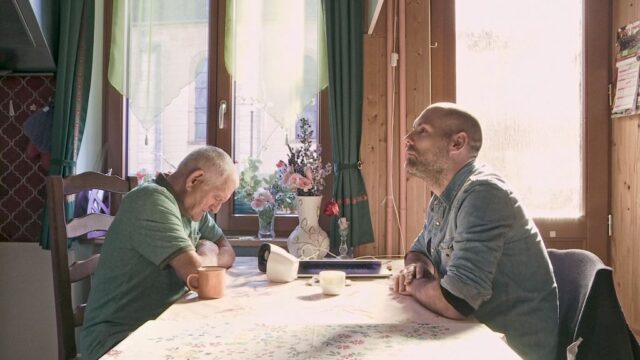
Claudia Marschal’s feature documentary La deposition tells a story of sexual abuse within the Catholic Church and of one man’s refusal to be silenced over the wrongs he had to suffer.
A quarter century after suffering alleged sexual abuse at the hands of a trusted Catholic priest, Emmanuel Siess is still angry that nobody ever listened to his pleas for help, and that his alleged abuser, Father Hubert, remains both a practising cleric and upstanding pillar of the community.
In many ways, Claudia Marschal’s La deposition is a tale of two fathers; that of the charismatic priest, and Emmanuel’s own father Robert who trusted much to Hubert and the institution of the Church, but is now determined to right the wrongs of the past, even if his approach is somewhat akin to a bull in a china shop.
Emmanuel himself is prickly and uncompromising in his desire to see justice done, but never loses his faith, even if he leaves the Catholic Church to be re-baptised within a Protestant Evangelical Church (which he later departs after they suggest ‘deliverance therapy’ to remove the spirit they assume entered his body when he was abused). But he has always been a model devotee, who served mass within the church directly located behind the lively restaurant his mother and father ran when he was a kid.
Director Claudia Marschal witnessed at first hand Emmanuel’s upbringing. “[We] have always been really close because he’s actually my cousin. We were always close as kids, and I was always kind of fascinated by his rapport with religion and to faith because, as we can see in the film, he still goes to mass a lot. He always used to pray before going to sleep. He loved going to church. He wanted to become a priest. And I was just very intrigued by that,” she says.
“Furthermore, after what happened to him, still his faith was strong. And I always wondered how he could reconcile [that with] what happened to him,” she adds. “When he decided to get baptized for the second time, that’s when I offered to make a film. That was the trigger. But his baptism was also the trigger for his past to resurface, and his past became much more prevalent [when] the priest came back into his life. That’s how it all started.”
The film is also a tale of two depositions, one given by Emmanuel to the police, and which forms the spine of the film, and another given to the progressive Catholic Monsignor Ravel, who is determined to expose sexual malpractice within the Church.
Throughout La deposition, we see Emmanuel’s anger and frustration with his unsophisticated father Robert, whose grammar Emmanuel corrects on occasion, and who acts very much on instinct. When Robert visited Father Hubert to question him over Emmanuel’s allegations, he accepted too easily the denials of a priest whose authority was beyond question, we are told. The letter that Emmanuel subsequently received from Hubert, blandly suggesting that they should meet to discuss matters “as soon as I return from the health resort,” further sparked in Emmanuel “a need for justice, a need to be heard.”
“The father [Robert] tries to find the truth by going to the priest, and he just can’t fathom [how] the priest won’t admit to the crime he’s committed, that he won’t admit to lying, because in his mind, the father’s convinced that a priest can’t lie. He really can’t wrap this around his head,” director Marschal opines.
All the time, Emmanuel’s frustration is fuelled by his never having been listened to since he was a child. Oftentimes, victims of sexual abuse remain mute, whether out of a sense of shame or fear. But the teenage Emmanuel went to his mother (who died in 2008), his grandmother, his father and to a teacher at school. “He spoke and nothing happened. So how do you construct yourself as a child when you went to see the adults that are supposed to care for you? And nothing happened. So it’s true that his anger can make him come across as a difficult character,” says Marschal.
“But I think he wants to get closer to his dad,” she adds.
Which he seems to do as the film progresses. After the penny finally drops for Robert and he understands the seriousness of what his son had to suffer, the pair stand outside the church where Father Hubert is saying mass, mere metres from its door. The scene is poignant but deftly presented, as Robert is all for confrontation while Emmanuel is determined to pursue a more delicate path.
“[Robert] acts like he’s in a western. He’s like a cowboy who wants to find justice and do it himself. On the other hand, you have Emmanuel who is more, how can I put it, nuanced in his response,” says Marschal. “The way forward is now to seek justice, but from a legal point of view, and that’s why he writes a letter to the prosecutor. He does things by the book.”
Furthermore, the father/son relationship, which rests on the shaky foundations of regret, frustration and awkwardness, is further strained by Robert’s determination to make his son’s cause his own. “The father became extremely adamant that what happened to Emmanuel needed to become public knowledge,” explains Marschal. “His main concern was not to die with the weight of the secret and guilt. And I think that Emmanuel kind of felt dispossessed, in a way, of his story.”
Given that the film is based on ostensibly dry spoken deposition, Marschal was determined to apply key visuals to recreate the “bygone world” of Emmanuel’s youth. Much of this archive comes from an unusual source – the local mayor – who shot lively dinner/dance Super-8 footage inside the family restaurant, and of the young Emmanuel in full altar server garb.
“These Super-8 eight images really helped me to bring to life a world that has disappeared, and also to bring to life the relationship between the priest and the children to really show the context in which the assault happened,” the director explains. “I just found it interesting to work on a kind of juxtaposition between past and present. I wanted to create a dialogue between temporalities and highlighting how time has passed and this world has gone, but also showing that there’s something totally immutable. At some point, time kind of stopped, but the settings are the same, and this whole landscape, this whole universe, is the inner landscape of the characters.”
The film is sold by Shellac and will be released across France in October 2024. The company will also oversee an international Impact campaign focussing on the issues of sexual violence that Marschal addresses.
In October, 2021, an independent commission on sexual abuse within the Catholic Church in France (the Sauvé Report) estimated that there are approximately 330,000 victims of sexual abuse. Tragically many of these cannot go to trial due to statute of limitation restrictions.
“There’s talk in France about removing statute of limitations for sexual crimes against children. This is a vast and very complex question, but if the film can somewhat contribute to the reflexion and debate, raise awareness and bring these specific questions to a broader audience, I’d be very pleased,” Marschal ends.