Even before the full-scale invasion of February 24 2022, Ukrainian director Juri Rechinsky was co-ordinating the movement of refugees from his country to other parts of Europe. At the time he was based in Austria.
After the invasion he was determined to return, not just to chronicle the war, but also to understand the situation in his home country. “I wanted to have a direct experience about what is happening. And it’s not possible to have it through media. It’s not possible to get it through stories of your friends. I had a really strong urge to go there and to figure out what the fuck is going on.”
When he started the project his focus was the relocation of refugees, “meeting them and figuring out what to do, what to do next, where to accommodate them, and so on and so forth.”
He also set out to record the process of transferring the elderly and infirm to safety. “This is how we spent the summer and part of autumn, researching and filming this part of the film about people of age and people who have difficulties with mobility and health issues. This was one storyline and one big flow of people,” says Rechinsky.
“What I discovered when I came to Ukraine, what I discovered for myself is that war is about movement. It’s about flows of people and things either from the frontline, either towards the frontline…and it was super impressive the scale of this thing and also the risks and the tragedies, the condition of people who are being evacuated. The scale of it was powerful. The experience was very powerful, scary, painful, everything.”
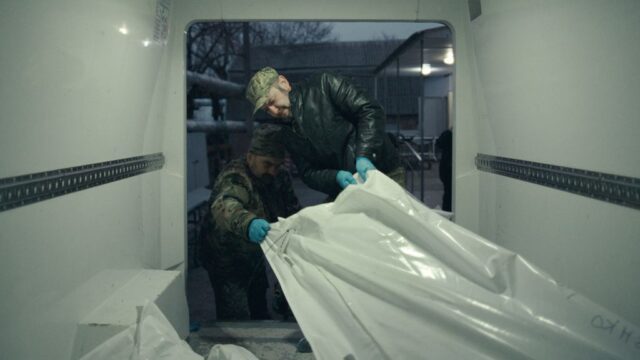
But Rechinsky wanted to explore yet another angle, one that was both poignant and painful, but essential to document. “We came across this topic of relocating dead soldiers, which is also a huge flow and a complicated process.” The director conducted a research trip as part of a crew returning bodies to their families all over Ukraine. “It’s something I never experienced before. It’s something I had never seen before. I wanted to dig into this topic as a human being and also as a filmmaker, to explore it and also to tell about it,” Rechinsky underlines.
In the film the bodies are located, placed into bags, delivered to the mortuary and prepared for final delivery to their families for burial. The latter scenes are desperately sad. “You’re my only son. It should be you burying me. Not I burying you. My dear child, wake up,” one grieving mother beseeches her boy.
The process of acquiring the go-ahead to shoot such personal scenes was frenetic. “We are getting permission to get there and leave there the camera five minutes before the parents are coming,” explains Rechinsky. “We’re jumping in, setting up the camera, and then the relatives are coming. So we are stuck in a situation where we are not supposed to be, where we are not ready to be. We stopped moving, we stopped breathing, the camera is rolling and the scene is happening in front of us…I was one meter away from the head of the guy. And I think that relatives were not even noticing us because they were busy with other things of course.”
“When the film crew is leaving the place, we’re watching each other and we realized that everybody was crying,” the director adds. “Every meeting was horrible and heart-breaking.”
Equally moving is a follow-up scene where streets of a town are lined by hundreds of its inhabitants, bowed and kneeling as a fallen soldier is returned.
Elsewhere in the film, we follow mothers and children as they are evacuated by train to other parts of Central and Eastern Europe, their passage eased by folk displaying great concern and kindness, and elderly residents suffering from a plethora of ailments who are evacuated from their homes to safe accommodation.
“For the first time in my life I have such a journey,” one old woman expresses. “As long as this is not your last journey, that’s all that matters,” she is reassured.
One can imagine that the emotional and psychological strain on Rechinsky was considerable. Doubly so, he concedes.
“There are two very different phases. One is when I was there on the research and during shooting, and another was when I came back with the material and was editing it for almost a year in Vienna, and they’re very different regarding challenges in psychological state,” says the director.
“The first phase I had this trick. I realized very quickly that it’s very difficult and almost impossible for me to be an observer,” Rechinsky adds. “Psychologically it’s very difficult to just stand there and watch things happen. So I was participating. I was literally doing the work together with the characters of this film, helping them at every stage. And this is something which was keeping it together. Because when you are doing some actually quite simple – physical work, in my case – it was holding me together.”
He describes tasks such as unloading and delivering 30 bodies. “It brings it from this psychological sphere into a very concrete situation.”
But the process the editing was “way more difficult,” Rechinsky stresses. “I started to have all the symptoms of quite severe PTSR combined with the necessity to watch and work with the material every working day.”
He explains that this wasn’t his first harrowing experience as a director. “I started my career spending three years with homeless kids who are living in the basement and taking drugs [Sickfuckpeople, 2013]. After a while doing it, and after doing it, I had a quite crazy psychological state with a lot of consequences, which in the end, I managed to overcome and to somehow integrate into my image of reality. So I had already some experience of putting myself in a traumatic situation for a prolonged amount of time, and then again with some time in getting out of this state to, in the end, feel myself richer…stronger.”
Rechinsky intends to return to the subject of traumatized soldiers with his next film. He further maintains that the war must be documented as closely and as thoroughly as possible. “Every person with a camera, it is a very different perspective, which is capturing a very different event or doing it in different way.”
“The war is still going on. It changed a lot of things in Ukraine, it has changed people, soldiers. Everybody’s in a very different state. Everybody is on the edge of exhaustion and madness,” he adds.
“[On Dear Beautiful Beloved] I wanted to participate. I wanted to take part, even if it is a microscopic part, but I wanted to take part in what is going on with the hope to make the situation better, even if it is just 0.00001%. And to do it with the tool which I’m familiar with, which is a film camera,” Rechinsky signs off.
Dear Beautiful Beloved is produced by Thomas Herberth, Florian Brüning for Horse&Fruits, and is sold by Filmdelights.