Midway through Adele Tulli’s feature doc Real, members of a Queer community meet as avatars in a VR to discuss aspects of their identity. The VR may not be their physical world, but for some it is their ‘real’ world, a place where they can seek (and find) both comfort and approbation. “I just feel so affirmed as a queer person in ways that I haven’t in the physical world,” voices one.
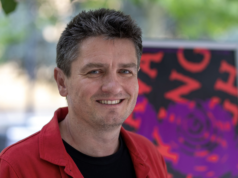
For Italian director Adele Tulli this scene represents the core of her documentary, and is indicative of the overall Caesar shift in how we perceive/assess our place within the digital world. “This specific thing [the avatar conversation] was maybe the most revelatory and stupefying experience throughout this process, getting close to this community inside the VR, which I didn’t know much about when I started, and actually getting to know them made me understand so much of some of these reflections about the nature of reality and how it’s changing,” Tulli tells BDE.
“That’s maybe one of the reasons why the film is called Real,” she adds, further affirming in her notes how, “I began this project with an urge to delve into the ongoing emotional, social and cognitive metamorphoses triggered by our relationship with digital technologies…I felt that whatever we used to call real was collapsing and I started looking for ways to represent this collapse.”
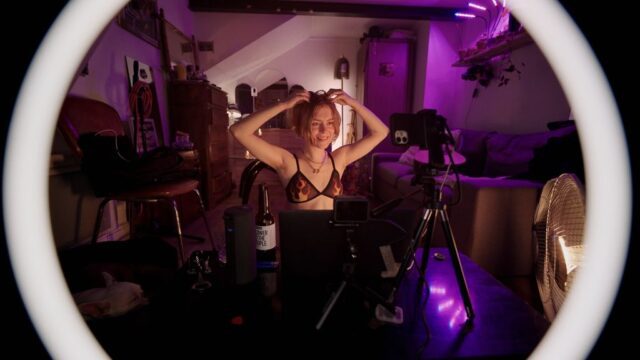
Elsewhere across the doc, we meet a plethora of folk whose existences are defined by their digital output. A delivery rider in Korea makes his work bearable by vlogging the whole experience. A sexcam worker seems to experience non-threatening and reasonably profitable exchange online (even though she implores one customer to ‘finish it soon’ so she is not too ‘wasted’ to play guitar later). We see a series of YouTube influencers owning up to the pressure, loneliness and depression they feel in retaining their online following. A young man in rehab may wish to wean himself away from 18 hours per day of online, but still recalls the “authority” he has within the digital space, while another likens himself to “one of the dead bodies you see in shooter video games that have a floating ‘revive’ icon above them.” We also meet a family in Korea who can live rent-free in exchange for data on all aspects of their lives, in essence allowing the digital gaze to be turned on them.
As Tulli further writes in her notes for the film, “the story of these existences permeated by new digital technologies is narrated in the film by constantly interacting with the raw footage recorded by their own devices, evoking the presence of a mechanical, automated, surveilling gaze, recording everything, all the time: an omnipresent, constant and inseparable gaze, so familiar to feel almost invisible, while dominating our hyperconnected routines.”
She tells BDE how she began to develop the idea for the film when living in London, which at times seems like the surveillance capital of the planet. “[They are] not only where you’d expect them [CCTV cameras], but everywhere, literally from shops, schools, pubs, churches, whatever,” she says. “So at the time I kept looking at them just wondering how this mechanical disembodied gaze would look at us humans. What kind of representation and interpretation of reality would that gaze offer? And not only obviously the cameras around the city, but also the cameras that we carry with us in every digital device.”
“But then when the pandemic happened, the acceleration of our relationship with digital technology was just unprecedented and somehow unexpected…our bodies being confined at home and our old relationship interactions – life, essentially – being mediated by a screen.”
Tulli is intrigued by the performative aspect of online interaction, a factor that she explored in her previous film Normal (2019). “Before the internet we used to have a group of friends. Now we have a community of followers. And this community often is very much something that we feel close to, but at the same time it’s interesting how we are also performing for them. We are trying to please them in different ways. So there is this element of performativity that has become so strong and I’m fascinated by this sort of backstage point of view as well, so in the film you see people [in relation to] the device that they’re performing to.”
Much of the time her characters will be alone in their rooms with a small device in front of them. “It’s interesting to have these contrasts between a life populated with so many people, but at the same time a lot of isolation.”
At other times we see life from the perspective of the device, whether in the form of digital markers on the key facial areas of a human subject or, as in the case of multi-faceted images such as a crowd on a street, detailed identification and naming of each component within the frame.
A mid-point montage culled from the web (YouTube, TikTok et al) presents a hallucinatory reminder of the diverse and ever-weird ways that people present themselves to the world.
“Those sequences obviously highlight more the absurd aspects of some of the contents that you come across. But at the same time, I try to contextualize them and humanize them and find the balance of empathy with the stories of the people I met, [such as] the delivery guy that has this relationship with his community, but also the sex worker who’s really having this warm interaction with the subscribers,” says Tulli. “This balance between empathy and absurdity is what I look for in this project, but also in general within my work.”
The film, produced by Agostino Saccà, Valeria Adilardi, Laura Romano, Luca Ricciardi and Mauro Vicentini for Pepito Produzioni and sold by Intramovies, will world premiere August 12 at Locarno.
“Obviously, for this film in particular, I’m very intrigued to know how the audience will react, also in terms of age, because obviously there are generations that were born even before the internet existed and still [have] very little relationship with it,” says Tulli. “My generation saw it happening, because I’m from 1982 and apparently the internet’s official birthday is 1983, so I was born with the internet development and I saw all the stages happening throughout my life…So it’s an interesting position to be in when you try to investigate how it is impacting anthropologically and socially us humans.”
“Younger generations have a completely different attitude, and for them the distinction between the physical and digital and virtual is really obsolete, and something that is so 20th century,” Tulli signs off.