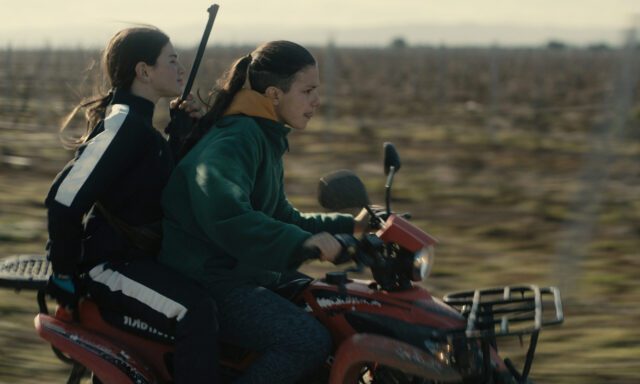
Directed by Spanish filmmaker Alberto Martín Menacho and produced by Bern-based David Fonjallaz of Lomotion, the €300k Antier Noche is described as “a portrait of four young people from southern Europe, who are united by deep roots, words and gestures, and who grow up questioning the immobility of their society.” The film is co-produced by Mizunonaka (Spain).
The protagonists of the film live in the small town of Salvaleón whose population has radically reduced from over 5000 to just over 2000 over the past half century. As people leave the town and as older folk die, the local economy has become blighted. Yet cohesion within the community remains intact, not least due to the prevailing traditions kept alive and practised by the locals, one of which is the hunting of hares with greyhounds. Spain is the only EC country where this tradition is still observed, say the filmmakers.
In the character of seven-year old Diana we are invited “to reflect on the violence inherent in hunting.” Her desire to discover the hunt is transformed into her further acceptance of its violent consequences. Diana’s mother is a casualty of the town’s dire economic status, yet a woman who exhibits a “deep desire for emancipation.” Santi meanwhile is desperate to leave the town and to discover a new life. But Francisco, a calf and pig farmer to whom she is devoted, has worked in the fields since he was a child and is tied to the land and its traditions. Santi’s fear of leaving and Francisco’s fear that she will move away is a dilemma that unites them again.
In his film notes producer Fonjallaz describes Antier Noche as “a choral film that deals with universal subjects at a local level, and proposes to establish questions that confront our world, the rural against the urban and the animal against the human. A research into the existing fracture between antiquity and modernity, in other words, between tradition and progress.”
Principal photography on the film completed this week and editing commences next week. The filmmakers are looking to complete post-production by the end of 2022 in time for a festival premiere during the first half of 2023. There is no sales agent yet attached. Filmbringer will release in the film in Switzerland, while Vitrine Filmes will distribute in Spain.
“I wish to observe primitive elements of the human being that still persist in time,” writes director Menacho of his approach to the project. “Two of these principles, that are closely linked to the history of humanity, are hunting and migratory movements. Hunting today is not done as a survival method. It is considered a sport, a hobby or a passion. Perhaps, to evoke this rupture, [it] is already recalling the fracture between an ancient world that disappears and a modern world that takes its place.”
“This film was born from the desire to make movies in a forgotten corner, in Extremadura, a region that I love, where a group of young people live, that I know and with whom I have worked previously,” Menacho continues. “Cinema has given me the opportunity to communicate and to go to meet them…Observing the reality of this youth has given me the possibility to build this story together with them. What does the place where we grew up impose on us culturally and historically?”
“This film observes the hunt, but it is not a film about hunting, it is a reason to travel in time, through the violence inherent in it. This story deals with universal issues at the local level, and attempts to connect primitive violence with modern technology communication. It is a sociological and cultural heritage story in a rural context. It is a story of love, of loneliness too, of childhood and of the beauty of youth.”
“I have personally never seen hare hunting with greyhounds in a movie. The abused life of these dogs must be known in an honest, fair and dignified way. In this case, I will achieve this by being there among humans and animals, filming an ancestral ritual observed by my gaze and the gaze of a little girl,” Menacho ends.