

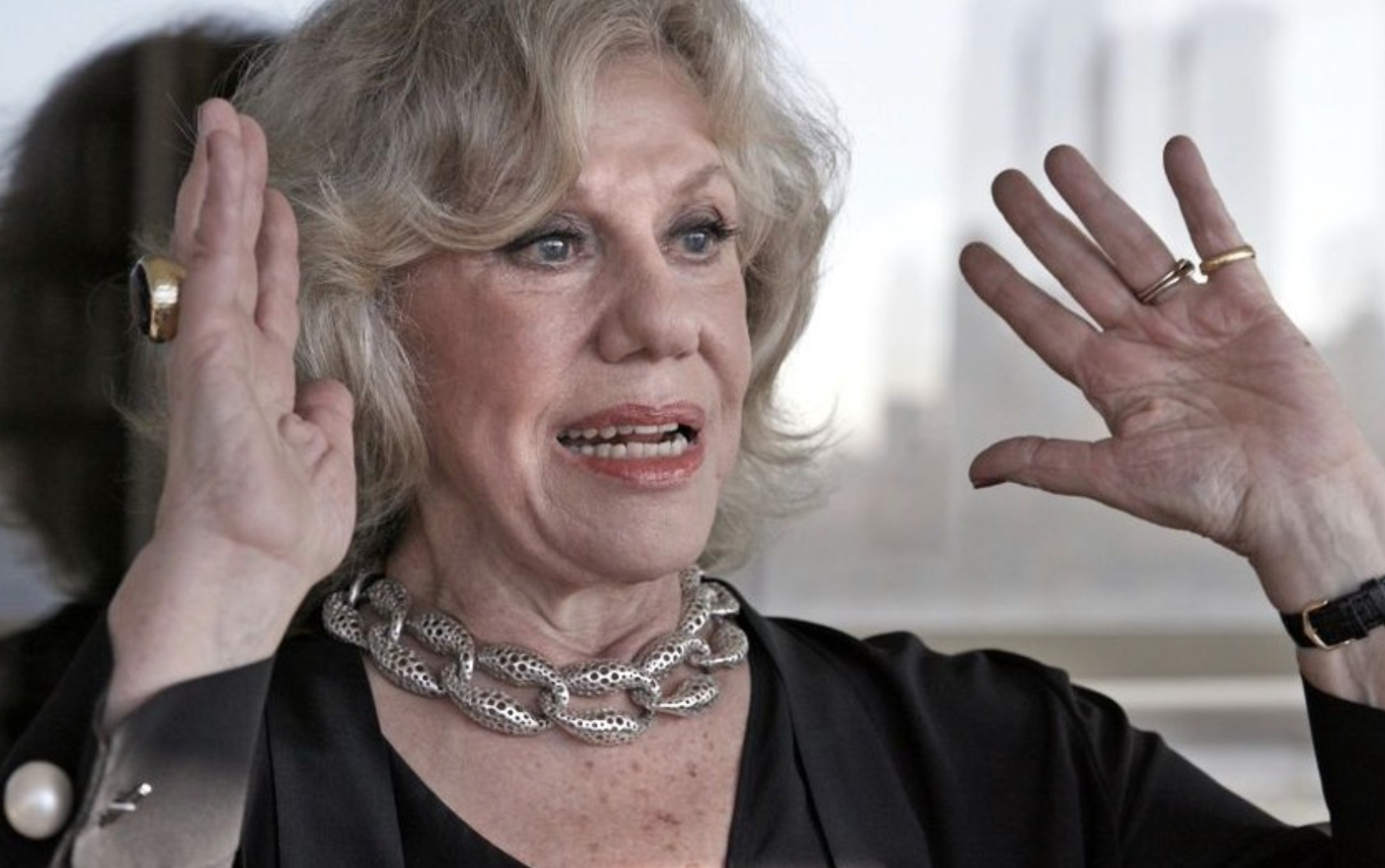
She is the author of ‘Fear Of Flying,’ the bestseller from the early 70s credited with liberating a generation of women and still remembered for its punchy, provocative catchphrase, the ‘zipless fuck.’
New York-based Erica Jong, who turned 80 earlier this year, has been a full blown literary celebrity for going on half a century. She has written many books and has been a regular fixture on US talk shows. Until now, though, nobody had made a proper documentary about her.
Enter Swiss filmmaker Kaspar Kasics, whose film Erika Jong – Breaking The Wall (sold by Berlin-based Rise and Shine) premieres Out of Competition in Locarno. Kasics discovered Jong’s work not through ‘Fear Of Flying’ but through her much later work, ‘Fear Of Dying.’ He was intrigued that these two volumes seemed to book-end her life and career.
“When I read ‘Fear Of Dying,’ I realised she is so intelligent, this woman, and she has such a lot of humour and wisdom,” Kasics observes. He went on to read ‘Fear Of Flying’ but couldn’t understand why the book had been considered so controversial. (Some people even attacked it as pornographic). He read many of her other books.
“Not all of the books are that good but in all of the books, she is treating the subject of equality in a very special way,” he says. He admired Jong’s quest to “change the world” and to re-define gender relationships.
Early on, the American didn’t fully understand what Kasics was trying to achieve. She assumed he would sit her down in front of the camera, ask her some questions and then leave again. “When I met her [Jong] the first time, we had a good talk but I realised she had no idea what a documentary means,” the Swiss filmmaker remembers. “She always thinks in categories of interviews on talk shows because she has taken part in so many talk shows in her life.”
Kasics explained that his film would be “an adventure.” He and his camerawoman would be observing her in her everyday life. They would be with her for “three, four or five hours” at a time, not just for a few minutes looking for soundbites.
”Then she started to talk differently, much more personally.”
The film took “two or three” years to complete. “Every time I came, she was ready to go a step further,” the director says of his evolving relationship with his subject.
At first, Jong was baffled that Kasics wanted to film seemingly banal moments in her everyday life, for example to show her working out. He explained to her that he would combine these moments with her thoughts. “Finally, she understood. She said ‘aha, you will need tons of material, the same as when I write a novel.’”
The documentary delves into Jong’s past, talking about her difficult relationship with her mother (a brilliant artist), and also deals with her immediate family. Kasics addresses Jong’s challenge to be both an artist and a mother. “I realised this is still occupying her. This is a question she has not really answered for herself because, as is obvious, she has not had very much time for her daughter. Her daughter suffered a lot because she [Jong] was always there for everybody, for television, for editors, other artists but not really for the child. She tried to do it but I am not sure she really succeeded. Her daughter had a hard youth.”
Kasics was keen to include the daughter in the documentary. He interviewed her but realised she was very wary about the film and ended up not using the material. The director therefore instead put more focus on the grandchildren to whom Jong is utterly devoted. These kids were naturals on camera. The director, though, couldn’t help but note the differences between the grandson and granddaughter. The former showed a certain youthful machismo and loved to talk about weapons and power while the latter was much more reflective and loved to read books. In their own way, the kids were living up to older gender stereotypes.
Work started on the documentary before the pandemic began. With the scourge of Covid looming, Kasics realised the film was going to take a far longer time to complete than originally planned. Jong and her husband were strongly affected by the lockdown. Over a period of a year, they hardly left their apartment.
“I knew I had to include the pandemic but I didn’t know how,” the director recalls. Back in Europe himself, he contacted a cameraman in New York, asking him to go downtown to the Jong’s apartment to do some extra filming. Meanwhile, he stayed in touch with Jong by phone and zoom.
The pandemic forced him to re-think his conception of the film. “In a way, something amazing happened. I realised while editing that this isolation of the social situation has a link to the isolation in which Erica has to go when she is writing. She told me ‘when I write, I have to forget everything that went before.’ When I was there, she was fighting for this isolation so she could go on writing. I wasn’t conscious before that writing had to be such an isolated process.”
Jong and her husband Kenneth Burrows (who also features prominently in the documentary and who was diagnosed during shooting with Parkinson’s disease) have now seen the film.
“I went to New York in February this year. I showed the film…I told her and her husband, ‘Erica, you know now a bit more what documentary means. It was a real adventure for you. Now, it will be another adventure when you see the film’…they watched the film and they were fascinated. They would never have believed that in a film, you could show what a writer’s life is.”
This was a very intimate and candid portrait of the author. Kasics told Jong that if she was unhappy with any part of the documentary, they could discuss it. He made it clear, though, that it would remain his choice as to whether or not to change it. In the event, she had no objections.
Having made the film, Kasics’ admiration for Jong has only grown. “When you make a big documentary, I always say it is a long journey. People change. The protagonists in the film are not the same as they were at the beginning…now, she [Jong] is like a really good friend,” the director observes.
“What I realised was that success has a lot of sides. She expresses it partly in the film…you become a servant of the public. When you look back, I realised that she has her doubts about whether it was right to be such a servant. For me, this was very impressive, to see how such a career defines her life,” Kasics further reflects. “In a certain way, it is also imprisoning you. But she is a very dialectic thinker. She is not ideological. She always sees the opposite and she always sees the contradictions in human beings. This was very impressive to me.”
Erica Jong: Breaking The Wall will world premiere in Locarno on August 7.





