

When Oscar-winning US documentary maker Elizabeth Chai Vasarhelyi (co-director of Free Solo with her partner Jimmy Chin) was growing up, she had a youthful fascination with the great Anglo-Irish explorer, Ernest Shackleton (1874-1922).
“My father is a professor. He was born in Hungary but grew up in Brazil before he came to the States. I grew up with a great fascination for exploration because he was so interested in it,” Vasarhelyi remembers. “I’ve always been fascinated by great adventure stories.”
Ripping yarns don’t come any more hair-raising than that of Shackleton’s voyage to the Antarctic in 1914 aboard The Endurance. As recounted in the Alfred Lansing book about the expedition, Shackleton and his crew had had to abandon their ship which sank in the ice in the Weddell Sea. Somehow, they stayed alive. Shackleton and some of his crew made a journey in an open boat to South Georgia, crossed the island by foot, found help and then went back to rescue the rest of the men who had been left on Elephant island, almost 350 miles from where the Endurance sank. Astonishingly, everyone survived.
The story of The Endurance is told in Vasarhelyi’s new film, co-directed with Jimmy Chin and Natalie Hewit. The documentary also tells the story of another remarkable expedition, that of a group of intrepid modern-day explorers, scientists and even a historian (Dan Snow), led by Dr. John Shears, who retraced Shackleton’s journey and found the wreck of The Endurance a reported 3000 metres beneath the surface.
Vasarhelyi was drawn to Shackleton’s status as an outsider. He was an Irish man who never quite fit in British society. “He wasn’t fancy, he didn’t go to all the right schools,” Vasarhelyi says of him. “And yet clearly there was a force of character that was quite inspiring.”
In the film, historian Dan Snow describes Shackleton as “a plausible rogue.” By that, Snow tells Business Doc Europe, he means the explorer was “hopeless with money…he left with unpaid debts, creditors shaking fists at him on the quayside. He left with probably a few husbands shaking fists at him on the quayside as well. He was charismatic, brilliant but he wasn’t a details guy so the expedition lacked critical supplies.”
Students on business leadership courses still study the story of The Endurance. There’s a certain irony here. Shackleton’s expedition, to make the first land crossing of the Antarctic, wasn’t remotely successful. Nonetheless, he was revered by his men and continues to be regarded as one of the most inspirational figures of his generation.
“What really struck me was the civility of how they maintained day-to-day life, be it from the porcelain they ate off or the shanties that they sang, the plays they put on, the books they passed around. They kept up morale by this maintenance of civility,” Vasarhelyi says of the routine that Shackleton put in place and the mood of optimism he somehow always managed to create.
Even when all seemed lost, Shackleton was somehow always able to inspire the crew that they would “somehow get through it.”
His crew members had such a strong sense of patriotism and duty that the moment they got back from the Antarctic, many enlisted immediately to go and fight in the First World War trenches.
Frank Hurley, the brilliant Australian photographer who had been aboard The Endurance, was one of them. Having recorded Shackleton and his team in the ice of Antarctica, he took equally remarkable pictures on the front line.
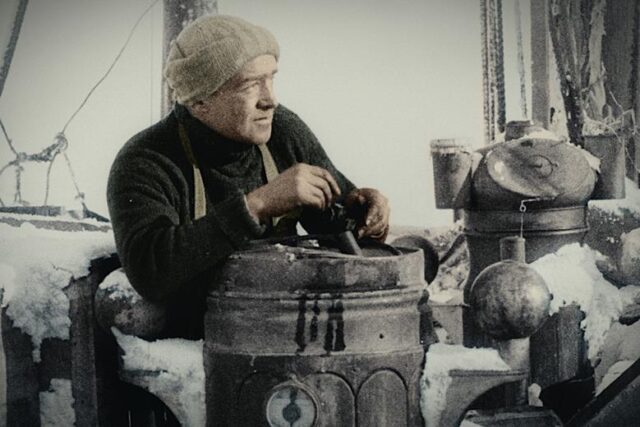
Hurley’s footage of the Shackleton expedition featured in the classic 1919 documentary, South. That footage, preserved and restored by the British Film Institute, is also included in Endurance. It has been colourised and looks as if it was shot yesterday.
The filmmakers have also used AI to bring the voices of the explorers back to life.
Artificial intelligence has provoked huge disquiet in the film industry in recent months – and was partly behind last year’s Hollywood actors’ and writers’ strikes. Here, though, it is used to ingenious and rewarding effect.
Vasarhelyi’s father is a professor of AI. “AI in my opinion is a tool,” she declares. “I think it can be abused. The ethics around AI…the legislation is not there. There is a lot of very valid fear around the abuse of artificial intelligence. But in terms of our movie, how amazing is it that there is an existing recording of someone’s voice…”
The filmmakers have taken the snippets of audible material available from Shackleton and other team members in order to replicate their voices. That means we have them reading from their own diaries. (The AI work was done by Ukrainian company, Respeecher).
Shackleton didn’t allow women on his crew (although a few applied to be part of the team).
“I am a very outspoken person on the representation of women, empowering women and empowering female storytellers,’ Vasarhelyi explains her own position. Nonetheless, she deeply admired Shackleton’s devotion to his crew members and seems ready to cut him some slack. He had abandoned an earlier mission because he knew it would put his men at risk.
In the documentary, the filmmakers interweave the Shackleton story with that of the modern-day expedition searching for The Endurance.
“What was hard here was the two different storylines because the stakes were so different,” Vasarhelyi acknowledges.
For the Shackleton expedition, it really was a matter of life and death.
By contrast, team leader John Shears, French subsea engineer Nico Vincent and the others on the modern expedition, have the benefit of GPS and modern technology. They’ve also got plenty of food. Nonetheless, they too endured some tense and fraught moments. They’re a very long way from civilisation. If someone was to get badly injured, it would take many days to get them to a hospital. They also have to deal with the expectations of their backers who’ve invested a huge of money in their work and expect them to find The Endurance (although the chances of them doing so are odds against).
“The passion, dedication and excellence of John, Nico and all the scientists aboard – I get really excited about that,” Vasarhelyi says. “I love it when people are passionate. And the two expeditions really do speak to each other.”
As has been exhaustively chronicled over the last century, Shackleton shone on this expedition, somehow guiding his men back to safety when it seemed far more likely they would all die. Back in Europe, he was regarded as one of the greatest heroes of the day – and yet he didn’t have a distinguished war. Nothing in his later life matched his heroics in Antarctica.
“As we all know from our own lives, someone who is brilliant in one field turns out to be slightly hopeless in another,” Dan Snow says of this enigmatic explorer. “There is no one better than Shackleton when everything goes to pot and you’re in the ice and you haven’t got enough fuel and clothes and time, and you don’t know where you are. There is no-one better on this earth than Shackleton! But if you’re wanting someone to build a textile business in Lancashire or represent your interests in Parliament, he’s not your man…that’s what so fascinating. He’s a hero but also a man of extraordinary flaws and shortcomings, as we all are. That’s why he’s so attractive, I think…”
Endurance launches on National Geographic on Sunday 3rd November and on Disney+ on 2nd November. The documentary, which had its UK premiere at the London Film Festival, was made through Little Dot Studios, Consequential & History Hit, in association with Little Monster Films.





