

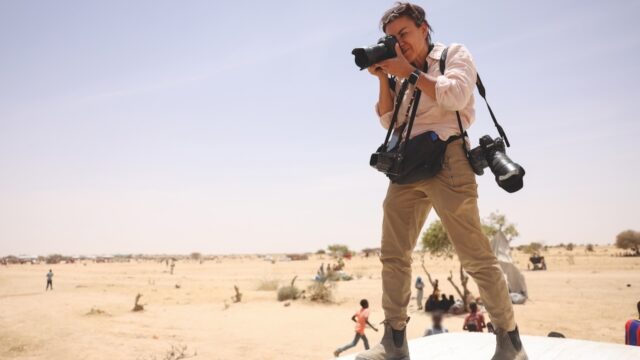
It’s not just about being courageous. Ask Chai Vasarhelyi (co-director with Jimmy Chin of Love+War) what most distinguishes the film’s subject, conflict photographer Lynsey Addario, and she points to Addario’s “diligence.”
Wherever she is, whether in Ukraine after the Russian full-scale invasion, or in Afghanistan, Iraq or Sudan, the photojournalist has “the discipline to do the work to an excellent, uncompromising level…and what is so special about her work is the heart, humanity and emotion she brings to it.”
Love+War, already being talked up as a potential awards contender, recently screened at the BFI London Film Festival following its world premiere at TIFF. It was produced through National Geographic Documentary Films and Little Monster Films. The release in UK cinemas by Dogwoof is on October 24.
The images Addario captures are often heartrending and brutal: civilians killed in Ukraine, women in agony after self-immolating in Afghanistan, US soldiers under fire, wounded and famished mothers and children in Sudan.
In Love+War, though, the lens is turned on her. This is a project with a feeling of Chinese boxes: Addario is photographing, but is being photographed herself in turn. Out in the field, cameraman Andriy Dubchak films her as she chronicles the war. Meanwhile, when she returns from gruelling trips abroad to north London – where she lives with her husband, former Reuters journalist Paul de Bendern, and their two young sons – documentarian Thor Thielow is waiting with his camera.
“He has this knack of embedding. I think as Lynsey puts it, he shows up and he never leaves,” Vasarhelyi explains how Thielow captures the most intimate domestic moments in Addario’s life.
Addario knew exactly what Thielow was looking for when he came into her home. She decided, though, to “allow myself to be the subject; allow myself to be vulnerable.” Her husband and children gave their permission for him to film them too.
“It’s what I do for a living. I do it to other people, in their homes. I am usually the photographer who shows up and asks if I can come at 5 in the morning and watch them through the day. Even in a war zone, I did that,” Addario points out the reversal in roles.
One of her recent jobs featured a young girl with terminal brain cancer. “I followed her through the last three months of her life. It meant me asking her mother if I could come watch them sleep, if I could be there 24 hours a day, if I could be there when she entered a hospice.”
With Love+War, she reasoned that the filmmakers were Oscar winners and knew what they were doing. She’d find it “very annoying” if a subject told her how to do her job – and didn’t want to get in their way or to insist they shot her in a flattering way.
“Otherwise, there’s no point. No-one needs to see another glamorous war correspondent movie. No-one needs to see another movie of one of us walking through bullets. It’s boring! We need to see that this is not an easy life. It’s a full-time commitment. Whether it’s on the front line or dealing with the emotional trauma at home.”
In the documentary, Addario is continually shown as being emotionally torn. When she’s at home, she yearns to be back in the field. When she’s on assignment, she pines for her loved ones in London. She is never quite sure she is in the right place.
Growing up in a close-knit family in Connecticut as the daughter of a hairdresser, the future photojournalist rarely, if ever, encountered violence. Now, in her work, she sees it all the time.
“I am not inured to it. It was a gradual exposure. Growing up in this relatively sheltered life, I never imagined I would become a war photographer…I guess I was first really exposed to violence when I [covered] India and I started documenting women ostracised from society. Then, I started going to Afghanistan under the Taliban. Little by little, I was exposed to violence but in different ways. It’s not always gun violence or mortar attacks. Violence takes many, many forms, and trauma takes many forms.”
Over the years, Addario has learned to “compartmentalise” and to process the suffering. Her goal is to “channel what I am witnessing into my work so the public can also be aware of what is happening.”
Her pictures in the New York Times, The Atlantic and other outlets have had a huge impact, sometimes changing politicians’ perspectives as well as exposing general readers to horror and injustice in far flung places.
Does she do it for the adrenaline? It’s a question she is asked all the time and she generally gives the same blunt answer: no.
“But it is invigorating and it’s a real privilege to live on the front lines of history and to be able to walk in and out of people’s lives; to be able to sit with people and tell their stories, to give people a voice who don’t have a voice.”
In an ideal world, she acknowledges, her subjects would be “telling their own stores,” not relying on western news agencies to chronicle their tragedies for them. “[But] local people are often persecuted for telling the truth on many different levels. They’re imprisoned or they’re silenced or ostracised within their communities for trying to tell stories that that community doesn’t want told. I think that’s where the role of international media comes in. It’s important to have someone from the outside be to able to come in and tell those stories.”
Addario adds that she will always look to work with local sources and fixers.
This wasn’t an easy film to structure. “It was quite challenging because of the breadth of Lynsey’s career, and how many important events and critical issues she has borne witness to. Every film has to find its reason for being. I thought it was really important to allow audiences a glimpse into the real courage behind the work,” Vasarhelyi explains why the documentary places such focus on its subject’s inner life. “It jumps around in time all over the place but it makes sense in the end of the day.”
When Addario and her family saw the film for the first time, they didn’t know what to expect. The photographer was at first “shell-shocked” by the experience.
“None of us could stop crying. In fact, we just left without even having a meeting because we were so emotional….suddenly to see here’s the fall-out of every decision you have ever made with your professional life on the people you love!”
If she was that deeply moved, Addario reasoned, it must have meant the filmmakers had done a decent job.
Both Addario and Vasarhelyi are now already busy with other projects. The former is working on a book “revisiting six or seven of my past subjects, looking at where they’re at now, and how that photograph played into their lives for better or worse.”
It remains crucial for her to keep links with the people she photographs. “I often enter their lives at their most vulnerable moments and I don’t think it’s fair to take that piece of them and never talk to them again…there are moments and situations that bind me forever to my subjects: the father of the soldier killed in Afghanistan, I was the last person with his son and so we will forever be connected.”
Vasarhelyi is working on another project on extremes sports with the working title, From The Edge, that is being made for Sphere Entertainment, the outfit behind the Las Vegas Sphere.
When Addario’s six-year-old son saw her on a poster for Love+War that had been left outside his bedroom, he was so excited that he ran down the stairs to ask if she had been in Africa.
“But my 13-year-old who will be 14 in December, he is aware of what I do and that is a difficult conversation. He has not yet seen the movie. He will see it this week or next. We have to sit down and watch it with him. I think he’s aware of what I do but he shields himself quite a bit. He doesn’t want to know too much. When I come back from Ukraine or Sudan, I ask him if he has any questions for me and he just says ‘no.’ He says ‘was it dangerous?’ and I say ‘yes’ – and he basically doesn’t ask me any other questions. I think this film will be really instrumental in showing what I do and why I am never home…”





