

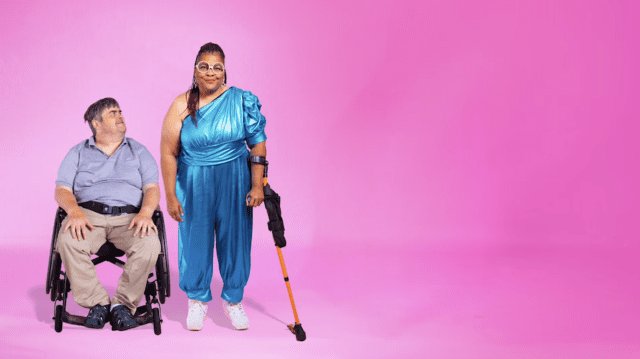
Patrice: The Movie (sold by Autlook) is an unlikely combination: a crowd-pleaser that may change US legislation regarding marriage and disability benefits. The day after it premiered on Hulu in the US last month, the Social Security Administration in the US issued a statement acknowledging the film, saying it was ready for changes to its own outdated system…if only Congress would pass the relevant new laws.
The film, directed by Ted Passon, tells the story of the remarkable Patrice Jetter, a crossing guard (a lollipop lady in British parlance), artist model, railway enthusiast, costume designer, figure skater and disability activist. She is a charismatic and ebullient personality who tends to charm everyone she meets.
Patrice also remains a relentless optimist despite the curve balls fate throws at her. She plans to marry her long-term partner, Garry, but if they proceed with the wedding, they learn they will lose their disability benefits. That would almost certainly push them into unsustainable poverty.
When Patrice realises she won’t be able to marry, she and Garry have a “commitment” ceremony instead – one attended by other couples who issue a rallying cry for a crazy law to be changed.
Patrice screened to sold-out audiences at the London Film Festival last week following its premiere at the Toronto International Film Festival earlier in the autumn. The doc won the audience award at the Camden International Film Festival last month and has already had a short theatrical release in the US
Filmmaker Passon has known Patrice for almost 20 years. He first met her through her niece, Kimya Dawson, a singer-songwriter whose music featured prominently in the 2007 hit indie movie, Juno.
“When I was just out of college, the first music video I ever made was for Kimya. We became friends. She would come to town three or four times a year. We would see each other and Patrice would always come and hang out as she lived nearby…I just fell in love with her immediately.”
Passon quickly knew he wanted to make movie about his new friend. He just wasn’t sure what form it might take.
In 2019, he was filming a quirky series for Netflix called Worn Stories based around its subjects’ most meaningful items of clothing. This was created by Emily Spivack (now one of the producers on Patrice).
Passon roped in Patrice for a short segment in the series.
“I got to see that she was, not surprisingly, very comfortable on camera. We had a lot of fun. Everybody just fell in love with her and said, ‘oh, we should do more with her.’”
However, Passon had to work on another major project first. The PBS docu-series Philly DA, which he co-directed with Yoni Brook and Nicole Salazar, was a cinema verité series following Philadelphia politician Larry Krasner, one of the most controversial figures in US local politics. This was an intense and difficult endeavour which took up huge amounts of time.
After finishing it, the exhausted director knew he needed to do something different. “Hanging out with Patrice” seemed a very attractive prospect. The one nagging question Passon had was: what was the story? This, though, was just the moment when Garry was proposing to Patrice. Their attempts to marry in the face of restrictive laws provided an obvious focus for the documentary.
The film begins in deceptively upbeat fashion with scenes of Garry and Patrice dancing on the ice. “There was a little bit of thought to the trope of the super happy, sweet, everything is fine disabled person, but then showing you no, we are not actually going to do that,” Passon explains why the light-hearted overture is soon followed by episodes that are far darker.
The director recreates his subject’s childhood in ingenious, highly stylised fashion with scenes recreated on colourfully designed sets in which Patrice plays herself – but all the other characters, including her mother, are portrayed by kids.
Passon wanted to tap Patrice’s natural humour. He had discovered that whenever she talked about the grimmest moments in her life, she would always still use humour to leaven the mood.
“We realised it was really important to understand Patrice’s back story and what it took for her to get all of the things that she is threatened with losing if she gets married,” Passon explains. “We also knew we wanted her art work to be foregrounded in the film somehow. One of the thoughts early on was, what if she designs the world of the past and it’s all through her lens. She’s a storyteller anyway.”
The director talks of giving the audience a “sneaky gut punch.” It may seem as if we’re watching some zany, high-jinks recreation of Patrice’s past “but the inhumanity of the system is laid bare when you juxtapose it next to a child.”
Patrice’s life is thrown into further upheaval when her van breaks down. She can’t afford to replace it. Without it, she and Garry are effectively stranded. She isn’t even able to get to work. Ever resourceful, she tries to save money in any way she can, and launches an online appeal for funding. This provides an extra layer of drama and suspense – will she get the vehicle or not?
“I don’t think any of us understood how important the van was going to be to the storyline,” Passon says of what became one of the main motors of the plot.
The director and his team filmed Patrice and Garry over a period of around three years. Passon was very conscious of the “ableism” which sometimes scars even the best-intentioned films – and of the tendency to patronise disabled characters and portray them as victims.
“Sometimes, we lean too much on suffering and we don’t tell stories with the full range of human emotions and experiences. Life is not one note – but a lot of time, our storytelling can be!”
“If the story was told well, it had a lot to do with the fact that we had disabled folks at every level of production, working with us…they were always there, helping us check on the story,” Passon continues. “They were helping along the way, making sure it [the film] was authentic. Obviously, we had Garry and Patrice there too. We were following their lead…putting that altogether, I think that helped make it an honest story.”
Despite Patrice’s obvious star quality, this was a tough project to finance. “In this landscape, it’s difficult to find money for a film that’s not about celebrity or a murder,” Passon makes a familiar observation.
Some potential backers were put off by the recreations. Others felt that the project wasn’t bankable. “That part was stressful.” However, the director did eventually find a champion in the shape of ABC News Studios exec Poh Si Teng. She eventually threw her weight behind the project, now shaping up as a major awards contender.
Patrice: The Movie was produced through All Ages Productions. ESS Projects and Cedar Road were the co-production partners.





