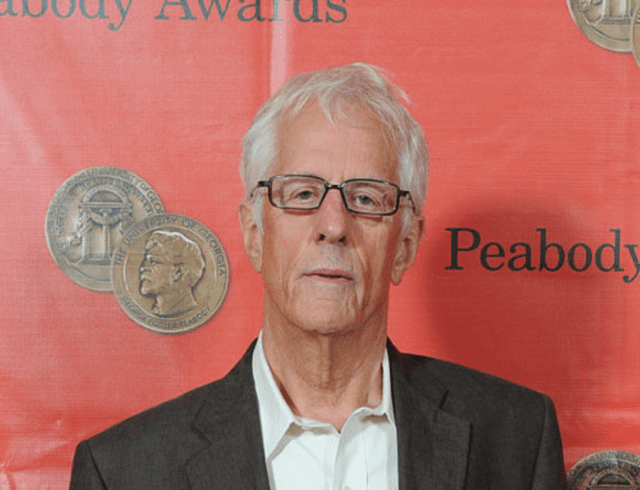
Michael Apted. pic: Charles Manley
International Documentary Festival Amsterdam (IDFA) founder and former director Ally Derks has paid tribute to British director Michael Apted, who died in Los Angeles last week, aged 79.
The Englishman began his career on the celebrated SevenUp! series. The series followed 14 British kids, starting in 1964 when they were seven and then revisiting them at seven-year intervals. (The most recent instalment, 63Up, was released in 2019).
Alongside his Hollywood movies, James Bond and Narnia films, as well as episodes of famed UK soap Coronation Streetthat he directed, Apted remained active in the documentary field throughout his career. He later directed Married In America, a series of documentaries following nine American couples, and Moving The Mountain, a 1994 documentary about the tragic events in Tiananmen Square in 1989. He also directed the official film for the 2006 FIFA World Cup. The ardent West Ham fan later directed another football documentary, The Power Of The Game (2007).
Apted sometimes came to IDFA too. The British filmmaker was one of the guests of honour at the festival in 2006 where he presented the world premiere of Married In America 2. Additionally, his Me & Isaac Newton was selected for IDFA Feature-length Competition in 1999. (He was coincidentally in the Netherlands that year preparing to shoot his wartime thriller Enigma starring Kate Winslet, which was made with Dutch backing.)
“It was really sad to hear that he has died. He was very friendly when he was at IDFA,” festival founder Ally Derks said of Apted. “He was big for us.”
“I loved the SevenUp! Films,” Derks continued of Apted’s highly acclaimed ground-breaking series. “Seeing how a generation grows up. You have expectations of what will become of them but it [turns out] completely different. It was a really great series. I love his fiction as well.”
Apted would conduct his interviews upstairs in IDFA’s former (spiritual) home, de Balie in Amsterdam, and clearly relished being in among a documentary crowd. “I’m a documentary filmmaker at heart…making documentaries is for me the most challenging and gratifying work,” he used to claim.
The director never concealed his hatred of reality TV, which he said “offends every filmmaking bone in my body,” but remained passionate in his advocacy of documentary.
Speaking at IDFA in 2006, Apted made predictions that now seem very prescient about how the doc form would evolve and prosper. “Documentaries, as long as they can be kept to a reasonable scope, can take advantage of the vast number of (new) outlets and niche markets,” he said. “I am guardedly optimistic that documentaries won’t have such a tough time as network television or movies are going to have, with their colossal escalating costs. Since there is such a vast demand for content, documentaries have a real chance to fill the vacuum.”
The veteran filmmaker also reflected on the Married In America series, through which he set out to explore on screen “what makes a committed relationship work.”
“I could be seen as the most expensive marriage guidance counsellor on the planet and they [the couples in the series] all stay together because they don’t want to be seen to have broken up on network television,” Apted joked. He went on to make a more serious observation about the way documentaries affect the lives of their subjects. “It’s a worry of course, but it’s at the heart of every documentary film. It’s at the heart of every piece of invasive art, whether it’s a narrative film or a documentary. Are you getting the truth or are you creating a parallel universe by doing the film? I don’t know the answer to it. I’d rather do the film that not do the film, even if I am affecting their lives.”
In his top 10 for BFI magazine’s Sight & Sound 2014 greatest documentary poll, Apted chose Alain Resnais’ Night And Fog (1956) as the documentary that influenced him the most “in its use of passage of time.” He also nominated Humphrey Jennings and Stewart McAllister’s Listen To Britain (1942) which he termed “film as poetry,” Frederick Wiseman’s Hospital, Errol Morris’ The Thin Blue Line, Steve James’ Hoop Dreams, Dror Moreh’s The Gatekeepers, Michael Moore’s Roger & Me, Les Blank’s Burden Of Dreams, Barbara Kopple’s Harlan County USA and DA Pennebaker’s Don’t Look Back. It’s an eclectic list, one that fully underlines the breadth his documentary passions.